Key Details
- Performance: Doron Spielman narrates his own material, giving the personal and advocacy sections a directness a hired narrator could not replicate.
- What it covers: biblical archaeology, Jewish historical ties to Jerusalem, the modern politics of the Israeli-Palestinian conflict
- Feel: Passionate, argument-driven, personal rather than academically detached
- Our call: A well-constructed, openly advocacy-driven account best suited to listeners who want the argument made directly rather than a neutral survey.
Can three thousand eight hundred years of buried evidence settle an argument that modern politics has failed to resolve? That is the question at the center of this audiobook, and Doron Spielman, who self-narrates, spends nearly eight hours making the case that archaeology at Jerusalem's City of David offers something the ongoing Israeli-Palestinian conflict rarely gets: physical, datable evidence rather than competing claims. Spielman writes and narrates from an explicitly pro-Israel advocacy position, and the book is most useful approached with that framing clear from the outset.
Spielman Blends Archaeology, Politics and Personal Story
What comes through clearly across reviewer response is that Spielman blends three registers, archaeological reporting, geopolitical argument, and personal narrative, and does it more successfully than that combination usually manages. One reviewer specifically praises the book for blending history, politics, and personal narrative into a compelling story while still making complex issues understandable, a real needle to thread: archaeological methodology is technical, and geopolitical history is contested, and doing justice to both without losing a general audience is a genuine writing challenge.
The throughline is the physical transformation of the City of David itself, from what the synopsis calls a neglected hilltop village into a major excavated heritage site, and Spielman uses that literal excavation as a structural metaphor for the book's larger argument: each layer of soil removed is presented as one more piece of evidence in an ongoing historical case. Whether or not a given listener accepts every conclusion Spielman draws from that evidence, the throughline itself is a genuinely well-constructed piece of narrative nonfiction architecture.
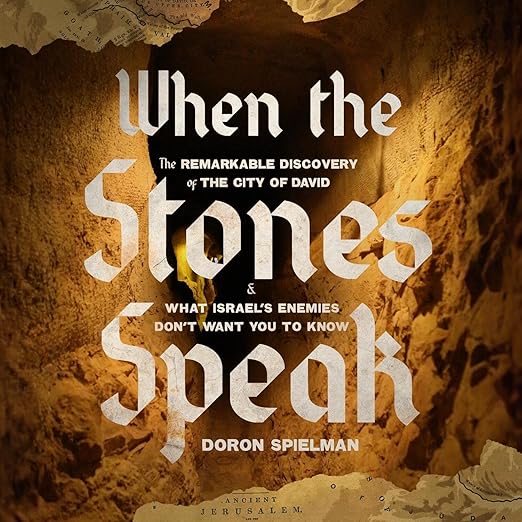
The title's central image, stones that speak, does real interpretive work worth pausing on. Archaeology is fundamentally a discipline of reading silence: artifacts do not narrate themselves, and every claim about what a given layer of excavated soil means depends on interpretation layered onto physical evidence. By framing the book's title as an act of stones literally speaking, Spielman is making an implicit argument before the first chapter even begins, that the physical evidence here is clear enough to not require extensive interpretive framing to be persuasive. Listeners should treat that framing as itself part of the book's rhetorical strategy, not a neutral description.
Spielman's Own Voice Lends the Advocacy Directness
Spielman narrating his own material matters more here than in most nonfiction, since this book combines firsthand experience, reviewers note the personal narrative element specifically, with advocacy argument, and hearing both in the author's actual voice lends the personal sections a directness a hired narrator could not replicate. If you are going to spend nearly eight hours with a strongly held point of view, hearing it from the person who actually holds it is arguably more honest than a neutral third-party read would be.
The archaeological material benefits specifically from audio's narrative pacing. One reviewer calls the book accessible despite covering genuinely technical excavation methodology and historical dating, and a well-paced narration can carry a general audience through that technical material more forgivingly than dense print exposition might, provided, as reviewers confirm here, the writing itself already does the work of translating specialist material into a clear story.
The book's account of the City of David's physical transformation, described in the synopsis as becoming one of the most important archeological heritage sites in the world, gives Spielman's narration a clear before-and-after structure to build tension around, moving from obscurity to international significance. That kind of transformation arc translates naturally to audio pacing, since a listener can track the site's rising importance the same way they would track a more traditional narrative's escalating plot.
Nine Wars Since 1948 Frame the Argument
This book is explicitly advocacy-driven, not a neutral academic history, and listeners should go in with that clearly understood. Spielman frames the City of David excavations as direct evidence against what he characterizes as organized denialism of Jewish historical ties to the land, a position aligned with a specific side of an active, painful geopolitical conflict. The archaeological facts presented may be genuinely significant, but the interpretive and political framing around them reflects one committed perspective, not a balanced survey of competing scholarly or political views.
The book's publication timing is worth noting directly: reviewer commentary and the synopsis both connect it explicitly to the October 7, 2023 Hamas attack on Israel, framing the book's themes as having foreshadowed the events that followed. That framing will land very differently depending on a listener's own views and proximity to the conflict, and it is worth knowing the book positions itself in direct conversation with extremely recent, ongoing events rather than treating its subject as settled ancient history alone.
Listeners specifically interested in biblical archaeology as a field, separate from the geopolitical argument layered on top of it, will still find real substance here: one reviewer notes the book ties biblical passages to actual archaeological finds in a way that works even for a secular person approaching the Bible as a historical resource rather than a religious one. That narrower archaeological throughline can be engaged with somewhat independently of the book's more explicitly political claims, if that is what you are looking for.
The synopsis anchors its argument in a specific count, nine wars fought since Israel's 1948 founding, a factual claim about the region's turbulent history that frames everything that follows. Citing a concrete number rather than a vaguer decades-of-conflict phrase is a rhetorical choice that lends the book's opening pages an air of documentary precision, setting the tone for how Spielman wants archaeological evidence to be received throughout: as another form of countable, verifiable fact rather than one more contested interpretation among many.
Listeners should also know this book sits within a broader, active publishing category of Israel-advocacy and biblical-archaeology titles, and comparing it against others in that specific space, rather than against neutral academic archaeology writing generally, is the fairer way to evaluate what Spielman accomplishes here relative to his actual genre peers.
Look Elsewhere for a Purely Academic Source
Readers interested in biblical archaeology, Jerusalem's ancient history, or the modern political debate over indigenous claims to the land will find a passionately argued, well-constructed case here, narrated with the direct authority of someone who worked at the site himself. It rewards listeners who want a personal, on-the-ground account of a major ongoing excavation project.
Listeners who follow contemporary Middle East reporting and want a primary-source-adjacent account from someone directly involved in a major excavation, rather than secondhand journalism about it, will find real value here regardless of where they land politically, since the book gives direct access to how one committed advocate constructs and supports the argument.
Skip it if you are looking for a neutral, multi-perspective treatment of the Israeli-Palestinian conflict rather than an explicitly one-sided advocacy argument, or if you would rather engage with City of David archaeology through a purely academic source without the accompanying political framing this book builds around it.