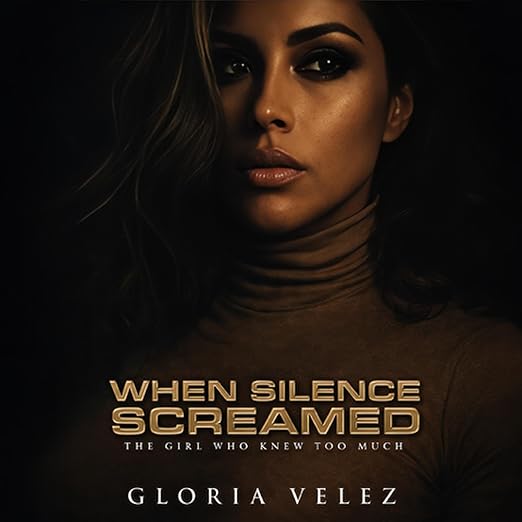
Gloria Velez makes a specific craft choice from the first chapter of When Silence Screamed: she narrates her own life without the protective distance that most memoirists instinctively maintain. She does not write about the abuse from childhood as something that happened to a younger self she has learned to observe with detachment. She writes from inside it, in the voice of someone who lived it and is still, on some level, processing what it cost her. That decision makes this audiobook harder to listen to than many memoirs in the survivor space, and considerably more honest. The choice to perform her own narration amplifies that honesty in ways that a hired voice actor would have been unable to reproduce.
Genuine Emotion Where Performance Usually Takes Over
Velez's life does not follow the arc that memoir marketing usually promises. Her story moves from family dysfunction and childhood abuse through the music industry, a world that offered visibility and came with its own forms of exploitation, without arriving at the redemptive conclusion that the genre convention expects. What she offers instead is something rarer: an account of what it actually takes to survive those experiences and still be standing, still be speaking, still be recognizably yourself. The subtitle, The Girl Who Knew Too Much, is not hyperbole. Velez learned early what adults who should have protected her were willing to do and willing to ignore, and that knowledge shaped everything that followed.
The self-narration is doing significant work here. Velez reads her own account with an urgency that occasionally outstrips conventional audio performance polish, and that quality serves the material. When she recounts moments of genuine danger or betrayal, the emotion in her voice is not performed. It is present. Listeners who have experienced similar trajectories, family trauma followed by industry exposure followed by the hard work of building a self that was not defined by either, will recognize something in the way she reads these passages that transcript alone cannot capture.
Reviewer EABlade described the memoir as 'a glimpse into what made someone into who the world sees,' which is a precise description of what Velez is attempting. She is not asking listeners to understand her public persona or to place her in the entertainment landscape's hierarchy. She is asking them to understand how she became the person capable of surviving what she survived, and that is a different and more demanding kind of story.
How Overlapping Systems of Harm Reinforce Each Other
The structural argument of this memoir is one that survivors of overlapping systems of harm, family dysfunction, industry exploitation, and public scrutiny, will find particularly well-constructed. Velez understands that these systems reinforce each other: the damage done in childhood creates the vulnerabilities that predatory industry figures locate and exploit, and the industry's exploitation creates a public version of the person that has no room for the private damage underneath it. Making that mechanism visible is a genuine contribution to how we discuss celebrity survival narratives.
Nicole W. noted that the book has some repetition and that sentences occasionally echo across sections, a structural issue that the self-narration can sometimes make more noticeable than a professional editor's pass might have caught. That is a fair observation. When Silence Screamed does not have the polish of a major publishing house memoir, but it has something that polished memoirs sometimes sacrifice: the sense that you are hearing the account as the person who lived it would actually tell it, without the smoothing and shaping that editorial convention imposes.
At seventeen hours, the audiobook covers a substantial arc of Velez's life, and the pacing is more expansive than compressed. Elias noted a slow introduction that accelerates once the narrative finds its footing, which matches my experience of the first several chapters. The investment pays forward, but patience in the early sections is required.
No Trigger Warnings, By Design
This memoir covers childhood abuse, family betrayal, and industry exploitation without significant hedging. Listeners should be aware that the content is graphic in places and may activate strong responses in those with similar histories. Velez does not write with trigger warnings or protective framing, which is consistent with her approach but worth knowing before you begin.
The repetition that some reviewers noted is real, and it occasionally disrupts narrative momentum in the longer middle sections. This is more a structural editing issue than a narrative flaw, and it does not undermine the memoir's emotional honesty, but listeners who notice it may find certain passages feel more extended than they needed to be.
For Listeners Who Refuse the Redemptive-Arc Convention
When Silence Screamed will resonate most deeply with listeners who have lived in the intersection of family trauma and public-facing professional life, who understand from personal experience how those two worlds interact in ways that neither adequately acknowledges. Velez is writing for people who know what it means to maintain a functional exterior while carrying history that would surprise the people observing that exterior.
Listeners drawn to celebrity memoirs that refuse the redemptive-arc convention, who want to understand not just what someone achieved but what it actually cost them and what it required to survive the getting there, will find this a more honest account than most public figures offer. Fans of Velez's work in the entertainment world who want to understand the person beneath the public image will find exactly what the subtitle promises: the story of the girl who knew too much, finally told on her own terms, in her own voice.
When Silence Stops Being a Shield
One specific element that distinguishes Velez's memoir from similar accounts in the survivor and celebrity space is her treatment of silence itself as an active force rather than merely an absence of speech. The title is not simply poetic: Velez spent years in situations where speaking was dangerous and where the people around her benefited from her silence, and she writes about that experience with clarity about how silence functions as a survival mechanism that eventually becomes its own kind of prison. The decision to write and narrate this memoir is itself the act the title describes: the moment when silence finally stops being a shield and becomes something that has to be broken.
- Narration: Gloria Velez narrating her own memoir brings an emotional immediacy and urgency that professional narration could not have replicated; the occasional roughness in delivery serves the material's refusal to be comfortable.
- Themes: Childhood trauma and family dysfunction, the music industry as a second system of exploitation, survival without clean redemption arcs, and the long process of reclaiming a self that was shaped by forces you did not choose.
- Mood: Raw, unflinching, and emotionally present in the way that survivor memoirs rarely allow themselves to be, demanding listener attention and offering genuine honesty in return.
- Verdict: An unusually honest and structurally ambitious survivor memoir that is worth seventeen hours of listening time for audiences ready to engage with its content on its own terms.