Quick Take
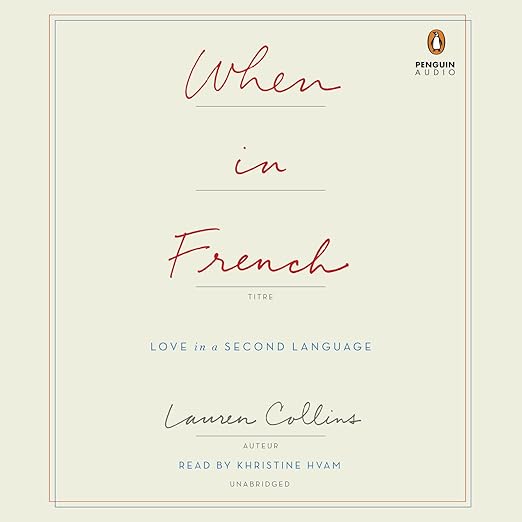
- Narration: Khristine Hvam brings the memoir’s wry, essayistic intelligence to life with a dry humor that prevents the linguistic tangents from feeling like detours.
- Themes: Language acquisition and identity, cross-cultural marriage, what we lose and gain in translation
- Mood: Witty and intellectually meandering, occasionally indulgent
- Verdict: A genuinely smart memoir about language and love that will reward patient listeners, though those who prefer narrative momentum over digression will struggle with the pacing.
I started this one on a long train ride, the kind where you have settled into a seat and accepted that you will be there for a while. That turned out to be exactly the right listening context for Lauren Collins’s When in French, because the book has the rhythm of a long, pleasurably recursive conversation rather than a story moving purposefully from A to B. It rewards you when you are not in a hurry.
Collins is a New Yorker staff writer, and the book bears all the hallmarks of that formation: dense with observation, comfortable with digression, committed to the long sentence. She moved to London and fell for a Frenchman named Olivier, a relationship that developed entirely in English, and then when the couple relocated to Geneva, she decided to learn French. The stakes, as she frames them, are partly romantic (what does she not understand about Olivier by only knowing him through his second language?) and partly maternal (she does not want to become, her phrase, a Borat of a mother who cannot understand her own children). Those are compelling motivations, and Collins mines both with intelligence and humor.
Language as a Mirror, Not Just a Tool
The book’s best passages occur when Collins stops narrating her own French class mishaps and starts asking larger questions about what language is actually for. Reviewer Laurence R. Bachmann identified this as the book’s core achievement: it explores not where language and culture intersect but where they diverge. That is an unusual angle, and Collins pursues it with genuine rigor. The chapters on French identity and the particular social weight the French place on linguistic correctness are illuminating for anyone who has tried to navigate that culture from the outside. The accidental telling of her mother-in-law that she has given birth to a coffee machine is funny, but the underlying point about what gets lost in imprecise translation is genuinely sharp.
Reviewer Alicia, an American who had lived alongside a French boyfriend and his family, wrote that Collins captured the experience in words so beautifully that they deserve to find an international audience. That specificity of recognition is one of the markers of memoir done well. You do not need to have lived with a French family to feel it, but if you have spent time negotiating an intimate relationship across a language gap, the book’s central question, does love change when the language changes, is not an abstraction.
Where the Book Tests Its Own Readers
The criticism worth engaging with directly comes from reviewer MaryAnne Cohen, who gave the book three stars and found the linguistic treatises long enough to clutter a story that could have been charming. She is not entirely wrong. Collins’s academic and journalistic instincts occasionally pull her away from the personal narrative and into territory that reads like footnoted New Yorker reporting. A chapter that starts with a anecdote about Swiss language school will suddenly open into a long passage about the history of Francophone identity or the philosophy of translation, and listeners who came for memoir will feel themselves in an essay collection without quite knowing when the switch happened.
Reviewer Rob-o, who gave it four stars, described it as densely written and delightfully laden with imaginative spot-on metaphors, which is accurate. Dense is the operative word. This is not a breezy listen. The writing is precise and often beautiful, but it asks for sustained attention in a way that not all audiobook formats reward. A harsher reviewer called it disappointing and rambling, and while I think that undersells the book’s genuine strengths, the rambling charge has some basis. Collins trusts the reader’s patience in ways that occasionally go beyond what the narrative can support.
Khristine Hvam in the French School
Hvam is an excellent match for the material. She has a dry, intelligent delivery that handles both the comic moments (the coffee machine incident, the excruciating classroom role-playing games) and the more essayistic passages without flattening the tonal range. Her French pronunciation when Collins quotes French text is clean and unself-conscious, which matters when the entire book is about the relationship between sound and meaning. The nearly eight-hour runtime is right for the content, though listeners who prefer tighter narrative pacing will feel its length more than those comfortable with the essay mode.
Who This Is For
If you have ever tried to learn a language as an adult for love rather than utility, this book will speak to something specific in your experience. If you enjoy literary travel writing that takes ideas seriously and does not require a tidy emotional arc, Collins delivers that with real grace. New Yorker subscribers and readers of writers like Elif Batuman or Francine Prose will find the register familiar and welcoming.
If you want momentum, emotional revelation at regular intervals, or a memoir that moves briskly through its scenes, this is not that book. Collins is constitutionally incapable of passing through a room without stopping to examine what is on the shelves, and the book is both better and occasionally longer than it needs to be as a result. That is, for the right reader, not a complaint.
Frequently Asked Questions
Does When in French require the listener to know French to enjoy the book?
No French is required. Collins writes for a general English-language audience and explains linguistic concepts as she encounters them. The book is about the experience of not knowing French and learning it, so most of the relevant content is accessible from the outside.
Is this primarily a travel memoir about France and Switzerland or a book about language?
It is genuinely both, but the language material is the more developed thread. Travel and culture provide the context, but Collins is more interested in what French reveals about identity, marriage, and belonging than in describing Geneva’s geography or cuisine.
How does Khristine Hvam handle the memoir’s shifts between personal narrative and longer analytical passages?
She handles the transitions smoothly, maintaining a consistent voice that makes the shifts feel like natural extensions of Collins’s thought rather than abrupt gear changes. She is well cast for material that is equally comfortable being funny and erudite.
The reviews are genuinely mixed on this book. What does that reflect about the reading experience?
The polarization tracks a real divide in the book’s structure. Collins writes with exceptional intelligence and humor, but her essayistic instincts can dilute narrative momentum. Listeners who want ideas as much as story will rate it highly; those who come for straightforward memoir will find the detours frustrating. Knowing which camp you are in before you start will help set appropriate expectations.