Quick Take
- Narration: Derek Perkins handles the varied geography and traveler-biography format with consistent warmth, well-suited to material that is fundamentally about human curiosity and long-distance connection.
- Themes: Asian medieval trade networks, intellectual exchange along the Silk Road, correcting the Eurocentric view of the medieval world
- Mood: Curious and expansive, with the pleasure of well-told biographical vignettes
- Verdict: A vivid and accessible corrective to the standard narrative of the medieval world, organized around individual travelers in a way that makes vast historical sweep feel human-scaled.
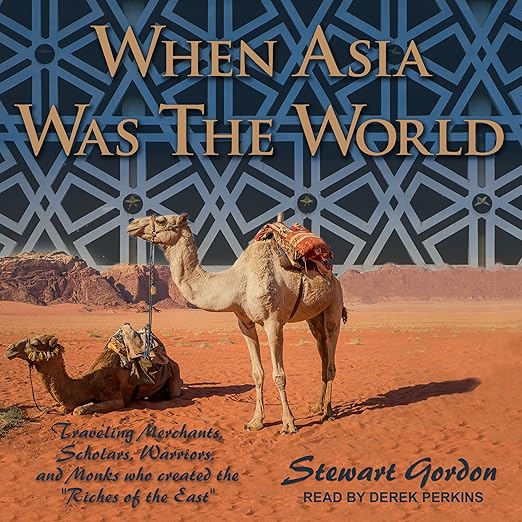
I was somewhere in a long stretch of driving when I started this one, and the format suited the circumstances almost perfectly. Stewart Gordon structures When Asia Was the World around the individual journeys of merchants, scholars, holy men, and apothecaries who crossed the vast connected world of medieval Asia between AD 700 and 1500, and something about moving through space while listening to stories of people moving through space created an unusually immediate listening experience. By the time I stopped for the night I had covered roughly the same number of hours as one of Gordon’s travelers might have covered in a week.
The book’s central argument is stated cleanly in its title and developed with consistent purpose throughout. While Europe was navigating what historians have called the Dark Ages, a network of commerce, scholarship, and religious exchange stretched from Arabia to China and encompassed almost everything that was intellectually or economically significant in the world. The pilgrims who carried Buddhist texts from India to China, the Arab merchants who moved spices along the routes that would later become the Silk Road, the Persian scholars who transmitted Greek knowledge into Arabic and Chinese traditions: all of these are present in Gordon’s book, and all of them are given human faces rather than being dissolved into abstraction.
The Traveler as Historical Method
Gordon’s organizing device is more than a narrative convenience. The choice to structure the book around individual journeys rather than around institutions or political entities reflects a genuine historiographical argument: that the medieval Asian world was connected not primarily through empire or organized trade policy but through the accumulated individual decisions of thousands of people who decided to move. The merchants and scholars and holy men Gordon profiles were making practical decisions about where to go, what to carry, whom to trust, and how to negotiate enormous cultural and linguistic differences. Their individual intelligence and adaptability are what made the network function.
Xuanzang, the seventh-century Buddhist monk who traveled from China to India to collect texts, is perhaps the most famous figure in the book, though Gordon treats him with the same biographical care he extends to less well-known subjects. The apothecaries who moved pharmacological knowledge between China and the Islamic world, carrying medicinal plants and the knowledge of how to use them across thousands of miles, are particularly fascinating: a medical exchange network that predates the Western colonial-era encounter by centuries.
Correcting the European Frame Without Preachiness
One of the book’s quieter accomplishments is the way it makes its corrective argument without becoming a polemic. Gordon is not writing an angry revisionist history; he is simply describing what was there. The effect on the reader who has absorbed the standard Western historical frame, in which the medieval period is primarily a European story of stagnation punctuated by crusades and plagues, is genuinely disorienting in the best possible way. The world Gordon describes is cosmopolitan, intellectually vibrant, and connected across distances that seem impossible given the available technology. The reorientation is accomplished through accumulation of specific detail rather than through rhetorical argument.
One Audible reviewer describes finding the book by accident and being unable to stop reading until the final page, citing decades spent in Asia as context for the particular fascination Gordon’s historical coverage produced. Another reviewer highlights the book’s treatment of specific notable people and their relationships with the world in each period as what distinguishes it from more abstracted historical accounts. Both responses reflect something Gordon does consistently well: the human face on the large historical argument.
Derek Perkins and the Scale of a Long Journey
Perkins is a reliable narrator for accessible narrative history and he brings a quality of gentle enthusiasm to Gordon’s prose that suits material about human curiosity and discovery. He does not overperform the travel narrative elements but gives them enough warmth to prevent the book from feeling like a textbook. At just over five and a half hours, the runtime is the book’s one genuine limitation. Gordon covers an eight-hundred-year period spanning the entirety of the Asian landmass, and the individual biographical sections, while vivid, are necessarily brief. Listeners who want to go deeper into any individual figure or period will need to supplement with more specialized works. But as an orientation to this world and this argument, the brevity is also a strength: the book opens doors rather than trying to exhaust the territory behind them.
Finding Your Place in This World
This is an excellent starting point for listeners curious about Asia’s medieval history who want something accessible and human-scaled rather than comprehensive. It pairs well with more specialized works on the Silk Road, the Indian Ocean trade networks, or individual figures like Xuanzang or Ibn Battuta. Listeners already deeply familiar with medieval Asian history will find the individual vignettes charming but may want more analytical depth than the format allows. Anyone who has found European-centered medieval history exhausting and wants a different frame will find this immediately rewarding.
Frequently Asked Questions
Does the book cover the Mongol Empire and its role in Asian trade?
The Mongol period falls within the book’s 700 to 1500 AD timeline and is addressed in the context of how the Pax Mongolica affected long-distance travel and trade. The book is more interested in individual travelers than in political empires, so the Mongol analysis is present but not the central focus.
Is the book more focused on overland routes or maritime trade?
Both are present. Gordon is attentive to the overland routes associated with the Silk Road and to the maritime networks of the Indian Ocean and South China Sea, which he argues were equally significant for the exchange of goods and ideas.
How does this compare to Peter Frankopan’s The Silk Roads?
Gordon’s book is considerably shorter and more narrowly focused on the medieval period. Frankopan offers a much broader sweep from antiquity to modernity and is more explicitly revisionist in its argument. They serve similar corrective purposes but at very different scales.
Are the individual traveler profiles based on primary sources?
Yes. Gordon relies primarily on the travelers’ own written accounts, including Xuanzang’s pilgrimage record and the administrative reports of Chinese officials, which means the biographical sections are grounded in contemporary testimony rather than reconstruction.