Quick Take
- Narration: Virtual Voice AI narration; functional for survey-style informational content, though it lacks the warmth that would suit the more contemplative passages.
- Themes: Sacred texts across traditions, cross-cultural empathy, religious history and influence
- Mood: Measured and educational, respectful in tone
- Verdict: A well-organized comparative survey that serves curious beginners well, though AI narration and breadth-over-depth trade-offs mean dedicated scholars will want to look further.
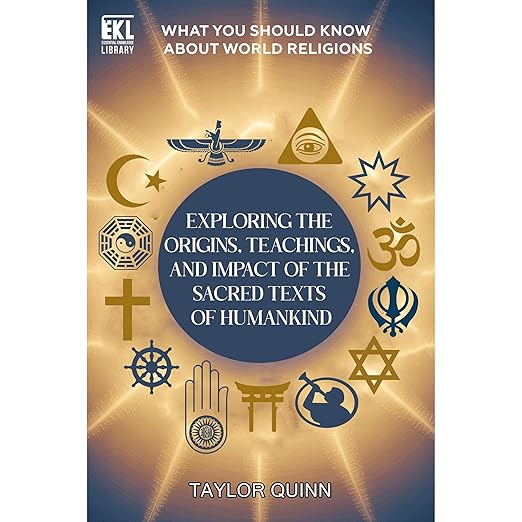
I have spent years reading comparative religion texts, from Karen Armstrong’s sweeping histories to Huston Smith’s patient introductions, and what I notice most about newcomers to the genre is that they often do not need more depth. They need a map. They need something that tells them where everything is before they start making choices about where to go. Taylor Quinn’s What You Should Know About World Religions is, at its best, exactly that: a useful map of sacred texts across twelve distinct traditions, drawn with care and without agenda.
The scope is genuinely impressive. Most introductory religion books cluster around the Big Five and move on, but Quinn includes Zoroastrianism, Jainism, Cao Dai, and the Baha’i Faith alongside the more expected Christianity, Islam, Buddhism, Judaism, and Hinduism. Each chapter unpacks the core scriptures of a tradition, examines how those texts shaped art, law, and philosophy, and gestures toward why they remain relevant in contemporary life. The inclusion of timelines has been praised by readers, and the glossary at the back addresses one of the genuine weaknesses of this genre: the assumption that readers already know the vocabulary.
Our Take on What You Should Know About World Religions
The approach is resolutely balanced. Quinn does not advocate for any tradition over another, and the tone throughout is what one reviewer described as respectful of each tradition it covers. That is harder to achieve than it sounds when you are moving between traditions as different as Jainism and Mormonism. The chapter on the Book of Mormon’s relationship to American frontier culture is a particularly good example of this even-handedness: it contextualizes without condescending, and it connects theological content to historical circumstance without reducing one to the other.
Why Listen to What You Should Know About World Religions
At eleven hours, this is a substantial listen for what is essentially a survey course in audio form. The structure is modular, which means you can move through it sequentially or return to specific traditions as questions arise in your reading or daily life. Several reviewers note that it sparked curiosity rather than providing an endpoint, which is exactly the right ambition for this kind of introductory work. The glossary and recommended further reading list function as a genuine next-steps guide rather than a placeholder.
What to Watch For in What You Should Know About World Religions
The narration is handled by Virtual Voice, Amazon’s AI narration system. For content that is largely expository and informational, this is less damaging than it would be for fiction, but it does affect the listening experience in the passages that call for contemplative warmth rather than clear delivery of information. The sacred texts of traditions like Taoism or Hinduism have a rhythm and resonance that AI narration flattens. This is worth knowing before you purchase if narration quality is a significant factor in your listening enjoyment. Additionally, the breadth-over-depth approach that makes this useful as a starting point also means it will not satisfy listeners already familiar with any of the traditions covered.
Who Should Listen to What You Should Know About World Religions
This is a strong choice for anyone beginning an exploration of comparative religion, students looking for context before a more demanding course, or curious listeners who want to understand why a neighbor’s faith looks the way it does. It is not the right book for anyone with existing knowledge of the traditions covered, or for listeners who find AI narration a dealbreaker. If you are new to this subject and willing to work with the narration, this is a well-structured and respectful introduction to territory that can otherwise feel overwhelming.
One thing the reviews make clear is that this book works best when approached as a starting gun rather than a finish line. Multiple readers note that they immediately wanted to read more about specific traditions after finishing. That is perhaps the highest compliment a survey can receive: it made the subject feel larger and more interesting rather than smaller and more managed. For listeners at the beginning of a genuine curiosity about world religions, that appetite-building function is worth a lot.
Frequently Asked Questions
Does this audiobook cover lesser-known religions as well as the major world faiths?
Yes. Beyond Christianity, Islam, Buddhism, Judaism, and Hinduism, the book covers Zoroastrianism, Jainism, Taoism, Shinto, Sikhism, the Baha’i Faith, Mormonism, and Cao Dai, making it more comprehensive than most introductory texts in this category.
Is the AI narration a significant problem for this particular audiobook?
For a primarily expository and informational text, AI narration is more workable than it would be for fiction. However, passages that touch on contemplative or poetic sacred texts lose some of the tonal quality that a skilled human narrator would bring. Listeners sensitive to narration quality should factor this in.
Is this suitable for someone who already knows a lot about one or two of the traditions covered?
Probably not as a main listen. The book is written for beginners and treats each tradition at an introductory level. If you are already knowledgeable about Christianity and Buddhism, for example, those chapters may feel too brief to justify the full listening commitment.
Does the book include a glossary and further reading recommendations?
Yes. The synopsis and multiple reader reviews confirm the inclusion of an extensive glossary, timelines for each tradition’s texts, and a recommended further reading list at the end. These are genuine assets for listeners who want to continue their exploration.