Quick Take
- Narration: Fajer Al-Kaisi delivers the economic argument with clear authority, pacing the denser analytical passages without losing momentum or listener engagement.
- Themes: Government expansion and market distortion, the inequality paradox of state intervention, the anatomy of bailout culture
- Mood: Urgent and diagnostic, like a well-sourced argument from someone who has done the reading
- Verdict: One of the more intellectually honest economics audiobooks of recent years, with a thesis that will unsettle readers across the political spectrum.
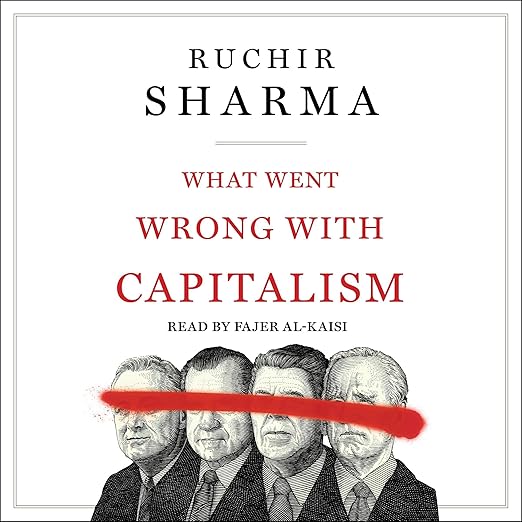
I picked up What Went Wrong with Capitalism on the recommendation of a friend who works in asset management, who described it as the book that made him feel most uncomfortable about everything he had previously assumed. That kind of discomfort recommendation is often more reliable than enthusiasm, and in this case it turned out to be exactly right. Ruchir Sharma is not writing a polemic from a familiar position. His argument defies easy political sorting in ways that feel deliberate and honest rather than strategically centrist or contrarian for its own sake.
The book was named a Best Book of 2024 by both the Wall Street Journal and the Financial Times, which is unusual company for a single title and suggests Sharma’s argument lands across readerships that usually disagree. Fareed Zakaria called it absolutely fascinating. Robert Rubin, former Secretary of the Treasury, called it fresh and accessible. One reviewer simply wrote that it was the best economics book they had read, noting they read many economics books, and that it should be read by every politician even though it would not be. That last observation captures something important about the book’s ambition: it is written for people who actually want to understand what is happening rather than confirm what they already believe.
The Argument That Unsettles Both Sides
The core thesis is this: capitalism has not failed on its own terms. It has been systematically distorted by a century of expanding government intervention that began with good intentions and accumulated into something that now serves primarily to protect those who already have assets. Sharma’s uncomfortable observation, which he frames as partial agreement with progressives, is that modern capitalism really does look like socialism for the rich. But his diagnosis of the cause challenges the progressive prescription. He argues that more state intervention will not fix the distortions that prior state intervention created. Bigger bailouts, more quantitative easing, more protection from economic pain for all classes deepens the structural dysfunction rather than addressing it.
This is a thesis that will frustrate both conventional conservatives, who prefer not to examine how government rescues have primarily benefited the already-wealthy, and conventional progressives, who argue that the solution is a larger and more redistributive state. Sharma is not interested in satisfying either position. He is interested in what the data shows, and what it shows is documented carefully enough that readers across the spectrum describe finding themselves persuaded against their initial instincts.
Fajer Al-Kaisi and the Challenge of Economic Narration
Economics audiobooks present a specific narration challenge. The material requires clarity and pacing that keeps complex argument legible without being condescending, and it requires a voice that can move between historical narrative, data-driven analysis, and direct address without losing tonal coherence. Fajer Al-Kaisi handles this well. The densest sections of Sharma’s argument, the historical reconstruction of how government economic reflexes changed across the twentieth century, the analysis of zombie firms and billionaire concentration, the explanation of how asset bubbles form and persist under cheap money conditions, come through without the glazed-over effect that economics narration can produce. At nine hours and nineteen minutes, this is a substantial listen, but Al-Kaisi keeps it propulsive rather than exhausting through varied pacing and consistent tonal authority.
What Sharma Does Best and Where He Reaches Further Than the Evidence
Sharma’s strongest material is the historical argument, tracing how completely the default response to economic difficulty has changed from the nineteenth century’s hands-off stance to the present’s reflexive intervention. The progression is documented with enough historical specificity that the shift feels evidenced rather than asserted. His analysis of how cheap money fuels asset bubbles, monopoly formation, and zombie company survival is similarly well-grounded in observable data. Where the book is weaker, as one reviewer notes carefully, is in the treatment of labor dynamics. Labor is portrayed as a relatively static factor across time, with insufficient attention to how the shift from a manufacturing to a service economy has changed the structural position of workers and whether that shift affects Sharma’s diagnosis. This criticism has merit and is worth holding alongside the book’s genuine strengths.
Who Should Listen and Who Should Skip
Essential for anyone interested in how financial markets work and why they have produced the specific pathologies of the present. The Wall Street Journal and Financial Times endorsement signals this is serious analysis worth engaging with seriously. Readers with strong priors on either the left or the right will find something to push back against, which is part of the book’s value. The free audiobook format is a good way to engage with Sharma’s argument in a format that suits his discursive, historically grounded style.
Frequently Asked Questions
Is Sharma’s argument politically conservative, or does it challenge that framing?
It challenges the framing deliberately. Sharma acknowledges that progressives are partly right to mock modern capitalism as socialism for the rich, but then argues that the solution is not more government intervention. The thesis resists easy left-right placement, which is both a strength and a source of frustration for readers with strong priors.
How data-driven is the book, and does Sharma support his claims with evidence rather than assertion?
The book is substantively data-driven. Reviewers consistently note that Sharma supports his arguments through research and historical analysis. One reviewer who describes reading many economics books calls it the best they have read. The data is made accessible rather than academic in presentation.
What is the main weakness reviewers identify in Sharma’s argument?
The most substantive criticism is that Sharma treats labor as a relatively static economic factor without adequately accounting for the structural shift from manufacturing to service economies and how that affects labor’s bargaining position over time. His solutions section is also noted as thinner than his diagnosis section.
Does Fajer Al-Kaisi’s narration make the dense economic material accessible in audio format?
Yes. Al-Kaisi handles the complex material with clear pacing and tonal control that keeps even the denser analytical passages legible. The historical narrative sections flow particularly well. At just over nine hours, the listening experience is demanding but not punishing.