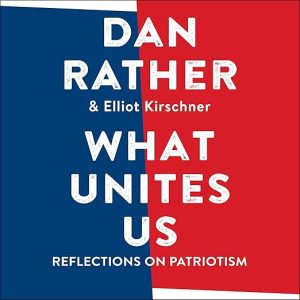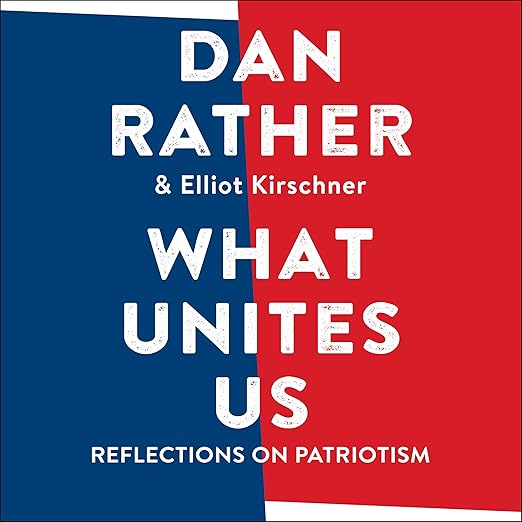
I finished What Unites Us on a Sunday afternoon when the week had left me more cynical than I wanted to be. Dan Rather reads his own essays in a voice that carries the specific gravity of a man who was in Dallas in 1963, at the Watergate hearings, and in front of a camera for 9/11. That biographical weight is not incidental to how the book works. Rather is not making abstract arguments about American values; he is describing what he witnessed those values do, and fail to do, across seven decades of American life.
The collection is organized around institutions and values that Rather believes sustain the country: public libraries, national parks, the civil rights movement, scientific exploration, and what he calls the fundamental sense of hope that has survived every catastrophe he has personally reported on. At 7 hours and 5 minutes, it moves efficiently through its categories without feeling rushed. Rather writes, as one reviewer noted, with a sentimentality he openly acknowledges, but the book earns that sentimentality by grounding it in specific historical observation rather than vague aspiration.
Our Take on What Unites Us
The essays are strongest when Rather is closest to his own experience. His account of what public libraries meant to working-class Texas families in the 1930s is more persuasive than any abstract argument about civic infrastructure, because it is grounded in memory rather than theory. The same is true of his sections on civil rights, where his reporting experience gives him a moral authority that a purely scholarly account would lack. He is not presenting himself as a hero of that history, but as a witness who understood what he was watching.
The book is more conventional when it moves into broader civic idealism. The section on national parks is gentle but does not break new ground. The argument that Americans are ultimately united by shared values is a thesis that requires more friction than Rather provides, and at least one reviewer noted that the book does not offer much of a roadmap for how to restore civil discourse once it has broken down. That is a legitimate criticism. What Unites Us is a diagnosis and a celebration, not a prescription, and readers expecting practical guidance will be disappointed.
The self-narration is the essential element here. Rather's voice is not performed or projected; it is simply itself, which at 85-plus years of age is a document of its own. There is a quality to hearing a man read his own reflection on what the country has been and what it might still be that no professional narrator could replicate. Reviewers have called him authentic, and that is exactly the right word. When he describes loving his country with a sentimentality that may seem anachronistic in today's more jaded world, you believe him, not because the prose is particularly elegant, but because the voice belongs to someone who has actually been there.
The book also functions well as a counter-argument to the idea that American civic culture is entirely irredeemable. Rather is not naive about the failures he has witnessed, and he does not pretend that the institutions he celebrates have always lived up to their promises. His discussion of the struggle for civil rights is honest about how long and how painful that history has been. But his fundamental position is that the capacity for self-correction is itself part of the American character, and he builds that argument from evidence rather than sentiment alone.
What to Watch For in What Unites Us
The essay format means some chapters land more powerfully than others. Rather is a journalist first, and his prose is clear and direct rather than literary. Listeners looking for the linguistic texture of a David McCullough or a Joan Didion will not find it here. The writing is purposeful and occasionally moving, but it does not reward the kind of close attention you might give to a more densely constructed work.
The book was written in 2017 and engages with the political climate of that specific moment. Some of its urgency now reads as period-specific, and the framework of what divides Americans has continued to shift in ways Rather could not have anticipated. That context does not diminish the book's core argument, but it is worth knowing that you are reading a document of a particular political moment as much as a timeless civic meditation.
Who Should Listen to What Unites Us
Listeners who want a historically grounded argument for American civic values from someone who spent his career watching those values tested will find this deeply satisfying. It works especially well for listeners who are somewhere between cynicism and hope and want a reason to reconsider the latter. Skip it if you need policy prescriptions rather than reflection, or if Rather's particular brand of centrist patriotism is not a register that speaks to you. But if you have any interest in what American institutions were designed to do and what they have actually accomplished, the self-narrated audio version is the right format.
- Narration: Dan Rather reads his own essays with the measured, plainspoken authority of a man who covered six decades of American history firsthand, and that weight is irreplaceable.
- Themes: civic patriotism and shared institutions, the erosion of civil discourse, American identity across generations
- Mood: Earnest and hopeful, with an undertow of genuine concern
- Verdict: A self-narrated collection of civic essays that lands best as a meditation on what American institutions are actually for, even if it stops short of prescribing how to repair them.