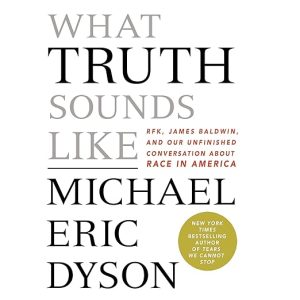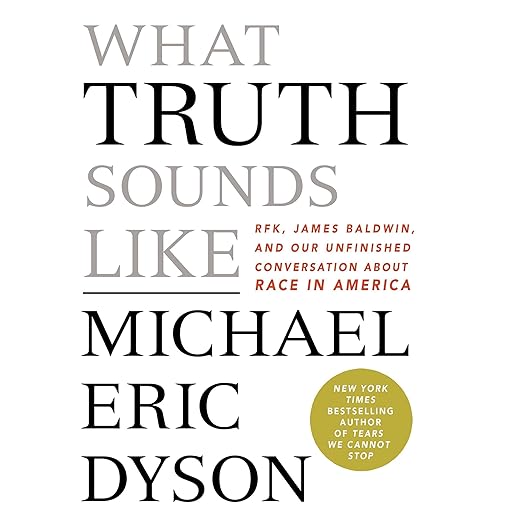
I first encountered Michael Eric Dyson on the radio, years before I read anything he'd written. The voice is unmistakable, that particular layering of the preacher's cadence, the professor's precision, and what can only be described as jazz-like riffing on ideas. When I learned he'd narrated What Truth Sounds Like himself, I was more interested in the audiobook than I'd been in the text on the page. I was right to be.
The book's animating event is a 1963 meeting in New York City arranged by Attorney General Robert Kennedy. Kennedy sought out James Baldwin to help him understand the rage then threatening to ignite Black America. Baldwin assembled a group that included playwright Lorraine Hansberry, psychologist Kenneth Clark, and activist Jerome Smith. What followed was nearly three hours of confrontation that left Kennedy furious, shaken, and, ultimately, transformed. Dyson uses this encounter as a fulcrum to examine every argument about race in America that persists to this day: patriotism and dissent, the immigrant experience versus the racial experience, the responsibility of Black artists and intellectuals, the question of whether political reform or moral witness better serves the cause of justice.
A Closer Look at What Truth Sounds Like
Dyson's central argument is that the arguments made in that room haven't aged, they've mutated and recurred. Jerome Smith's refusal to fight for a country that oppressed his people maps directly onto contemporary debates about Black dissent. Kennedy's belief that Black people were insufficiently grateful for the Kennedys' support reappears as the charge of victimhood politics. The immigrant experience Kennedy represented, versus the racial experience Baldwin embodied, still generates the same friction it did sixty years ago. Dyson makes these connections explicit without being reductive about them, and the result is a book that feels like intellectual excavation and urgent commentary simultaneously.
The AudioFile Magazine review noted that Dyson's passion for the African-American cultural tapestry reverberates in this audiobook, which is accurate, and understates the case. Dyson's range of reference is genuinely dazzling: he moves from Baldwin to Lorraine Hansberry to hip-hop to BLM with an ease that makes the connections feel inevitable rather than forced. This is writing that assumes an educated, curious listener and delivers at that level without condescension.
What Makes What Truth Sounds Like Worth Hearing
Dyson is a special case among author-narrators because his speaking voice is itself part of his literary instrument. The rhythms of his prose are inseparable from the rhythms of his speech, the rhetorical accumulation, the sudden switch into direct address, the cadences borrowed from the Black church and the university lecture hall at once. Hearing him read his own work is not the same as hearing a competent narrator read it; the inflections carry meaning that would be lost in translation.
At just over six hours, this is a concentrated listen that rewards replaying certain passages. The sections on Jerome Smith, whose unfiltered fury at the meeting most disturbed Kennedy and most electrified the other attendees, are among the most powerful Dyson has written, and hearing them in Dyson's own voice adds an additional layer of advocacy that feels appropriate to the material.
Things to Know Before Starting What Truth Sounds Like
The book's most enduring contribution is its refusal to let the Kennedy-Baldwin encounter function as a safe historical story about progress made. The tensions in that room, between the person who holds political power and the person who bears witness to moral truth, between the pragmatist and the prophet, are not resolved. Dyson isn't interested in comfortable resolution. He's interested in what it costs a society when it systematically chooses the pragmatist's logic over the prophet's urgency.
Multiple reviewers describe the book as convicting. One reviewer called it a read that revealed the depth of what he didn't know about American racism. Another sought it out while looking for Baldwin's work and found Dyson's engagement with Baldwin's legacy as illuminating as the source. That cross-referential quality, the book as a companion to Baldwin, to the history it describes, to contemporary movements, is one of its genuine strengths.
It's also worth noting how Dyson handles the figures in the room who have been less frequently discussed than Baldwin and Kennedy: Lorraine Hansberry, whose intervention at the meeting was forceful and prescient; Kenneth Clark, whose psychological research on the damage of segregation had already shaped national policy; and Jerome Smith, the young activist whose unfiltered anger was the most challenging presence in the room for Kennedy. Dyson gives each of them dimension rather than treating them as supporting players in a two-man drama, and in doing so he restores the collective quality of Black intellectual and activist life that tends to get flattened when the narrative focuses too narrowly on a single figure. That restoration is one of the book's genuine historical contributions.
Who Michael Eric Dyson Is Writing For
Listeners who found Dyson's earlier Tears We Cannot Stop compelling will find this a natural and more historically grounded companion. Anyone seriously interested in the history of American civil rights, the intellectual traditions of the Black freedom movement, or contemporary debates about race and politics will find the book essential. The self-narration makes it a particularly strong audio choice.
Listeners who prefer their historical nonfiction strictly chronological and narrative-driven may find Dyson's essayistic, associative structure demanding. And listeners who are early in their thinking about American racial history may want some foundational reading before tackling this, not because it's inaccessible, but because it rewards prior knowledge.
Before You Listen
How does Dyson's self-narration differ from a professional narrator reading this text?
Significantly. Dyson's spoken rhythms are built into the prose itself, the preacher's cadences, the academic precision, the jazz-like riffing. A professional narrator could approximate it but couldn't replicate the alignment of voice and intent that comes from the author reading his own work.
The book centers on a 1963 meeting, how much does Dyson cover the actual history versus using it as a launching point?
The 1963 Kennedy-Baldwin meeting is the book's fulcrum, not its full subject. Dyson covers the historical encounter in detail but spends equal time drawing lines from that room to contemporary racial debates, making it a hybrid of historical reconstruction and current analysis.