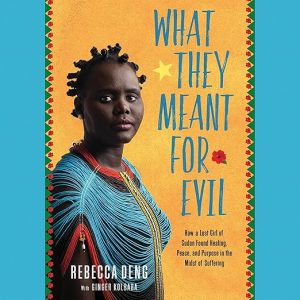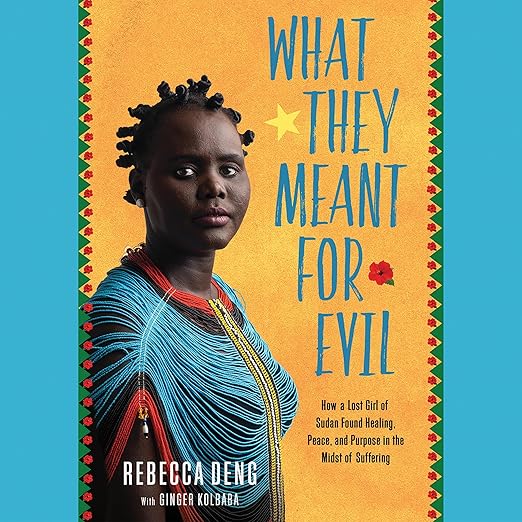
How does a four-year-old's memory of running from gunfire survive into an adult's prose? That question sits under every chapter of this audiobook, and Rebecca Deng's answer is to refuse the obvious repair. What They Meant for Evil recounts a childhood interrupted at four by an attack on her village in the late 1980s, then years of flight through hunger, strength-sapping illness and the specific dangers the book names without softening any of them: lions, snakes, crocodiles, soldiers. In 2000 she became one of the first unaccompanied refugee children to enter the United States. Seven hours and eighteen minutes carry that journey, and the narration is credited not to Deng but to Tsidii Le Loka.
Le Loka Performs a Memory That Isn't Hers
Deng was four when the attack came, and the book's central technical decision is to keep the child's angle of vision rather than swap it for adult hindsight. The description calls this "the candor and purity of a child," which sounds like jacket copy until you notice how much the writing declines to explain. Craig Kallemeyn, reviewing days after publication, arrived carrying the question religious readers bring to this material, which is why a loving God permits harm to innocent people, and reported finding something other than an argument in response: an engaging history of the war-torn Sudan and South Sudan, a reason to endure hardship, and a reminder to be grateful for the relative safety most listeners have.
Who reads it is the other decision worth naming, because Deng does not. Tsidii Le Loka is credited with the narration, which is less common than you might expect for a first-person testimony, where an author's own voice normally supplies part of the authority. Handing a child's-eye account to a performer changes the transaction: what reaches you is an interpretation of a memory rather than the memory reported by the person holding it. Whether that counts as a loss depends entirely on what you came for. Testimony gains something from being performed and gives something up by not being spoken by the witness, and the listing does not tell you which trade was made here.
Notice Which Item on That List Comes Last
Very little in this book is about being a refugee in the abstract. It is about specific hours: which direction to run, what can be eaten, which animal is in the water, which adult can be trusted. DeLynn Unema's September 2019 account tracks the arc precisely, listing resilience, a family's love, a community built around love for each other, then war, refugee camp life, and finally the courage it took to leave the only life she knew and come to America alone as a teenager. Read that list again and notice which item comes last. In the book itself none of it is arranged for effect: Deng hands over the sequence as she met it, and the refusal to foreshadow is what keeps the middle stretch tense rather than merely sad. The escape is the part a film would use. The arrival is the part this book takes seriously.
Faith is load-bearing here rather than decorative, and it is worth being clear about that before buying. Faith Words published the recording, the listing carries a religious tag, and the description states plainly that divine intervention is part of how Deng understands what happened to her and how she came to a new life. This is not a secular survival narrative with a grace note at the end. Anybody after the history and not the theology will find the two braided together throughout, and a listener who wants the theology will find it argued from inside a life rather than asserted from outside one.
This Review Grades a Courier Rather Than a Memoir
Not every account in the pool is about the book. One five-star review from September 2025 reads, in its entirety, that the item was as advertised and arrived on time, which grades a courier rather than a memoir. That is one of five visible responses, so the page effectively shows four usable ones against a listing reporting 221 ratings. The 4.8 average is aggregating opinions about a physical object, a digital file and an audio edition inside a single number, and nobody is separating them out for you before you decide. On a book this widely read that hardly matters to the verdict, but it does mean the number is a popularity signal rather than a judgment on the recording.
A second caution concerns tone rather than data. Kim Padan's four-star account, the only one on the page below five stars, describes the book sitting unopened in a reading app for several months, and then describes what happened once it was opened: reflection, and gratitude for a comfortable life. That is an honest response and also the risk this form carries, because a survival narrative can slide into being an instrument for the comfortable reader's self-improvement. Deng largely resists it, mostly by declining to be inspirational on demand, but a listener determined to be uplifted will find plenty to take and may well take the wrong things.
The Arrival Is More Demanding Than the Escape
Church groups and book clubs will find this an unusually easy pick, and readers of refugee memoir will find it a strong one. Adam Taub's account identifies the specific thing that makes it stick: at the end of the book you discover the Bible passage the title comes from, along with the story attached to it, and Deng relates her own experience to that passage, at which point going back and rereading it with fresh eyes becomes close to involuntary. That same account describes hunting down Deng's interviews and other work afterwards, which is the honest measure of a testimony, since the real question is whether the listener wants to know what happened next.
One caution is theological rather than literary. Listeners who do not share the book's framework will meet a survivor explaining her survival through providence, at length and without hedging, and that material cannot be skipped because it is the spine of the thing. Younger listeners are worth thinking about separately: the content includes gunfire, starvation, serious illness and the loss of most of a family, told from a child's position, and the unhurried, undramatized telling makes it heavier rather than lighter. For anyone who can take that, this is the rare memoir where the arrival in America is more demanding than the escape from a war.
Questions Listeners Ask
Does Rebecca Deng narrate the What They Meant for Evil audiobook?
No. The narration is credited to Tsidii Le Loka, so a first-person testimony arrives in a professional voice rather than in the voice of its subject. That is worth knowing going in, because you are hearing an interpretation of the account rather than the account as its own subject would speak it.
How much does this audiobook assume I know about the Lost Boys?
Very little. The description positions the book against the better-known Lost Boys stories and presents this as a Lost Girl telling one for the first time, but the narrative opens with a childhood interrupted by an attack and builds its own context from there. No prior reading about Sudan's civil wars is needed.