Quick Take
- Narration: Robertson Dean delivers Garry Wills’s scholarly but accessible prose with appropriate gravity, the measured pace suits a book asking listeners to read slowly and carefully alongside the author.
- Themes: sacred text interpretation versus political distortion, Abrahamic tradition and shared theological inheritance, the obligation of civic understanding
- Mood: Measured, scholarly, and quietly urgent
- Verdict: A Catholic intellectual reads Islam’s foundational text with genuine rigor and openness, essential context for anyone who has absorbed years of contested claims about what the Quran actually says.
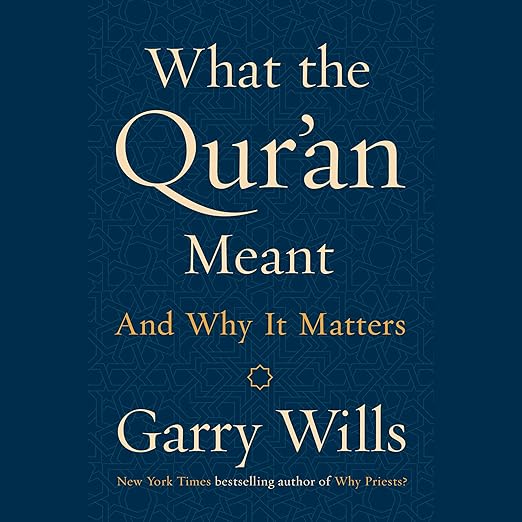
I read Garry Wills’s Lincoln at Gettysburg years ago and came away with genuine respect for his ability to take a text that everyone claims to know and show how much has been accumulated over it, layers of assumption, political use, and received wisdom obscuring what the words actually say. What the Qur’an Meant applies the same methodology to a far more politically charged subject, and the result is one of those books I find myself thinking about weeks after I finished it.
I listened to it over several morning walks, which turned out to be exactly the right context. This is not a book to rush. Wills is explicitly a non-Muslim approaching the Quran as an outsider, and that position of principled ignorance, he admits in the opening that he had never read the text before undertaking this project, is both its limitation and its strength. He is not telling Muslims what their scripture means. He is modeling the act of reading it carefully for the first time.
Our Take on What the Qur’an Meant
Wills organizes the book around the questions that most shape non-Muslim Western perception of Islam: Does the Quran justify religious war? What does it actually say about veiling women? What is the relationship between Islamic teaching and the violence attributed to it by extremists? His method is to go to the text itself, then set it against the layers of tradition and political manipulation that have distorted both external understanding and, he argues, some internal Islamic practice.
The comparative framework he employs, drawing parallels between Quranic passages and the Old and New Testaments, is genuinely illuminating. As one reviewer noted, the similarities between Islamic, Jewish, and Christian teachings are striking and underreported. Wills does not collapse the differences, but he contextualizes the Quran within the Abrahamic tradition in ways that make the distance between the texts feel smaller than centuries of conflict have suggested.
Why Listen to What the Qur’an Meant
Robertson Dean’s narration is patient and clear, which suits a text that moves carefully through arguments and references. Wills writes in the accessible register of his Classics background, the prose is precise without being academic, and Dean honors that without adding artificial warmth or drama. For a book dealing with material this politically sensitive, a narration that stays analytical in tone is exactly right.
Multiple reviewers noted that Wills is honest about his limitations: he does not read Arabic, he is not an Islamic scholar, and he says so. That honesty is part of what makes the book trustworthy. He is not claiming authority he doesn’t have. He is performing the kind of careful lay reading that he argues more non-Muslims need to undertake, and the project has a generosity to it that more polemical treatments of the subject lack.
What to Watch For in What the Qur’an Meant
The book is not a comprehensive introduction to Islam. Wills focuses tightly on the text itself, the traditions that have accumulated around specific passages, and the political distortions that have weaponized those passages. Readers looking for historical context about Muhammad’s life, the development of Islamic jurisprudence, or the diversity of contemporary Muslim practice will need to supplement with other sources.
At just over six hours, it is also one of the shorter books in this genre. It reads as an extended essay more than an exhaustive treatment, which is a legitimate choice, Wills is opening a conversation, not closing one. The brevity means some threads are introduced and not fully developed, which may frustrate listeners who want depth on every point raised.
Who Should Listen to What the Qur’an Meant
Essential for: American listeners who want to form an opinion about Islam based on actual primary text engagement rather than secondhand characterizations, anyone interested in comparative religious study across the Abrahamic traditions, and readers who appreciated Wills’s work on Christianity and want to see him apply the same intellectual tools to an unfamiliar subject. Less suited to listeners seeking either a theological defense or a critique of Islam, this is an act of honest inquiry, and it refuses both positions.
Frequently Asked Questions
Is Garry Wills writing from a critical or sympathetic position toward Islam in this book?
Neither, in the polemical sense. Wills is explicit that he approaches the Quran as a non-Muslim who is trying to read it fairly, the way he describes Pope Francis reading it, as a book that has guided people for centuries. He is not an apologist and not a critic. He is performing careful inquiry.
Does the book address controversial topics like jihad and the treatment of women directly?
Yes. Wills specifically takes on the questions that most shape Western misunderstanding of Islam, whether the Quran justifies religious war, what it actually says about veiling, and how extremist groups have distorted its teachings. These are not sidestepped.
Is Robertson Dean’s narration suitable for a scholarly text of this kind?
Reviewers did not flag narration as a concern. Dean’s measured, clear delivery suits the book’s analytical tone. For a subject this politically sensitive, a narration that stays calm and precise is appropriate.
How does What the Qur’an Meant compare to more comprehensive introductions to Islam for Western readers?
It is focused and short, an extended essay rather than a survey. It covers the text closely and addresses specific politically contested questions, but does not provide deep historical, biographical, or jurisprudential context. Listeners wanting a broader foundation should pair it with something like Reza Aslan’s No god but God.