Quick Take
- Narration: Jane Christmas narrates her own story with dry wit and sharp self-awareness; the Canadian lilt adds warmth without softening the edge
- Themes: midlife reckoning, the gap between spiritual expectation and travel reality, female friendship and its fractures
- Mood: Sharp, funny, and quietly moving
- Verdict: A candid and often hilarious account of one woman’s Camino that earns its emotional payoff precisely because it refuses to romanticize the walk.
I picked this one up on a Tuesday afternoon when I was between commutes and mildly skeptical. Camino memoirs have a particular reputation for arriving at profound wisdom right on cue, somewhere around kilometer four hundred, and I was braced for exactly that. What I got instead was Jane Christmas hallucinating that Steve Martin had joined her walking group somewhere in Spain, and that changed everything.
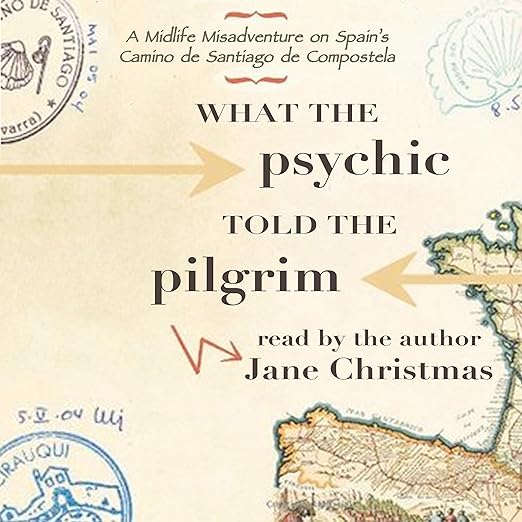
Christmas started this journey at fifty, framing it as a birthday gift to herself and a way of confronting the bruising uncertainties of midlife. She joined a group of fourteen women, which already tells you something about her appetite for friction. A psychic had warned her of catfights, death, and a fair-haired stranger. She went anyway. That decision is the whole book in miniature: stubbornly moving toward things that probably will not go smoothly, then writing about them with enough honesty to make you laugh and wince in the same breath.
When the Group Splinters and the Real Walk Begins
The first portion of this audiobook tracks the social implosion of the group with a kind of mordant precision that I found genuinely entertaining. Christmas does not protect anyone here, including herself. The squabbles that develop among fourteen women sharing dormitory bunks and exhausted legs are specific and recognizable, the kind of petty grievances that travel amplifies into something almost operatic. When the group finally fractures, the tone shifts in ways that feel honest rather than conveniently timed. The loneliness that opens up after the split is rendered with real weight, and it is in those solo stretches of the Camino Frances that the book finds its actual subject.
One reviewer noted that Christmas offers an honest account of one woman’s courage to confront her own self en route to Santiago, which is precisely right. But the book earns that framing because it avoids announcing it. The self-confrontation arrives through blistered feet and bad hostel lighting, not through revelation scenes. That restraint is what keeps the memoir from tipping into the genre’s most predictable territory. Another reader, a repeat traveler on the Camino, confirmed that Christmas gets the logistics right, the shared toilets, the wait times, the snarky attitudes from walkers who are emphatically not there for spiritual enlightenment, details the guidebooks leave out. That accuracy grounds the emotional story in something that feels earned rather than constructed.
The Psychic, Steve Martin, and the Fair-Haired Man
The title sets up a narrative thread that Christmas weaves through the whole journey with real skill. The psychic’s predictions function less as prophecy than as a running joke and a structural device, a set of pins that the walk either knocks down or quietly ignores. The fair-haired man does appear. Death also makes its presence felt, though not in the way you might expect. The Steve Martin hallucination, which arrives during a particularly depleted stretch of the road, is one of the funniest and strangely most affecting passages in the audiobook. Christmas has a gift for choosing the absurd detail that also carries emotional truth, and that hallucination earns both a laugh and something more unsteady.
Because she narrates her own work, the timing of those comic beats lands exactly right. There is a self-deprecating lilt to her delivery that never tips into performed modesty. She knows when the joke is on her, and she lets it land that way without editorializing. For a ten-hour listen, that voice sustains itself well. The narration also carries the weight of the more serious passages without straining; Christmas moves between registers with the ease of someone who has been telling stories for a long time and trusts her own instincts about when to shift.
What Unvarnished Actually Looks Like
Several reviewers praised the book for taking the romance out of the Camino while also putting it back. That is a useful summary of what Christmas is doing technically. Her descriptions of the logistics are specific enough to feel like actual reporting rather than atmosphere. At the same time, her attention to the landscape, the picturesque villages, the sudden arrivals of beauty in unglamorous places, is genuine. She is not performing ruggedness any more than she is performing transcendence.
One critic noted that the book grows tiresome toward the end, echoing the pilgrim’s own exhaustion with the pilgrimage. That is a fair observation, and it applies to the final third, which does drag slightly as the journey drags. But this is worth flagging rather than dismissing: the fatigue of the narrative is structural, not accidental. Christmas is matching her form to her experience, and if that choice occasionally taxes the listener, it also reflects something true about the Camino’s final kilometers. The weariness is part of the argument.
Listeners Who Will Love This and Listeners Who Will Not
This audiobook is well suited to listeners who are considering the Camino and want something honest about what the walk actually entails, physically and socially. It is also rewarding for anyone drawn to memoir that earns its emotional moments rather than announcing them. Readers who found Elizabeth Gilbert’s Eat Pray Love too conveniently redemptive will find Christmas’s approach more persuasive and more funny. You should skip this one if you are looking for a strictly spiritual meditation; Christmas’s relationship to the pilgrimage’s religious dimensions is respectful but detached, and the sacred infrastructure of the walk functions mainly as backdrop. If extended self-deprecating humor is not your register, the tone may wear thin by hour eight, but for most listeners the wit and the honesty carry the full ten hours without difficulty.
Frequently Asked Questions
Does Jane Christmas have any religious background that shapes how she approaches the Camino?
Her approach is primarily journalistic and literary rather than religious. She treats the Camino with a respectful detachment, curious about what the walk will reveal rather than seeking spiritual transformation in a conventional sense. Her irreverence for the pilgrimage’s devotional aspects is genuine, not performative.
The psychic’s warning sets up the book’s premise. Does Christmas take it seriously or treat it purely as comedy material?
Both, and that balance is part of what makes the book interesting. She treats the predictions with a kind of skeptical open-mindedness, checking them against events as the walk progresses. By the end, the psychic’s warnings have all arrived in some form, though never quite as expected, and the effect is quietly unsettling rather than confirmatory.
Is this audiobook accessible to listeners who have no interest in walking the Camino themselves?
Yes. Several reviewers specifically noted that the memoir works for readers with no intention of doing the walk. The humor, the character dynamics, and the midlife themes carry the narrative independently of any interest in pilgrimage routes or Spanish geography.
The title suggests a light tone. Does the book stay light throughout, or does it go to darker places?
It does go darker. The loneliness that follows the group’s split is handled with real candor, and death appears in the narrative in ways that shift the register away from comedy. The overall tone is witty, but the book does not avoid the heavier material that the Camino surfaces for its author.