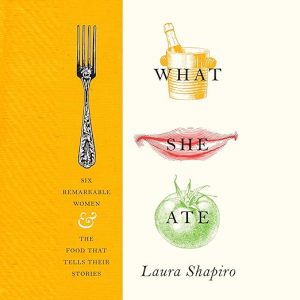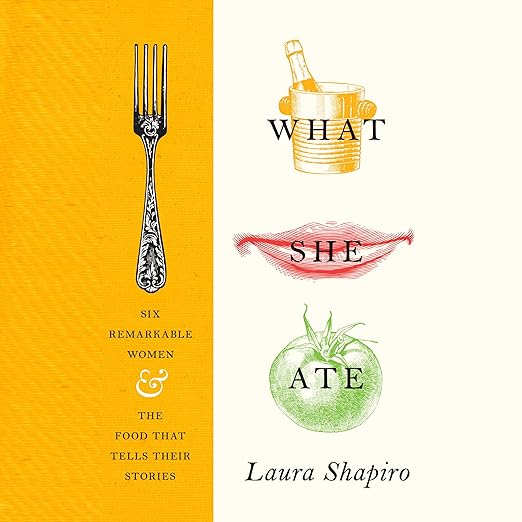
Six women who otherwise share little beyond fame become linked here through the most ordinary of details: what they ate, and how they felt about eating it. Laura Shapiro's audiobook groups Dorothy Wordsworth, Rosa Lewis, Eleanor Roosevelt, Eva Braun, Barbara Pym, and Helen Gurley Brown into a single collective portrait organized entirely around food and cooking, which sounds like a gimmick until you are several chapters in and realize how much biographers have historically left out by ignoring the kitchen table. Narrator Kimberly Farr, whose composed, measured register has served cultural-historical biography well elsewhere, gives each of these six very different life stories its own tonal weight without letting the throughline collapse into repetition.
Eleanor Roosevelt's Kitchen as a Political Statement
Shapiro's premise, one that reviewer Joan C. Curtis frames sharply as biography usually caring more about a woman's bedroom than her kitchen, holds up because she resists turning it into a single thesis stretched across six unrelated subjects. Each woman gets her own logic: Eleanor Roosevelt's chapter is really about her deliberate indifference to food as a political statement about austerity and duty, while Barbara Pym's is about how postwar British food scarcity shaped a specific kind of literary wit. The throughline is not argument so much as method, using a normally overlooked detail to reveal something the standard biographical record missed. It is a genuinely inventive angle for a book that could easily have become six disconnected essays instead of a cohesive collection.
The Eva Braun chapter is the audiobook's boldest inclusion, and it earns its place by refusing the comfortable, cozy register the food-and-biography premise might otherwise slip into. Shapiro uses Braun's relationship with food, and with domestic normalcy generally, to complicate rather than soften the listener's understanding of her, a genuinely uncomfortable pivot after chapters on Dorothy Wordsworth's careful household ledgers. That range, moving between warm literary appreciation and something closer to moral reckoning within the same book, is a hard needle to thread, and it is where Farr's narration earns its keep most clearly, since a lighter or more uniformly cheerful reading would have flattened exactly the distinction Shapiro is trying to draw.
Farr Holds Six Distinct Registers Together
Farr's steadiness across six distinct registers, intimate domestic detail for Wordsworth, brisk social climbing for Rosa Lewis, editorial ambition for Helen Gurley Brown, is the audiobook's structural backbone. A collection like this lives or dies on whether the narrator can move between subjects without the listener losing track of who is who or why the pivot matters, and Farr's composed delivery style, already an asset on other cultural-history titles, does exactly that work here. She does not perform enthusiasm to sell you on any single woman's story; she lets Shapiro's own reporting and quotation choices generate the interest, the right instinct for a book this focused on close-reading small details.
The book's pedigree helps frame expectations: a Washington Post Notable Nonfiction pick and an NPR Fresh Air recommendation from Maureen Corrigan both point to Shapiro's decades of food writing credibility rather than a first-time author testing a trendy concept. One reviewer specifically praises how the book connects historical events to the food of their era, calling it a genuinely unique concept that worked, and that reaction tracks with what makes this more than a novelty collection. Shapiro is not using food as decoration around biography; she is using it as an interpretive lens with real analytical weight, a harder trick to pull off across an entire book than it sounds.
This 3.8 Rating Reflects Real Unevenness
Not every chapter lands with equal force, and one reviewer's assessment, that some sections run slow while the first three chapters are the most fun, reflects a real unevenness across the collection. The Rosa Lewis and Dorothy Wordsworth chapters benefit from richer archival material to draw on, while a couple of the later portraits feel comparatively thinner, more assembled from secondary sources than freshly discovered detail. At ten hours across six subjects, that is roughly ninety minutes to two hours per woman, enough space for a sharp essay but not always enough for the full emotional arc a single-subject biography would deliver.
The book's 3.8 rating across nearly 500 ratings suggests a more divided reception than the critical blurbs alone would indicate, and it is worth going in with calibrated expectations: this is closer to a collection of long-form magazine profiles unified by a clever organizing idea than a single sustained narrative. Listeners expecting deep, book-length treatment of any one of these six women will want a dedicated biography instead. What you get here is breadth and a genuinely fresh lens, not depth on any single life.
Skip It If Eva Braun Feels Uncomfortable
This audiobook suits listeners who enjoy collective biography and cultural history with a strong organizing conceit, readers who appreciate a clear analytical lens applied across multiple subjects rather than a single sprawling narrative. It is also a natural fit for anyone interested in food history or food writing specifically, since Shapiro's decades of expertise in that field inform every chapter's close reading of menus, kitchen habits, and eating rituals as historical evidence rather than trivia.
Skip it if you want a traditional, single-subject biography with room to develop over many hours, or if any of the six women covered, particularly Eva Braun, feels like an uncomfortable inclusion you would rather not spend a chapter with. Listeners hoping for a uniformly cozy food-and-history listen should also know the tonal range gets genuinely dark in places, a deliberate choice but not one every listener wants from what might look, from the cover alone, like a lighter culinary history.
The Short Version
- Narrator: Kimberly Farr's composed, measured register carries six very different women's stories without losing tonal distinction between them.
- Subjects: Food as biographical evidence, women's history, domestic life and public image
- Tone: Inventive and reflective, occasionally somber
- Bottom line: A genuinely fresh angle on collective biography that rewards readers interested in food history, even if a few of the six portraits run thinner than others.
Before You Listen
Does this audiobook cover Eva Braun respectfully given the sensitive subject matter?
Shapiro uses the chapter to complicate rather than soften understanding of Braun, and narrator Kimberly Farr shifts into a notably more serious register for that section rather than treating it with the same warmth as the other five portraits.
Is this audiobook more about cooking or about biography?
Biography. Food functions as an analytical lens throughout rather than the book's actual subject, so listeners expecting recipes or culinary history specifically should adjust expectations.