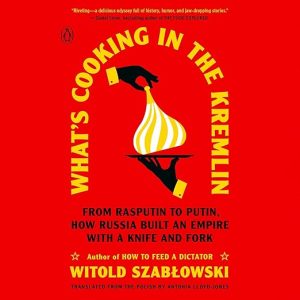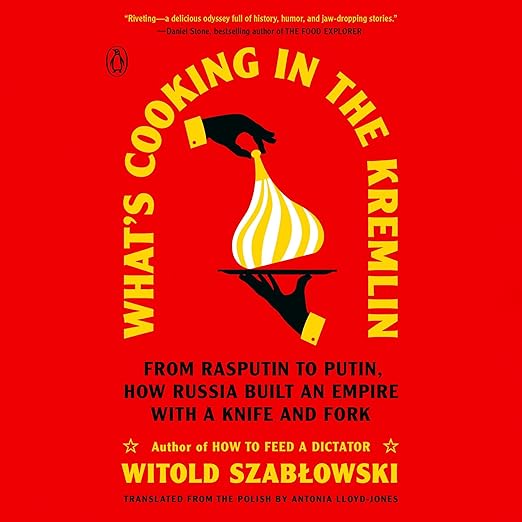
I found What's Cooking in the Kremlin on a recommendation that described it as the most unusual Russian history book available in English, which is a meaningful claim given the competition. Witold Szablowski, a Polish journalist with a track record of access journalism in difficult countries, has spent years tracking down people who cooked for Soviet and Russian leaders, and the stories they have given him are stranger and more illuminating than any straightforward political history of the same ground would be.
The premise sounds like a gimmick. It is not. When you learn that Stalin had a personal food tester while simultaneously engineering the Great Famine in Ukraine, the juxtaposition is not a joke, it is a precise and damning illustration of how totalitarian power insulates itself from the consequences it inflicts. When you learn why Brezhnev hated caviar, or what was served at the moment Soviet leaders decided the USSR should cease to exist, you understand something about those moments that a conventional political account would struggle to convey. The kitchen is where the human reality of power lives, in a way that official records rarely capture.
The Review
Szablowski's journalism draws comparisons to Anthony Bourdain and Hunter S. Thompson in the press materials, which is accurate about the energy if slightly generous about the prose. The journalist is in the gonzo tradition in the sense that he is present in his own reporting, willing to go to war-front steelworks in Mariupol, to Chornobyl, to Stalin's Georgia, to get the interviews he needs. The access he achieves is remarkable, the book opens windows into contexts that are genuinely forbidden to most foreign journalists.
One reviewer who described themselves as a Russophile with ambivalence about their interest noted that the book serves as a way to engage with Russian history and culture while fully confronting its horrors. The dual consciousness the reviewer describes, fascinated and appalled simultaneously, is exactly the effect Szablowski seems to be aiming for. He is not asking you to sympathize with the Soviet system. He is asking you to understand it from an angle you have not considered before, and the kitchen angle turns out to be remarkably revealing.
David Garelik's narration is the right instrument for this material. The book is structured as an oral history, which means Garelik is managing multiple interview subjects with different registers, ages, and emotional relationships to their memories. He differentiates these voices without making the transitions jarring, and his handling of Szablowski's own narrating presence, the journalist moving through landscapes, describing what he sees, keeps the documentary texture intact.
The runtime of ten hours and thirty-six minutes is substantial but earns its length: Szablowski is covering a hundred years of Russian power through a dozen or more interview subjects, each of whom represents a different historical moment. The book is structured so that each chapter functions as a self-contained portrait before connecting to the larger argument, which makes it well-suited to listening in sections.
What to Watch For in What's Cooking in the Kremlin
The book includes actual recipes, which is a charming and practical element in print but functions differently in audio, Garelik reads them with the same attention he gives the narrative sections, and they work as historical artifacts within the listening experience even if you are unlikely to use them. The recipe for the first soup flown into outer space is a highlight.
The Ukraine sections carry particular weight given the context of Russia's 2022 invasion, and Szablowski does not avoid the connection, the book treats food as a contemporary instrument of war as well as a historical one. Readers approaching this hoping to maintain comfortable distance from the present political situation will find the book does not offer that distance. It is honest about what the century of cooking it describes has led to.
Who It's For
Anyone with genuine interest in Russian history who wants an approach that is neither hagiographic nor simply horrifying will find Szablowski threading that needle with skill. Food writers and culinary history enthusiasts who have enjoyed books like Bee Wilson's Consider the Fork or Michael Pollan's work will appreciate the food-as-lens approach, though the political stakes here are considerably higher than most culinary history. General history readers who have found conventional Russian history books impenetrable will find Szablowski's journalism structure more accessible. The book is also a valuable companion to more conventional histories of the Stalin or Brezhnev periods.
Quick Take
- Narrator: David Garelik handles Szablowski's gonzo-adjacent journalist voice with energy and range, the oral history format, with multiple interview subjects, is navigated cleanly.
- Subjects: Food as political instrument and propaganda tool, the human texture of authoritarian power, Russian history from its kitchen outward
- Tone: Darkly entertaining and historically illuminating, with moments of genuine horror kept in check by the author's irreverent energy
- Bottom line: A culinary oral history that earns its subject through access and storytelling craft, Szablowski's reporting instincts make this something genuinely surprising rather than a novelty premise.
Frequently Asked Questions
How does Szablowski handle the Ukrainian famine given the current political context?
Directly and without euphemism. The Holodomor is contextualized against Stalin's personal food privileges, which makes for uncomfortable but important listening. The book does not shy away from the present implications of the history it traces, and the Mariupol section makes those implications explicit.
Is this primarily a food book or a history book, which audience does it serve better?
It serves both, but the food is the vehicle rather than the destination. Readers who come primarily for culinary content will find the political history substantial; readers who come for Russian history will find the food angle a genuinely illuminating lens rather than a novelty. The blending is the book's primary achievement.