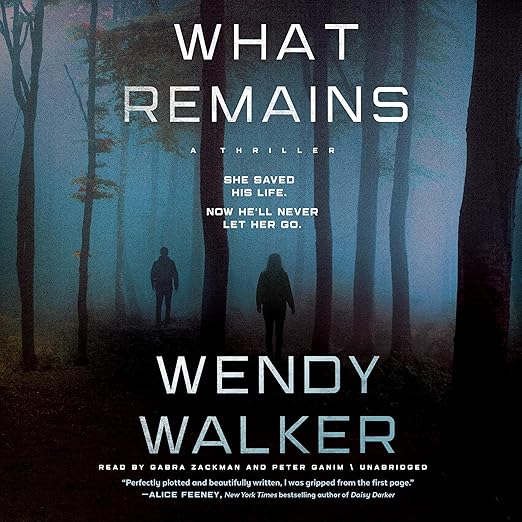
The Short Version
- Narrator: Gabra Zackman narrates this audiobook with taut, controlled tension that suits the psychological thriller's cat-and-mouse dynamics throughout its 8-hour runtime.
- Subjects: Guilt and obsession after a crisis decision, cold case forensics, the cost of being called a hero
- Tone: Tense and unnerving, with a clinical precision that makes the paranoia feel plausible
- Bottom line: Wendy Walker's psychological thriller delivers a strong protagonist and a genuinely complex setup, though the structural parallel tracks require active listening to follow cleanly.
Wendy Walker's What Remains opens with an explosion of ordinary circumstances: Detective Elise Sutton is at a shopping mall buying pink towels when shots ring out. The audiobook, narrated by Gabra Zackman across 8 hours and 23 minutes, uses that inciting mundanity deliberately. Sutton is a forensics expert with a specialty in cold cases, someone who prides herself on reading criminal behavior with detached accuracy. The crisis at the department store, in which she makes a split-second decision about whether and how to save a man's life, breaks that detachment, and the novel's central question is whether what replaces it will destroy her.
Walker's interest in the forensics of trauma is evident throughout. Sutton does not simply react to being stalked; she tries to construct a psychological profile of her stalker using the same methodology she applies to cold cases, which creates a running tension between her professional confidence and her personal vulnerability. The department store scene reverberates through the rest of the novel as the moment her toolkit of detached analysis first failed her, and Walker returns to it repeatedly through Sutton's narration, each time with a slightly different angle of regret. Zackman's performance in these retrospective passages has the quality of someone trying to revise a memory while knowing the revision is impossible, which is precisely what the character's psychology requires at those moments.
Misreading Her Own Emotional State
Walker, who received comparisons to A.J. Finn and The Woman in the Window in pre-publication materials, is working in the tradition of psychological thrillers built on an unreliable but deeply specific protagonist. Sutton is not unreliable in the conventional sense of hiding information from the reader; she is unreliable in the more interesting sense of misreading her own emotional state. She processes the department store crisis through the only tool she has: criminal psychology. When the man she saved becomes her stalker, she begins analyzing him the way she analyzes cold cases, mapping behavioral signatures and drawing inferences. Zackman's narration captures the split between Sutton's trained rationality and her mounting terror with controlled precision.
The cold case thread that runs alongside the stalker plot, with Sutton working a parallel investigation even as her personal situation deteriorates, is the book's structural engine. Walker uses Sutton's professional competence as both her resource and her blindspot: the same analytical framework that makes her excellent at finding killers makes it difficult for her to accept that she cannot simply solve her own situation. That tension between clinical skill and emotional overwhelm is what the book is actually about, and Zackman renders it clearly throughout the narrative's two competing timelines.
Zackman's Composure Cracks and It Registers
Zackman is a strong choice for this material. Her voice has a quality of composed authority that matches Sutton's professional self-presentation, which means when the composure starts to crack, it registers as meaningful rather than routine thriller-escalation. The book's comparisons to The Silent Patient and The Woman in the Window are reasonable in terms of ambition: Walker is genuinely trying to construct a protagonist whose inner life is the primary mystery, and she gets there more often than not.
The audiobook format suits the first-person structure well. Sutton's narration is not retrospective in the conventional thriller sense; she is processing events as they happen, which creates a real-time quality that Zackman maintains through careful pacing. The mall scene that opens the book sets the register clearly: present-tense urgency, a protagonist trying to think clearly under pressure, and the sense that what looks like a competent response might be quietly wrong in ways that will surface later. That setup pays off across the back half, though not without some structural unevenness along the way. The New York Times Editors' Choice designation reflects the book's ambition level accurately.
Confusing at Certain Junctions, Holding Attention Throughout
Several readers found the parallel structure, with the cold case investigation running alongside the stalker plot, confusing at certain junctions, and that feedback is not entirely unfair. Walker interweaves the two threads in ways that occasionally require the listener to track which timeline is active, and the audiobook format, without visual chapter breaks, can make these transitions slightly harder to follow than in print. Zackman manages the transitions with tonal variation, but listeners who prefer their psychological thrillers tidily compartmentalized may find the structural complexity adds friction rather than depth.
The resolution, which includes a final twist that the publisher compares to The Woman in the Window, will divide opinion. Some readers found it fully earned; others found it a reach. This is the standard variance for psychological thriller endings that depend on a revealed misperception, and whether it lands will depend on how much of the book's energy you have invested in Sutton's self-understanding. The reviewer who described the ending as a bit confusing but ultimately holding their attention throughout is probably the median honest response.
More Than Simply a Plot Delivery Mechanism
Strong for fans of psychological thrillers with female detective protagonists, particularly those who read The Silent Patient or The Woman in the Window and want something operating in a similar register. Gabra Zackman's narration is a genuine asset for listeners who appreciate careful vocal performance over simply a plot delivery mechanism. Less satisfying for those who prefer their thrillers to move cleanly and quickly through a linear plot; the parallel structure and interior focus slow the external momentum in ways that reward patience but penalize impatience. Listeners who enjoy Wendy Walker's previous work will find this consistent with her interest in the psychological cost of female expertise under pressure.