Quick Take
- Performance: Grover Gardner brings measured authority to the investigative structure, handling eyewitness testimony, forensic evidence, and historical narrative with clear differentiation.
- What it covers: Forensic history, the gap between evidence and popular belief, how dictatorships create ambiguity
- Feel: Investigative and methodical, with the dry tension of a case being built piece by piece
- Our call: A rigorously structured popular history audiobook that takes the enduring questions about Hitler's death seriously and works through the evidence to a defensible, clearly argued conclusion.
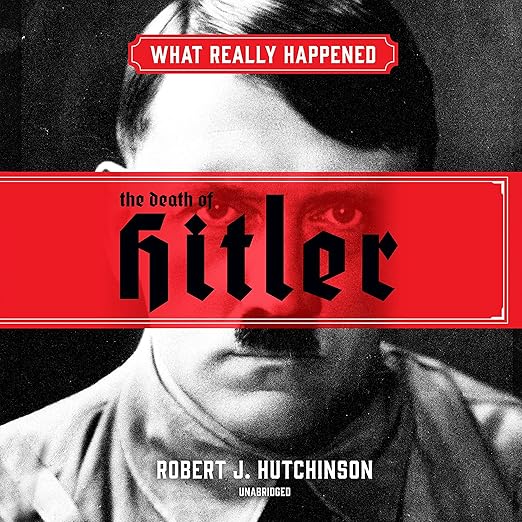
Robert J. Hutchinson opens his investigation with a statistic that stops you cold: in the immediate aftermath of World War II, fully fifty percent of Americans polled did not believe Adolf Hitler had died in his Berlin bunker. Fifty percent. This audiobook, narrated by Grover Gardner, makes the case that the confusion was not simply paranoia or wishful thinking by people who wanted to see the Nazi regime punished, but the product of genuine evidentiary problems that persisted for decades after 1945. Joseph Stalin himself told Allied leaders he believed Hitler had escaped, and at least two German submarines crossed the Atlantic and landed on the Argentine coast in July 1945. Hutchinson's What Really Happened: The Death of Hitler arrives as a careful, evidence-organized response to those unresolved questions.
Hutchinson is not a conspiracy theorist, and the book is not a conspiracy text. It is something more interesting: a disciplined popular history that takes seriously the historiographical problems around Hitler's death and works through the evidence with consistent rigor, ultimately reaching a conclusion that the escape scenarios cannot withstand scrutiny, while being honest about the forensic gaps that kept doubt alive for so long. He is the author of a previous volume in the What Really Happened series on the Lincoln assassination, and the same methodological approach is visible here: identify the questions that have kept doubt alive, examine what the witnesses actually said, assess the forensic evidence, and arrive at a defensible position.
The book covers questions that popular history has often treated as settled but which Hutchinson shows were not, at least not immediately. The role of body doubles, the absence of a recovered body in Allied hands, the FBI's continued investigation of Hitler survival reports for more than a decade after 1945 (reports declassified only in 2014), and the forensic tests on physical evidence conducted as recently as 2016. These are not invented mysteries; they are real evidentiary problems that Hutchinson addresses sequentially and fairly.
Joe Marino Changed His Position on the Escape
Grover Gardner is one of the more reliable narrators in popular history audiobooks, and his performance here suits the material precisely. He brings a dry, authoritative quality to the investigative sections and handles the shifting between eyewitness testimony, historical narrative, and Hutchinson's own analytical commentary without losing the listener's orientation. At eight hours and thirty-six minutes, this is a substantive audiobook that requires sustained attention, and Gardner's measured pacing supports that requirement rather than fighting against it.
Reviewer Joe Marino noted that he had read many books about Hitler's death while leaning toward the escape theory, and that Hutchinson's book changed his position. That kind of testimony from a reader who came in skeptical of the standard historical account and left persuaded by the evidence is meaningful. Barbara C. called it 'a no-put-down read' with detail 'easy to follow,' which is a fair description of how the book works as an audiobook: the pacing is brisk enough to maintain engagement even through the more granular forensic sections.
Gardner's Clear Narration of the Forensic Timeline
One reviewer noted that the book spends considerable time on the Stauffenberg plot, which is a fair observation. The sections dealing with the July 1944 assassination attempt on Hitler are more extensive than some readers expecting a focused treatment of the 1945 bunker events might anticipate. Hutchinson uses the Stauffenberg plot to contextualize the final year of Hitler's life and the breakdown of the Nazi leadership structure, but it does extend the book's scope beyond the immediate death investigation.
The book is explicitly popular history rather than academic scholarship, and the evidence review, while thorough for its format, is not as comprehensive as a monograph-length treatment could be. Readers deeply familiar with the archival literature on the subject may find Hutchinson's coverage selective. For the general listener, however, the evidence is presented clearly and the sourcing is solid.
The most provocative material involves the claims in books such as The Grey Wolf that Hitler survived until 1962 in an Andean hideout. Hutchinson takes these claims seriously enough to investigate rather than dismiss, and his treatment of them is one of the more satisfying parts of the book, both because the claims are intrinsically fascinating and because his methodical approach to evaluating them is instructive.
One of the book's more interesting structural choices is its treatment of the forensic evidence timeline. Hutchinson shows that the most rigorous forensic examination of available physical evidence, including dental records and tissue samples, was not completed until 2016, more than seventy years after the events in question. That delayed scientific closure explains in part why doubt persisted so long and why reputable institutions like the FBI continued investigating reports of Hitler's survival into the 1950s. Gardner's narration of these forensic sections is clear and well-paced, making technical material accessible without oversimplifying it.
Listeners Who Encountered the Documentary Escape Theories
This audiobook is an excellent choice for listeners who enjoy popular history with real investigative structure, particularly those interested in World War II and its immediate aftermath. It will appeal strongly to listeners who have encountered the Hitler escape theories in documentary form and want a serious, evidence-organized response to them. Gardner's narration makes the material accessible even to listeners without deep background in Second World War historiography. Those who want a more definitive academic treatment or who are specifically looking for detailed coverage of the Argentine exile community should treat this as a starting point rather than a final resource.
Good to Know
Does this audiobook argue that Hitler escaped or that he died in the bunker?
Hutchinson argues that the evidence, examined carefully, does not support the escape theories, despite the genuine forensic problems that kept doubt alive for decades. He takes the escape scenarios seriously enough to investigate them before concluding they cannot withstand scrutiny.
How does Grover Gardner's narration handle the different types of evidence in the audiobook?
Well. Gardner differentiates between eyewitness testimony, archival evidence, Hutchinson's analytical commentary, and the claims of escape theorists with clarity and appropriate tonal variation, keeping the listener oriented across a structurally complex argument.
Is the audiobook version of this book as useful as reading the print version for following the evidence?
For most of the content, yes. The evidence is presented sequentially and logically, which suits audio delivery well. Listeners who want to review specific sources or cross-reference individual claims may find a print version more useful, but the audio format serves the investigative narrative effectively.