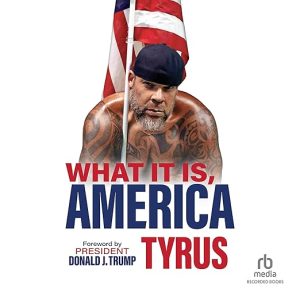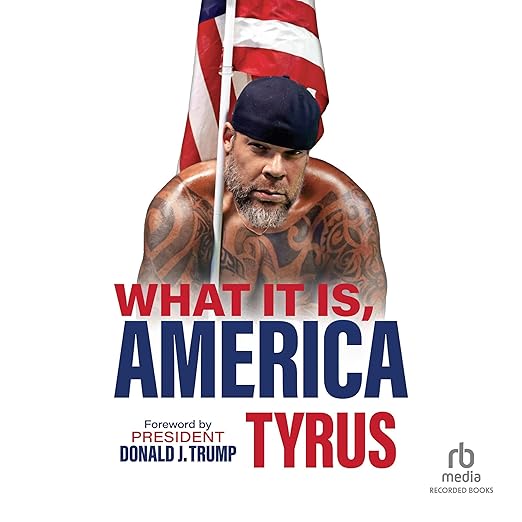
Tyrus has built a following on a premise that sounds simple and turns out to be genuinely rare: that most people, regardless of their politics, can tell the difference between a real conversation and a performance. What It Is, America, his third collection of personal and political stories, makes that premise literal. The audiobook accompanies his sold-out one-man show, and the recording captures a version of Tyrus that is closer to the man working a room than to the television commentator or the professional wrestler who preceded that career. All three identities are visible in a single collection, and understanding how they combine is part of what makes listening to this specific title more revealing than watching a single segment of the show that brought him to wider attention.
The stories gathered here span Tyrus's travel across America meeting people from, as the synopsis describes them, "all walks of life." His framing is deliberately non-ideological in the sense that he is not writing to confirm the existing views of either side of the current political division, but to represent the texture of actual American experience as he has personally encountered it. The encounter with then-presidential candidate Donald Trump at the Gutfeld! show is the most discussed episode among reviewers, and Tyrus handles it with the "bare-knuckle approach" to issues that characterizes the collection overall. He is not performing accountability for an audience that already agrees with him, and that distinction is more significant than it might initially appear.
A Life Shaped by What It Actually Cost Him
Reviewers describe Tyrus as someone who "keeps it real," and that phrase can be applied to anyone with a strong personality and a high-profile platform without meaning very much. What the specific responses to this book demonstrate is that the claim holds up under examination. Multiple readers describe the collection as genuinely "down to earth," as actively encouraging disagreement rather than demanding consensus, and as the product of someone who applies accountability without checking which party the subject belongs to first. That orientation is rarer in American political commentary than it ought to be, and it gives the collection a durability that more ideologically committed work does not have.
The personal stories are the stronger sections throughout the book. Tyrus's "school of hard knocks" material, covering his early life experiences and his trajectory through multiple professional identities, contextualizes the political commentary in a way that makes it feel earned rather than adopted from the outside. He is not analyzing America from a position of distance. He is describing America as someone whose life has been shaped by it in specific and sometimes difficult ways, and who has paid close attention to what those shaping forces have actually cost and given him in return.
One reviewer who loves watching Tyrus on Gutfeld described the book as an extension of what makes him compelling on television: his ability to hold humor and genuine concern for the country simultaneously without letting either one undercut the other. That tonal balance is present throughout the audio, and it is harder to maintain across nine hours of a single voice than the finished product makes it appear.
A Full Listening Investment Across Nine Hours
Tyrus narrating his own material produces something closer to a live performance than a conventional narrated memoir. His timing and his voice carry the humor and the sharpness that are central to his appeal as a public figure, and neither of those qualities survives intact in a neutral third-party narration. At 9 hours and 36 minutes, this is a full listening investment, and the storytelling register Tyrus sustains across that runtime demonstrates that the one-man show format he performs live translates to audio with minimal loss. The "unfiltered and unapologetic" style described in the synopsis is real rather than marketing copy, and audio is its native environment: Tyrus's comic timing, his use of repetition for emphasis, and his ability to move from self-deprecating anecdote to pointed political observation within a single paragraph are all performance qualities that the listening format preserves in ways a transcript cannot.
A Conversational Orientation, Not a Political Position
The sections where Tyrus describes encounters with ordinary Americans, not politicians or media figures, are the ones where the book's central argument is made most effectively. He is interested in the diversity of actual American experience rather than in its politicized representation, and those conversations with people he met on tour carry more persuasive weight than the commentary on specific current events, which will date faster than the personal material does.
His framing of what "common sense" means is worth tracking throughout. For Tyrus, common sense is not a political position but a conversational orientation: the willingness to hear a different perspective before responding, the ability to disagree without treating the other person as an adversary who must be defeated. That framing is consistent across the collection, and it is the reason listeners from different political orientations describe finding the book engaging rather than alienating. He is not asking you to agree with him. He is asking you to listen in the same way he claims to listen, and the invitation is extended with enough personal evidence to make it credible.
Skip the Policy Arguments, Stay for the Humor
Fans of Tyrus's work on Gutfeld! will find this the fullest representation of his storytelling voice available in audio form. Listeners interested in American life as it is actually experienced rather than as it is analyzed from a distance, and who are tired of commentary that demands ideological alignment before offering engagement, will find his approach genuinely refreshing. Skip it if you are looking for policy arguments, ideological frameworks, or sustained political analysis. This is a collection of stories and observations rather than a political thesis, and its claims are made through accumulation and testimony rather than through argument. The humor is real, the accountability is consistent, and the warmth toward the country he is describing is evident throughout.Sp
- Narration: Tyrus narrating his own stories is the only configuration that makes sense for this material, and his performance carries the same unfiltered energy that made his live show sell out across the country.
- Themes: American identity as lived experience, accountability across political lines, the power of plain-spoken dialogue over political performance
- Mood: Direct and warm, with sharp edges applied evenhandedly to politicians on both sides of the divide
- Verdict: What It Is, America works as an audiobook because Tyrus's voice is inseparable from his argument, and both are at their best when he stops performing and simply talks.
Before You Listen
Does What It Is, America work as an audiobook if you haven't read Tyrus's earlier collections?
Yes. Each collection stands independently. This is his third book, but the stories are self-contained and do not require familiarity with the earlier volumes. New listeners will find enough context within this book to understand who Tyrus is and where his perspective comes from.
Is this audiobook politically one-sided, or does Tyrus apply criticism across party lines?
Multiple reviewers specifically note that Tyrus holds leaders accountable regardless of party affiliation and actively encourages hearing perspectives different from your own. The collection is politically engaged but not partisan in its framing, and reviewers from different political backgrounds describe finding it honest rather than ideologically loaded.
How does Tyrus perform as a narrator of his own material?
Tyrus narrating his own stories is core to the audiobook's value. His live performance background, comic timing, and the energy he carries from his one-man show all translate to audio. The narration is not polished in a conventional studio-voice sense but is authentic to the material in a way professional narration would not match.
Does the audiobook cover specific current events that might date the material quickly?
Some sections address current events including the Gutfeld! show context and campaign situations specific to their moment. The personal storytelling and travel sections, which make up a large portion of the collection, are less time-dependent. Listeners coming to this later will find the personal material more durable than the political commentary sections.