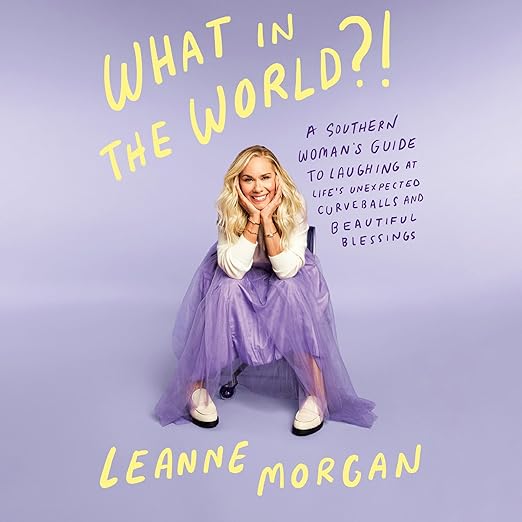
Leanne Morgan spends this memoir describing a search for her own voice, and the description says so in those words: a quest to find her voice after years of trying to work out what that meant. She then narrates the audiobook herself. This is no marketing coincidence, it is the whole case for choosing this edition over the hardcover, because a book about a woman learning to sound like herself is a strange thing to encounter in silence. Six hours and seven minutes, in the accent the copy explicitly names, from the person the accent belongs to.
The Long Stretch Before Anyone Was Listening
Six hours is a well-judged length for this kind of book, and the material justifies it. Morgan grew up a butcher's daughter in rural Tennessee, married Chuck, and by her own framing landed a husband with health insurance before she landed a career. The comedy came later and sideways, honed while selling jewelry at house parties, a detail so specific it does more work than a page of biography. The book covers hormones, diet trends, low-rise britches, Weight Watchers, perimenopausal mean girls and rock concerts attended in middle age, and the whole thing is organized around the argument that nobody in the industry believed a woman over fifty from the rural South could do this. The through line is not the punchlines. It is the long stretch before anyone was listening.
Reese Witherspoon supplies the cover line and the description leans on it, which tells you the register the publisher is aiming for: inspirational over caustic, warm over sharp. A reviewer signing as J.J. King describes the effect precisely, praising the way the jokes get set inside the larger context of a life, the bad parts included, without the book denying its own low points or the poor decisions that produced some of them. That is the balance here. Anyone expecting an hour of punchlines with a memoir attached has the proportions backwards.
A Comedian Reading a Comedian
Humor is what four of the five here single out, and one goes further, praising the way the book refuses to skip its low points. Every one of them is describing prose on a page. That leaves the strongest argument for the recording unmade by anyone except the publisher, which states it in the description itself: the charming southern accent is the delivery system. Stand-up material transcribed to the page loses timing, and an author reading her own transcription puts it back. Self-narration is a gamble with most memoirists. With a working comedian it is closer to a guarantee.
Morgan is not an unknown quantity walking into a booth for the first time either. The description points to a Netflix stand-up special, Unspeakable Things, and a sitcom carrying her own first name, and a reviewer mentions watching the first season repeatedly as a bedtime habit. Someone who has spent years performing this material live is unlikely to be defeated by six hours of reading it, and the comparison a listener should make is not against other memoirs but against her own recorded sets. On that scale the format question answers itself: a comedian reading a comedian is the closest thing to the real delivery that print can never supply.
Every reviewer here is warm about the book and one is quantitatively out of step: a four-star entry from Kate H. calls it funny, sweet, insightful and relatable, which reads like a five-star sentence attached to a four-star grade. That mismatch is worth noticing because it is the sole friction in this column, and it does not amount to a criticism. If you are looking for the reason someone might not enjoy this, nobody here has supplied one.
Three Votes Cannot Explain a 4.7
The physical object dominates this page in a way that will not help an audio shopper. A five-star entry from Joyce S opens by reporting that it arrived yesterday and was finished by that afternoon, a delivery timeline that means nothing for a download. Kirsten Thomas read it and passed the copy on to a parent. Another reviewer admires how the humor came across on paper. None of these observations are wrong, and none of them apply to the thing you would be buying, the same text delivered through a microphone.
Counts on this page do not agree with each other. The badge reports three votes; five signed responses sit visible underneath it, with dates running from September 2024 to February 2026. No honest reconstruction of a 4.7 from three whole-star ratings is available here, because the number resolves under only one rounding convention and the count is contradicted by the column below it. Read the five responses instead. They are consistent, specific and considerably more useful than the badge sitting above them, and they accumulated slowly over more than a year, and did not arrive in one promotional burst.
One small thing worth flagging for anyone searching: a January 2026 response spells the name LeeAnn, which is not how it appears anywhere else on the record, and that same reviewer describes a show and city tours, never a book. Another response is dated September 24, 2024, the release date itself. The publisher's own copy is print-facing throughout, promising to bring readers inside the story and calling the result a must-read, with no acknowledgment anywhere that an audio edition exists or that the author performs it.
Perimenopause and Family Life Fill All Six Hours
Fans of stand-up who want the biography behind a set they already know will get exactly that, and listeners who came in through the Netflix special or the sitcom will recognize the voice before the first chapter ends. Anyone who reads memoirs for the shape of a life more than the celebrity of it should come away satisfied, since the jewelry parties and the health insurance are more interesting here than the fame. Six hours makes it a two-evening listen at most, and the register suits a kitchen, a long errand or a night when nothing heavier will go down.
Comedy at a brisker clip is easy enough to find elsewhere, and the inspirational framing will put some listeners off on its own. The larger question is subject matter: perimenopause, diet culture and southern family life run straight through all six hours, and nobody should buy this hoping they stay incidental. Reading the jokes on a page is perfectly fine, and hearing them delivered is the entire argument for this edition.
Does Leanne Morgan read the audiobook herself?
Yes. The author and narrator credits carry the same name, so the six hours and seven minutes are performed by the person who wrote them. For a memoir whose stated subject is finding her own voice, and whose description advertises her southern accent, self-narration is the format the material was clearly built for.
How much overlaps with her stand-up material?
One reviewer familiar with the comedy says some of it will be recognizable, but praises the way the book resets that material inside the larger story of a life. Expect familiar bits given context, not a transcript of a set. The memoir covers her childhood, her marriage and her late arrival in the industry.
Is the audiobook funny throughout or is it a serious memoir?
Both, in a mix that leans warmer than a comedy special. The description promises real talk about hormones, diet trends and aging alongside the jokes, and one reviewer notes that the low points and poor decisions are not glossed over. Reese Witherspoon's cover line calls it inspirational, which sets the register accurately.
Why do the reviews describe a printed copy?
Because all five appear to be responses to the hardcover. One mentions the delivery arriving a day earlier, another passing it along to a relative, a third admiring how the humor worked on paper. None of the five discusses the recording, so the audio edition arrives on this page essentially undescribed by listeners.