Quick Take
- Narration: Richard Mitchley delivers Russell’s prose with composed authority, dry, precise, and appropriately unshowy for a philosopher who prized clarity above all performance.
- Themes: Secular ethics, the limits of religious morality, science and human flourishing
- Mood: Crisp and intellectually bracing, a short book that punches well above its runtime.
- Verdict: For anyone who wants Bertrand Russell’s core philosophical commitments in concentrated form, this is the clearest entry point available on audio.
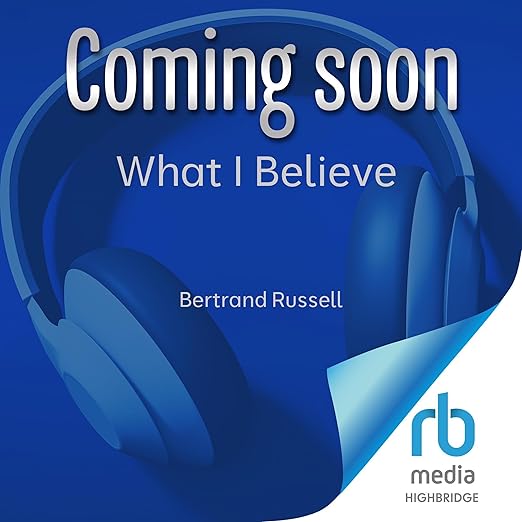
I tend to save short audiobooks for the strange in-between moments of a week: the twenty-minute walk to the pharmacy, the tail end of a flight that has run out of good film options. I started What I Believe on a Wednesday afternoon with barely two hours to spare before a dinner reservation, and I finished it, slightly stunned by its efficiency, before I had even sat down to eat. Two hours is all Bertrand Russell needs to lay out a coherent philosophy of human life, and the restraint of that ambition is itself a kind of statement.
Russell was many things over a long career: mathematician, pacifist, Nobel laureate, social agitator. But this 1925 essay, part of the Routledge Great Minds series, shows him at his most direct. He is not constructing an argument for a seminar; he is telling you, plainly, what he actually thinks. That quality of intellectual honesty, rare in writing and rarer still in philosophy, is what makes this particular title hold up almost a century later.
Our Take on What I Believe
The essay is organized around a handful of interlocking convictions: that human life can be guided by reason rather than faith, that conventional religious morality has caused as much suffering as it has prevented, and that science offers the most reliable framework for understanding our place in the universe. Russell makes these points without the usual hedging academics deploy to protect themselves from controversy. He simply says what he believes, and then explains why.
What I found striking, listening to this in 2026, is how little the terrain has shifted. Russell’s critique of organized religion in 1925 would read comfortably in a contemporary secularist essay. His insistence that a good life is one guided by love and knowledge rather than doctrine sounds almost commonplace now precisely because Russell and a handful of other early-twentieth-century writers made it so. That historical context matters: this is not a book that aged into relevance. It helped create the cultural conditions in which such ideas could be discussed openly.
The two additional essays included here, Why I Took to Philosophy and How I Write, add texture rather than weight. How I Write is particularly good: Russell describes his process of thinking through an argument by walking, then writing it out without revision, which explains the unusual clarity of his prose. There is something almost reassuring about learning that one of the century’s most readable intellectuals had a very ordinary relationship with his own sentences.
Why Listen to What I Believe
The audio format suits this material well. Russell wrote to be understood, not to demonstrate erudition, and hearing his essays read aloud strips away whatever intimidation the philosophy section of a bookshop might generate. Richard Mitchley’s narration is calm, measured, and lets the arguments breathe. He does not editorialize through tone, which is exactly right for a thinker who was doing plenty of editorializing on the page. The runtime of just under two hours is the other advantage: you can listen to the full essay in one sitting, which is how it was meant to be encountered.
There is a version of this review that complains Russell does not engage deeply enough with theological counterarguments. That is fair as a philosophical critique, but it misunderstands what this book is. It is a personal statement, not a formal debate. Russell is not here to defeat Christianity in an academic journal; he is here to tell you how he has chosen to live and what he has concluded after a long career of thinking. The essayistic mode he adopts is honest about its own limits in a way that makes the arguments more compelling, not less.
What to Watch For in What I Believe
Two passages deserve close attention. The first is Russell’s discussion of fear as the root of religious belief. He is blunter here than he would later be in Why I Am Not a Christian, and the directness can catch you off guard. The second is his treatment of love as a secular value: he argues that the capacity for genuine connection, freed from possessiveness and the anxieties organized religion tends to attach to sexuality, is the basis of the good life. For 1925, this was quietly radical.
Listeners who come to this expecting a survey of Russell’s wider philosophy may feel slightly underserved. What I Believe says almost nothing about mathematics or formal logic, which consumed a large part of his career. It is a moral and social essay, not a technical one. That is its strength for general listeners and its limitation for those seeking a comprehensive introduction to his thought. If you want the latter, A History of Western Philosophy is the place to go, though that is a considerably longer commitment.
Who Should Listen to What I Believe
This is well suited to listeners who enjoy short-form essays and want a concentrated encounter with a thinker who shaped twentieth-century secular humanism. It works for philosophy newcomers who have been curious about Russell but hesitant about where to begin. It also rewards readers already familiar with his work, who will recognize the threads here that he developed at length elsewhere. Listeners who want narrative momentum, personal drama, or detailed engagement with opposing arguments will find this too stripped-down. And those who approach philosophical essays on faith expecting a respectful pluralism should know that Russell was not much interested in providing one.
Frequently Asked Questions
Is this audiobook suitable for listeners who have no background in philosophy?
Yes. Russell wrote explicitly to be understood by general readers, and the essay’s structure is straightforward enough that no prior philosophical training is needed. The main arguments are stated clearly and without academic jargon.
What are the two additional essays included alongside the main text?
The collection includes Why I Took to Philosophy, a brief autobiographical account of how Russell came to his subject, and How I Write, a short reflection on his process and the principles behind his unusually clear prose style.
How does this compare to Russell’s longer work, Why I Am Not a Christian?
The two books share themes, particularly the critique of religious morality, but What I Believe is less combative and more constructive. Russell spends more time here articulating what he does believe rather than dismantling what he does not. It is a more personal and in some ways more interesting document.
Does Richard Mitchley’s narration suit Russell’s essayistic style?
Mitchley takes a deliberately unadorned approach, prioritizing clarity over dramatic delivery. This works well for Russell, whose prose is already doing the rhetorical work. Listeners who want expressive or theatrical narration may find the style understated, but for this material, the restraint is the right call.