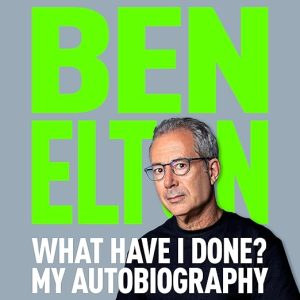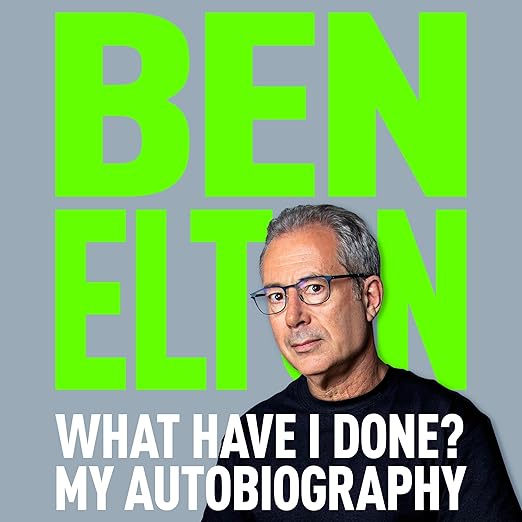
Ben Elton reading his own memoir is, frankly, the only way this audiobook could work. What Have I Done? - narrated by Elton himself at fifteen hours and fifty-nine minutes - is the autobiography of a man whose entire career has been built on the live relationship between performer and audience, and that relationship is reproduced in miniature every time he delivers a punchline to his own story. The result is something that functions simultaneously as memoir, comedy set, and cultural document about the stretch of British comedy that ran from the early BBC years through Blackadder, Saturday Live, and We Will Rock You. I found myself genuinely laughing out loud more than once while doing nothing more glamorous than folding laundry.
What sets this apart from a generic celebrity autobiography is the combination of self-awareness and genuine historical scope. Elton is candid enough to acknowledge his debts - to Rik Mayall and the Comic Strip cohort especially - while also being direct about the less flattering chapters of a very public career. Stephen Fry's endorsement on the cover ("snaps, crackles and pops with wit, bravado and glorious Ben-ness") is, for once, an accurate blurb. This is not a measured, careful accounting of a life. It is a performance.
BBC's Youngest-Ever Sitcom Writer Names His Debts
The structural strength of this memoir lies in Elton's willingness to name the mechanisms by which he succeeded. Being the BBC's youngest-ever sitcom writer is presented not as an achievement to be savored but as the starting point of a set of relationships that would define the next four decades. He is bracingly clear about what Rik Mayall's energy gave to The Young Ones, what Rowan Atkinson brought to Blackadder, and what it meant to collaborate with performers who were, by any measure, operating at a different altitude than most of their contemporaries. Reviewer Simon Rowell called this "gratifying" - the honest acknowledgment of debts owed - and it is one of the qualities that keeps the book from reading as pure self-promotion.
There is also a thread running through the memoir about what Elton has called "a little bit of politics" - his willingness to use comedy as a vehicle for genuine political argument. He was doing topical political stand-up on Saturday Live before it was commercially safe to do so, and his reflection on that period is sharper and more specific than the usual celebrity retrospective. He discusses which decisions cost him professionally and why he made them anyway, which is the kind of material that makes biography actually interesting rather than merely nostalgic.
Comic Timing That Took Thousands of Hours
The audio-specific bonus material makes this audiobook meaningfully different from the print edition. The inclusion of clips from stand-up shows and The Young Ones theme gives the memoir a documentary texture that prose alone cannot achieve. When Elton is describing a particular comedy style or performance moment, hearing the actual audio is a different kind of evidence than reading about it. For anyone who grew up watching British comedy in the 1980s and 1990s, those clips will do something emotional that even excellent writing cannot replicate.
Elton's narration is also technically accomplished in ways that matter for audio. His comic timing is precise - he knows exactly how long to hold a beat before delivering a payoff, and that knowledge comes from thousands of hours performing live. Reviewer Richard Smith noted the "happy memories" the book provoked, but the more specific quality is how Elton's voice recaptures the energy of those periods. There is a warmth to the delivery that coexists with the irreverence, and that combination is harder to sustain over sixteen hours than it sounds.
Dawn French Calls Him the Upstart Crow
One structural quality worth noting: autobiographies of this kind tend to follow a triumphalist arc, and Elton's is more interesting than that. He is honest about the periods when public opinion turned against him, about the years when his particular brand of loud political comedy fell out of fashion, and about the domestic difficulties that ran parallel to professional success. Dawn French's blurb ("a big life chronicled by truly the Upstart Crow of our generation") gestures at the Shakespearean-scale ambitions of the book, and those ambitions are met more often than not.
At nearly sixteen hours, this is a substantial commitment. Reviewer Simon Rowell noted the inevitable "self-absorbed" quality of any autobiography, and that's a fair observation. The book is dense with name-dropping - but the names dropped are genuinely significant figures in British entertainment, and Elton's assessments of them are specific and observant rather than mere celebrity cameos. If you have any tolerance for British comedy history, the density will feel like richness rather than excess.
Revelatory for Fans of the Stage Musicals
Anyone with affection for The Young Ones, Blackadder, or the British alternative comedy scene of the 1980s should treat this as essential listening. Fans who know Elton primarily from the stage musicals will find the early BBC years revelatory. Comedy historians and writers interested in the mechanics of collaboration will get more specific craft insight here than in most entertainment memoirs.
Listeners unfamiliar with British comedy of that era may find some of the cultural references opaque. The book assumes a baseline familiarity with the BBC comedy landscape that American audiences may lack. And if you're hoping for a linear chronological account with even chapter lengths, Elton's more performative, associative approach may feel loose. But for anyone already in his orbit, What Have I Done? is exactly the full, honest accounting his career has warranted.
Frequently Asked Questions
Does the audiobook include the bonus audio clips described in the synopsis, and are they worth it?
Yes, the bonus clips from stand-up shows, The Young Ones theme, and other BBC material are embedded in the audiobook. For listeners with any attachment to that era of British comedy, they add a documentary dimension that genuinely enhances the memoir.
Is this audiobook accessible to American listeners unfamiliar with British comedy?
Partially. Elton provides context for his projects, but the book assumes familiarity with figures like Rik Mayall, Rowan Atkinson, and the BBC comedy landscape of the 1980s. American listeners may miss cultural nuances but will still follow the professional narrative.
At nearly sixteen hours, does the audiobook sustain its energy throughout?
Largely yes. Elton's comedian timing keeps the pacing alive, and the book's willingness to address darker personal and professional periods prevents the triumphalist sameness that sinks longer celebrity memoirs. A few passages in the middle run long, but the final third recovers strongly.