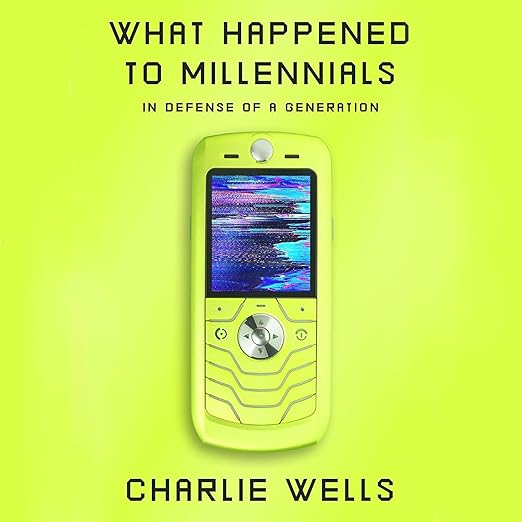
Quick Take
- Narration: Charlie Wells reads his own work with a reporter’s measured authority, which suits the book’s blend of personal testimony and structural analysis.
- Themes: Generational disruption, economic precarity, cultural identity under pressure
- Mood: Reflective and quietly urgent, with occasional flashes of genuine warmth
- Verdict: An empathetic, carefully reported cultural history that works best when it stays close to its five subjects rather than pulling back for generational thesis statements.
I finished this one on a Sunday evening after spending most of the day trying to write an essay about why certain people in my generation feel permanently behind. Not financially ruined, not visibly struggling, just subtly off-schedule in ways that are hard to articulate without sounding self-pitying. Wells starts the book in a similar place of quiet unease, and the alignment between his subject and my preoccupation made for a particularly absorbing listen.
The setup is transparent about its method: five millennials, hundreds of interview hours, the biggest events of the last twenty-five years filtered through private lives. That is journalism-as-portraiture, and when it works it is one of the most effective ways to make historical forces legible without reducing them to abstractions or statistics. Wells has the advantage of having spent enough time with his subjects that the conversations reach a depth that brief interview-based journalism rarely achieves.
Our Take on What Happened to Millennials
Charlie Wells has a Bloomberg News reporter’s instinct for structure, and it shows in how the book moves between the macro and the intimate. The five subjects are genuinely diverse in background, geography, and circumstance, and the honesty Wells secured from them about addiction, loss, and reinvention gives the book its emotional core. One reviewer called it a surprisingly breezy read that makes you look back and then think, and that is probably the most accurate capsule description available. Another described conversations about love, loss, work, and sacrifice that reveal how a generation once minimized can no longer be ignored.
Where the book is less sure-footed is in the thesis layer. One reviewer noted it failed to fully answer the central question, and I have some sympathy with that read. The book is better as a portrait than as an argument. When Wells pulls back from his five subjects to make claims about the generation as a whole, the writing becomes less specific and the reasoning occasionally circular. But when he stays inside a single life, observing how a recession or a pandemic or an addiction played out in one person’s kitchen, the precision is remarkable.
Why Listen to What Happened to Millennials
Wells narrates his own book, and this is the right call. His voice carries the controlled emotion of someone who spent years inside these conversations and emerged with something between conviction and grief. He does not perform the material, he inhabits it. At eight hours and twenty-three minutes it is a committed listen, but the pacing never drags because the individual stories provide enough narrative momentum to carry the structural argument even in its less certain passages.
The book also functions as a cultural defense at a historical moment when the generational critique has calcified into caricature. Wells takes the familiar dismissals, immature, selfish, weak, fragile, and actually follows the evidence back to the conditions that shaped the generation’s adulthood. What he finds is a cohort whose expectations were set extraordinarily high by the circumstances of their birth and then systematically dismantled, also by circumstance. Reviewer Doug Palmer noted that the book sparked conversations with his own millennial children, which suggests it functions as a bridge document between generations as much as a mirror for the one it chronicles.
What to Watch For in What Happened to Millennials
The Britney Spears opening that one reader flagged as a warning sign is, I would argue, intentional cultural positioning rather than evidence of shallow analysis. Wells is using the era’s shorthand to locate the reader in time before the harder material arrives. Whether that device earns the space it takes is a matter of taste. Some readers will find it effective context-setting; others will find it a soft entry into what should be a harder argument from the first page.
There is also the question of representativeness. Five subjects, however well-chosen, is still five people. Wells is careful about this, but the book occasionally slides from presenting individuals as examples of generational patterns into presenting them as evidence for those patterns, which is a subtle but meaningful distinction in how much weight the individual stories can bear.
Who Should Listen to What Happened to Millennials
Frequently Asked Questions
Does Charlie Wells narrating his own work help or hurt the listening experience?
It helps considerably. His measured reporter’s voice carries authority without performance, and the intimacy of the subject material benefits from the author’s direct presence rather than a third-party narrator.
Is this book only relevant to millennials, or does it speak to other generations too?
Wells frames the generation’s story through events that shaped American life broadly, so readers from adjacent generations will find it valuable as a cultural history, not just as a generational memoir.
How does the book handle difficult subjects like addiction and suicide among its five subjects?
Wells describes treating these as on-the-record conversations conducted with care. The book does not exploit its subjects’ hardships but situates them within the larger patterns of generational disruption.
Does the book ultimately answer why millennials turned out the way they did, or does it leave the question open?
Somewhat open. The book is stronger as a portrait of five lives than as a definitive generational argument. Readers expecting a tight causal thesis may feel the central question remains more illustrated than answered.