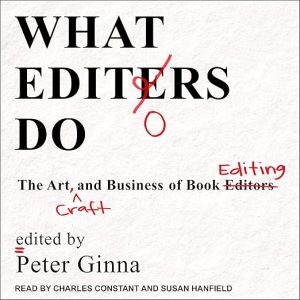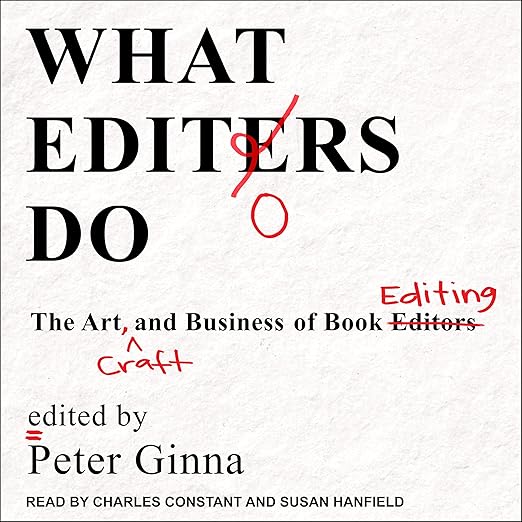
Editing is the kind of work that, when done well, leaves no trace of itself in the final product. That invisibility is professionally celebrated in publishing and deeply confusing to everyone outside it, including many writers who work with editors for years without fully understanding what their editors do between manuscript receipt and bound book. What Editors Do, assembled by Peter Ginna and narrated by Charles Constant in this twelve-hour audiobook, addresses that confusion with unusual directness: Ginna recruited twenty-seven senior figures from across the publishing industry - large houses, small independents, trade, academic, textbook, children's - and asked each of them to write honestly about their work.
Twenty-Seven Editors Compressed Into Twenty-Five-Minute Essays
The collection format is both What Editors Do's defining strength and the thing that limits its usefulness as an audiobook experience. Twenty-seven contributors across twelve hours means each essay occupies roughly twenty-five minutes of listening time, which is enough to establish an argument but not enough to develop it exhaustively. What the format does provide is an extraordinary breadth of perspective that no single-author book on editing could match. A children's book editor, a textbook acquisition editor, a literary fiction editor at an independent press, and a commercial nonfiction editor at a major house have genuinely different jobs, and Ginna's collection makes that visible in a way that is consistently surprising even for readers who thought they understood the profession.
The book belongs to the Chicago Guides to Writing, Editing, and Publishing series, which signals its professional orientation. This is not a light read for aspiring novelists curious about the business; it is a substantive resource for people who are either entering the profession or want a serious understanding of how it works. One reviewer used it for a graduate publishing seminar and reports that students gained both perspective and practical knowledge - that dual outcome reflects the book's genuine ambition to be useful rather than merely interesting. The series context also means Ginna's editorial choices are rigorous: these are practitioners with things to say, not brand names lending credibility to a celebrity anthology.
Constant Anchors Twenty-Seven Voices in One Register
Constant's narration maintains a consistent, professional register throughout. Navigating twenty-seven different authorial voices - each contributor writes in their own style - without losing coherence is a genuine challenge for a reader, and Constant handles it by anchoring himself in a neutral, authoritative baseline that lets the substance of each essay carry the chapter rather than competing with it. There is perhaps less vocal variation than an individual memoir would allow, but that restraint is arguably the right call for a professional anthology of this kind.
At twelve hours and eight minutes, the collection is a significant but manageable commitment. One reviewer notes that some contributors, particularly toward the end, could have said their piece more concisely, and that is a reasonable observation - the essays are uneven in execution even when consistent in quality of insight. The book's opening essays on acquisition and manuscript development are among the strongest: they answer the question that one reviewer explicitly names as the thing they most wanted to know, which is what causes an editor to acquire a specific book and reject an apparently similar one. The acquiring mind is the subject of some of the best professional writing in the collection, and several contributors are unusually candid about the role of instinct alongside the role of market calculation.
The Author-Editor Essays Are the Most Candid
The essays on the author-editor relationship are particularly valuable and often more candid than expected. Several contributors address the emotional reality of editorial work: the advocacy a good editor maintains for their author through a publishing house's internal politics, the moments when creative disagreement must be navigated without damaging the working relationship, and the particular difficulty of maintaining professional distance when you have spent months or years with a manuscript and its author. That emotional dimension of editing is rarely discussed in the professional literature, and its presence in this collection makes the book feel more honest than a purely procedural guide would be.
The chapters on the rapidly changing publishing landscape - digital distribution, self-publishing, the shifting economics of advances - are informative but reflect a specific moment in the industry's transformation rather than its current state. Listeners should treat those sections as context for understanding how the industry was thinking about itself at a pivotal period rather than as an accurate description of where things stand now. The core craft chapters on manuscript development, line editing, and the editor's role in production remain entirely relevant regardless of publishing format and are the sections most likely to reward re-listening.
A Professional Orientation for Publishing Careers
People entering or considering a career in book publishing will find this audiobook the most comprehensive professional orientation available in a single sitting. Writers who want to understand their own editors better - and by extension, how to work with them more effectively - will also find it genuinely useful, particularly the sections on acquisition criteria and the author-editor dynamic. The book is not aimed at casual readers curious about publishing as a cultural phenomenon; it is professional literature, and it delivers on that commitment at every level. Those who want a more narrative, entertaining account of publishing industry life may prefer a memoir by an individual editor. But for readers willing to invest twelve hours in understanding a complex, multi-faceted profession from the inside, What Editors Do is a resource with few equivalents in audio form.
At a Glance
- Narrator: Charles Constant brings a composed, knowledgeable register to Peter Ginna's multi-contributor collection; his voice sustains a professional tone that respects the insider expertise of the twenty-seven contributors without becoming self-important.
- Subjects: the invisible craft of editing, author-editor relationships, publishing industry economics
- Tone: Authoritative and illuminating
- Bottom line: Aspiring editors, publishing students, and writers who have ever wondered what their editor actually does all day will find this audiobook the most complete professional answer available.
Frequently Asked Questions
Does this audiobook require prior publishing industry knowledge to be valuable?
No. The contributors write for readers who are curious about editing rather than already practiced in it. The book is designed as an entry point as much as a professional resource, and the Chicago Guides series is known for accessible expertise. Complete outsiders and publishing students will both find it readable from the first chapter.
Is this audiobook focused on fiction editing, or does it cover other publishing categories?
The collection is deliberately broad, covering trade fiction and nonfiction, textbooks, academic publishing, and children's books. That range is one of its defining qualities. Listeners with a specific interest in one category will find dedicated essays on their area, but the book's overall value comes from its cross-category perspective.
Does the audiobook address what editors actually look for when acquiring a manuscript?
Yes, and this is among the collection's strongest sections. Several contributors write specifically about the acquisition decision - what distinguishes a book they pursue from one they decline, what questions they ask, and how they build the internal case for buying a project. It is the most consistently requested topic in listener reviews.
How current is the information in this audiobook given that publishing has changed so rapidly?
The craft-of-editing chapters are essentially timeless - the skills of manuscript development, line editing, and author relationship management have not been displaced by digital change. The business and distribution chapters reflect the industry at a specific moment and should be read as historical context rather than current practice.