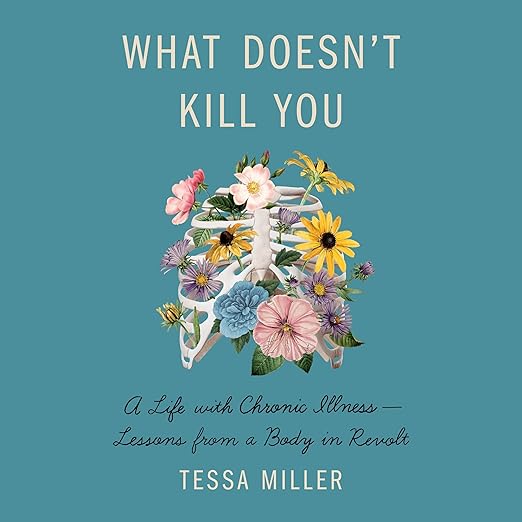
Tessa Miller's What Doesn't Kill You audiobook begins where so many illness narratives do not: not with the diagnosis, but with the years of misdirection that preceded it. Miller was an ambitious journalist in New York City when her body started seizing up on a random fall day, and her account of trying to function through escalating pain while receiving wrong or incomplete answers from a medical system she had not yet learned to navigate is among the most honest documentation of that specific experience I have encountered in this format. She self-narrates, which is the right decision for this material. These are her years. The searing pain, the procedures, the misdiagnoses, the life-threatening infections belong to her in a way that makes any other voice feel like a translation.
The Crohn's disease diagnosis, when it finally arrived, was not the resolution the structure of illness narratives usually promises. It was instead the beginning of a different and in some ways harder reckoning: that she would not get better, that chronic illness is definitionally not something you recover from, and that the cultural frameworks most Americans bring to illness, that hard work and the right attitude lead to recovery, do not apply to her situation or to the situation of the approximately 3 in 5 American adults who carry some form of chronic diagnosis. That refusal of the conventional recovery arc is what makes this book necessary rather than merely compelling.
Real and Raw Without Being Despairing
The book's most significant contribution is its refusal to separate the personal from the structural. Miller is a journalist by training and by habit, and she uses that toolkit throughout the narrative. Her own experience of IBD becomes a lens through which she examines how the American medical system handles chronic conditions at a systemic level: the shame and isolation that the culture imposes on people living with ongoing illness, the ways that healthcare infrastructure is designed around acute episodes rather than managed chronic conditions, and the gap between clinical management and what patients actually need to live with dignity and function with something like consistency. That combination of memoir and reporting is harder to execute than either form alone, and Miller does it without letting either element overwhelm the other.
Reviewers have noted the book's function as solidarity for those in similar situations. One reader recently diagnosed with ulcerative colitis described it as walking through all aspects of being a person with IBD in a way that was real and raw without being despairing. Another noted that finding compelling voices on chronic illness was genuinely difficult, that most writing on the subject was either too clinical or too self-help optimistic, and that Miller writes in neither of those modes. That observation captures the book's tonal achievement precisely.
Narrated Without Dramatization, Earning Real Sympathy
The audiobook includes a PDF of resources from the appendix of the print edition, which is worth noting for listeners who want to follow up on specific organizations, reading, or communities Miller references. The appendix provides practical infrastructure for people who are in or adjacent to the situations she describes and want concrete next steps alongside the narrative and reporting.
Miller's narration has the specific quality of someone who has rehearsed these sentences many times in their own head before committing them to the page. She handles the difficult material with the controlled clarity of someone who has done the substantial work of processing it over years rather than weeks. That restraint is more affecting than expressiveness would be. The hospital scenes, the procedures, the periods of acute crisis, are narrated without dramatization, which means you do not feel manipulated, which in turn means the sympathy the book earns is genuine rather than extracted from you against your better judgment.
One Person's Story Becomes an Argument
At 9 hours and 12 minutes, this is a full-length listen that earns its runtime through the sustained layering of memoir and journalism. The reporting sections, which pull the camera back from Miller's specific experience to examine how the healthcare system and broader culture handle chronic illness as a category, are among the most intellectually substantial portions. Some listeners primarily interested in memoir may find these sections extend the runtime beyond what the personal narrative alone would require, but they are what makes the book more than a personal account. They are what transform it from one person's story into an argument about how a society fails its chronically ill members.
The book is also honest about the ongoing nature of chronic illness in a way that does not provide conventional closure. Crohn's disease is not something Miller beats or manages into something resembling a healthy life. The audiobook does not resolve into wellness. What it offers instead is a framework for living with uncertainty and limitation that is more honest and ultimately more useful than the resilience narratives that crowd this genre. That honesty is both the book's most valuable quality and the quality that some listeners seeking comfort or inspiration may find difficult to sit with.
For People Who Need to Feel Less Alone
People living with any chronic illness, whether IBD, Crohn's, endometriosis, IBS, depression, diabetes, or any of the dozens of conditions Miller explicitly names, will find this audiobook speaks to experiences that most health media does not accurately represent. Family members, partners, and friends of people with chronic conditions will find it an unusually clear window into what that experience actually involves over years rather than across an acute episode. Healthcare workers who want to understand their patients' lives outside clinical encounters will find the reporting sections particularly valuable. This audiobook is not for people seeking a recovery narrative or a road map to symptom management. It is for people who need to feel less alone in something that does not go away, and for those who love them.