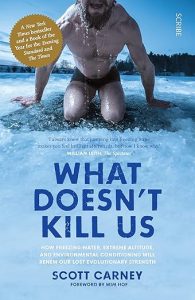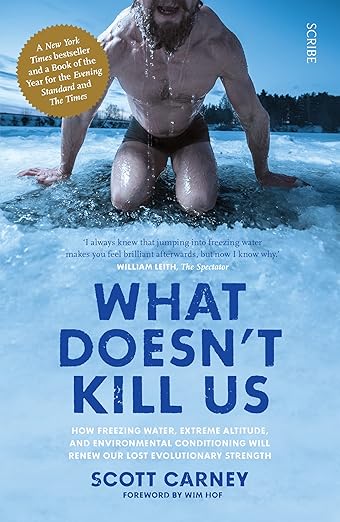
- Narration: Carney narrates his own book, and the self-deprecating candor he brings to his early skepticism about Wim Hof makes the eventual conversion more persuasive than a professional narrator could manage.
- Themes: Cold exposure and evolutionary biology, the limits of comfort culture, bodily autonomy and physical challenge
- Mood: Restless and invigorating
- Verdict: An intelligent, embodied argument that the modern body has been insulated from stresses it was built for, reported by a journalist who went and found out what happens when you reintroduce them.
I came to What Doesn't Kill Us in the middle of a particularly sedentary winter. I had been spending too many hours at the desk, too few outside, and I had that specific kind of physical restlessness that comes from a body that has not been asked to do anything genuinely difficult in some time. I was also skeptical of Wim Hof in the way that a lot of people who write about the body for a living tend to be skeptical of charismatic wellness figures: the initial assumption that the intensity of the following says more about the followers than the practice.
Scott Carney went in with precisely the same skepticism. He was an investigative journalist who had spent years exposing wellness frauds, and when he signed up for Hof's weeklong course in Poland, he was planning to write a debunking. What happens over the course of the book is not quite a conversion narrative, which would be too simple, but it is an honest account of a skeptic whose model of what the human body can do had to be revised. Carney does not become a true believer in the most credulous sense. He does, however, come to take seriously the possibility that modern comfort culture has insulated human bodies from environmental stresses they were built to handle, and that reintroducing those stresses in controlled ways has measurable physiological effects.
The early chapters, set at Hof's training facility in a dilapidated Polish farmhouse, are the most immediately vivid. Carney describes the process of cold exposure and the specific breathing technique Hof teaches with the clarity of someone who is simultaneously trying to understand it as a journalist and survive it as a participant. The hyperventilation exercises are unusual material in audio, because Carney's narration captures both the intellectual analysis of what is happening physiologically and the physical sensation of going through it.
The account of the group sitting in snow in their underwear, far longer than seems reasonable, is written with a combination of disbelief and grudging respect that makes it genuinely funny before it becomes genuinely interesting. Carney's delivery of this material as his own narrator is one of the book's real assets: the skepticism and the growing involuntary respect arrive in his voice at exactly the right intervals.
Why Listen to What Doesn't Kill Us
The book's climactic chapter covers Carney's participation in Hof's record-challenging ascent of Kilimanjaro in minimal clothing, twenty-eight hours from base to summit with nothing but shorts and running shoes. This is where What Doesn't Kill Us most directly confronts its central argument: whether the physiological adaptations Hof's method produces are real, replicable, and meaningful, or whether they are the result of selection effects and exceptional individual physiology.
Carney interviews the scientists running studies on Hof's practitioners and handles the preliminary nature of the research honestly. The evidence base at the time of writing was intriguing but incomplete. He does not oversell it. The book's strongest contribution is probably not the physiology but the cultural framing: the observation that Tough Mudder and its kin represent a hunger for managed discomfort among populations that have been too thoroughly insulated from it. That argument stands independently of whether Hof's method is clinically validated.
What to Watch For in What Doesn't Kill Us
The author narrating his own work is always a gamble, and in this case it pays off substantially. Carney's self-deprecating humor about his own early resistance, his own physical limitations, and his own moments of wanting to quit translates directly to the audio delivery. He sounds like a man telling a true story rather than performing a text, and for a book built around the theme of direct physical experience, that quality matters considerably.
International readers have found the book compelling enough to generate enthusiastic reviews in Germany, France, Spain, and the UK, an unusual degree of geographic range for this genre. The one practical note for European listeners: Carney uses imperial measurements throughout, feet and Fahrenheit rather than metric equivalents, which is occasionally disorienting if you are calculating what minus twenty Celsius actually means for someone standing in the snow in underwear.
Who Should Listen to What Doesn't Kill Us
A note on the runtime: at ten hours and twenty-two minutes, What Doesn't Kill Us is longer than its premise might suggest it needs to be. Carney earns the length by moving through multiple training environments and multiple scientific conversations rather than staying tethered to a single setting or a single argument. The Tough Guy obstacle course chapter, which covers the UK's original and reportedly most brutal endurance event, is particularly good: it gives the argument a competitive-event context that the more controlled Hof training lacks, and it brings in other participants whose responses to the same experience give Carney something to push against. The variety of settings keeps the book from settling into any single register for too long.
The book is most directly useful to people who have noticed the same restlessness Carney describes at the outset: a sense that comfort has become a trap rather than a reward, that the body is being under-used in ways that register as a kind of low-grade malaise. It will also interest anyone tracking the broader conversation about deliberate physical stress, cold therapy, and breath work that has accelerated considerably since this book was written. Carney's reporting predates the mainstream wellness adoption of these practices, and reading it in that context gives the phenomenon useful historical grounding.
Does What Doesn't Kill Us require prior familiarity with the Wim Hof Method to follow?
No. Carney introduces Hof and the method from scratch, treating his own initial ignorance as an asset. The book builds the context as it goes, and no prior knowledge of cold exposure or breathwork is needed.
How does Carney's narration compare to a professional narrator for this kind of material?
The self-narration is one of the book's strengths. Carney's delivery of his own skepticism, humor, and eventual conversion carries an authenticity that would be difficult to replicate. The audio quality is clean, and the performance is relaxed rather than performed.
Is What Doesn't Kill Us relevant to someone who has no interest in extreme cold exposure or obstacle races?
Yes, if the broader argument about comfort culture and evolutionary biology interests you. The Hof material is the vehicle, but the book's real subject is the physiological and psychological consequences of modern insulation from physical stress. That argument stands independently of whether you ever plan to sit in an ice bath.