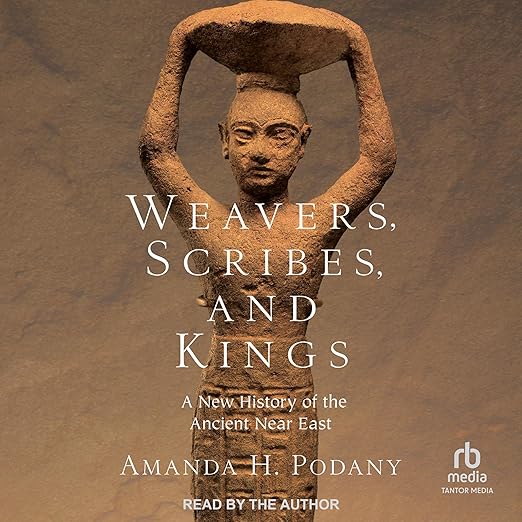
Quick Take
- Narration: Amanda Podany reads her own work with the measured warmth of a scholar who genuinely loves this material and trusts listeners to keep up, the self-narration is non-optional for a book this personal in its framing.
- Themes: The lives of ordinary people beneath the historical record, the clay tablet as primary document, continuity between ancient and modern institutions
- Mood: Expansive and intimate in equal measure, surprisingly moving
- Verdict: One of the most substantive and rewarding ancient history audiobooks in years, built from real primary sources and narrated with quiet authority.
I started Weavers, Scribes, and Kings on a Tuesday morning flight and finished it four days later on the train home from a conference. Eighteen hours of ancient Near Eastern history sounds like a commitment that requires some discipline to honor, and I went in expecting to treat it the way I treat dense nonfiction, worth the effort, but work. What I did not expect was to find myself genuinely moved by the story of a woman named Iltani who wrote letters about grain allocations and family tensions in the city of Sippar sometime around 1750 BCE. Podany quotes from her actual letters. They were preserved on clay tablets. The woman has been dead for nearly four thousand years and I was listening to her voice on a train in 2026.
That is what this book does, and it does it consistently over more than eighteen hours without ever exhausting the effect.
What the Clay Tablets Actually Contain
The most important thing to understand about this book before you begin is that it is not primarily a history of kings and battles. It is a history reconstructed from documents that ordinary people wrote and received: administrative records, private letters, contracts, legal proceedings, religious texts. Podany has spent her career with cuneiform tablets and she knows how to read them, which means she knows when a document reveals something surprising and when it confirms something expected. She makes that distinction clear to the listener without being pedantic about it.
The reviewer who noted that the book also serves as a comprehensive political and cultural history is correct, and this is the thing the synopsis slightly undersells. This is not a collection of charming vignettes loosely strung together. It is a rigorous history of roughly three thousand years of Near Eastern civilization, from the first cities through the conquests of Alexander, that uses individual stories as entry points into larger arguments. By the time you have heard the weaver advance to workshop supervisor, the merchant’s letters about a caravan that went wrong, and the king’s frustrated attempt to motivate his generals, you understand Mesopotamian society in a way that no summary of empires and dates could provide.
The Self-Narration and Why It Works
Podany reads her own book, and this matters enormously. Her voice is not the carefully modulated instrument of a professional audiobook narrator. It has the particular quality of someone who cares deeply about being understood, which creates a slight but perceptible tension in the delivery, she wants to get it right. When she quotes from a cuneiform letter, she pauses in a way that signals: pay attention to this, this is the actual evidence. That pause would be very difficult to instruct a voice actor to reproduce authentically.
Over eighteen hours, the self-narration also creates a cumulative intimacy. By the time Podany is describing the famine that struck the eastern Mediterranean around 1200 BCE and the desperate letters that survive from that period, you are not listening to a professional perform a script. You are listening to someone who has spent decades thinking about these people tell you about them directly. The difference is audible.
Scope and Density: What to Expect
Several reviewers have flagged that the book is heavier than the cover description implies, and this is worth taking seriously as a listener. The synopsis presents it as a series of individual biographies, which is accurate but incomplete. The political and institutional context is always present, and Podany does not shy away from complexity. The Bronze Age collapse, the shifting relationships between Sumer, Akkad, Babylon, and Assyria, the Hittite empire’s rise and fall, these are all covered, and covered carefully.
For listeners who come to this book as genuine novices to the ancient Near East, the density is manageable because Podany is a skilled explainer. But it helps to listen in longer sessions rather than in ten-minute fragments, because the arguments build across chapters and the individual stories make more sense in their broader context. This is a book that rewards concentrated attention rather than casual commute listening.
Who Will Get the Most from This
Listeners who loved David Christian’s work on deep history, or who found themselves wanting more texture after reading general surveys of ancient civilization, will find exactly what they are looking for here. The book is also an unusually good choice for people who study or teach history, because it models how to use primary sources to construct a human-scale narrative from institutional records, the methodology is always visible beneath the storytelling.
Those looking for a fast-paced narrative of conquests and battles may find the pace slow, though Podany handles military and political events with real clarity when they arise. The book is capacious enough that almost any interest in the ancient world will find something to hold onto, but its truest subject is the texture of daily life across three millennia, and listeners who come for that will not be disappointed.
Frequently Asked Questions
Do you need prior knowledge of ancient Near Eastern history to follow this audiobook?
Podany writes clearly enough that complete novices can follow along, but the book is dense with names, places, and time periods spanning three thousand years. Having some basic familiarity with Mesopotamia helps, though she provides enough context that attentive listeners can build their understanding as they go.
How does Weavers, Scribes, and Kings compare to other ancient history audiobooks like SPQR?
The scope is much broader, nearly three millennia versus Rome’s specific arc, and the primary source methodology is more central to the narrative. Where Beard is a polemicist who challenges received interpretations, Podany is a builder who constructs understanding from the ground up. Both are excellent; they do different things.
Is the 18-hour runtime justified, or does the book feel padded?
Multiple reviewers describe it as genuinely substantial rather than padded, the scope is simply that large. One noted it may be the best history book they had ever read, and the length reflects the ambition of covering three thousand years through individual lives rather than political summaries. The material earns the runtime.
Does Podany’s self-narration hold up over nearly 19 hours?
Yes. Her voice is measured and clear, and the slight personal quality of her delivery becomes an asset over a long listen rather than a limitation. Professional narrators sometimes flatten academic nonfiction; Podany’s investment in the material keeps the energy present even in the denser passages.