Quick Take
- Narration: Virtual Voice AI narration is the most significant limitation here, Bell’s raw, personality-saturated prose demands a human voice, and the mechanical delivery strips away much of the author’s texture.
- Themes: freedom and self-determination, family resilience on the road, African overland travel and its contradictions
- Mood: Unfiltered and occasionally abrasive, with genuine beauty underneath
- Verdict: A remarkable travel memoir that loses significant dimensions in AI narration, the print or ebook version may serve Bell’s voice better for most listeners.
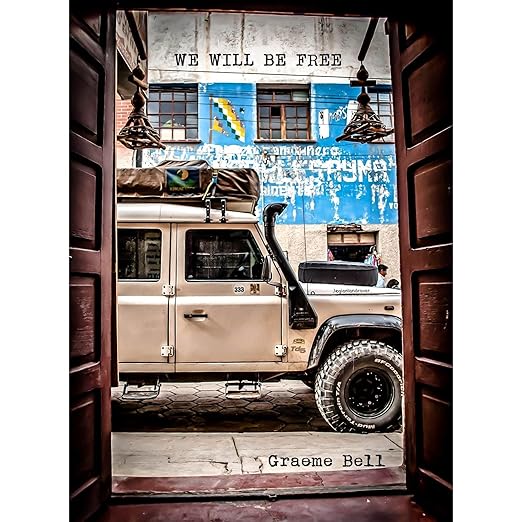
There is a particular kind of travel writing that has largely disappeared from mainstream publishing, replaced by the more palatable and polished overland memoir. Graeme Bell’s We Will Be Free belongs to the older, rougher tradition, books like Ted Simon’s Jupiter’s Travels or Che Guevara’s Motorcycle Diaries, where the journey’s physical and philosophical rawness is inseparable from the writing itself. Bell is a white South African writer, and his book makes no effort to smooth over the contradictions of that identity as he drives a Land Rover across Africa and circumnavigates South America with his family. It is an honest book, and honesty is not always comfortable.
The memoir chronicles the Bell family’s decision to extract themselves from conventional life and commit to years of overland travel, no safety net, no money inherited from wealthy parents, no carefully curated social media version of the experience. Bell writes about mechanical failures, border bureaucracies, the daily friction of family life in a vehicle, the other overlanders they encounter, and the countries and communities they move through with varying degrees of grace. One reviewer described him as divulging his raw, poetic and amusing consciousness. That is accurate, and it is also what makes the narration choice so consequential.
The AI Narrator Problem and What It Costs This Book
We Will Be Free is produced with a Virtual Voice AI narrator, and I want to address this directly because it shapes the listening experience fundamentally. Bell writes in a voice that is idiosyncratic, rhythmically specific, frequently irreverent, and occasionally profane. The humor is embedded in cadence. The honesty is embedded in the way sentences accumulate and turn against expectations. An AI narrator cannot perform any of this. It renders the text mechanically, which means the jokes land flat, the poetic passages lose their rhythm, and the moments of genuine raw emotion, including the reportedly extraordinary Chapter 11 that one reviewer called possibly the best chapter they had read in a long, long time, arrive without the inflection that would make them resonate.
I listened to a substantial portion and then spent time with print excerpts available online. The gap is significant. For a book this personality-driven, the physical or ebook version is a materially different and arguably superior experience. Listeners who are specifically seeking the audiobook format should be aware of this tradeoff before committing to the nearly eleven hours of runtime.
The Journey Itself: Africa, South America, and the Overlanding World
What saves the audiobook despite its narration is the quality of the underlying material. Bell’s account of overland Africa, the roads, the border crossings, the landscapes, the encounters with other travelers and local communities, has the texture of genuine experience rather than curated highlight reel. He is not always likable. Reviewers note his broad stereotypes in the early sections, his consistent commentary on the physical appearances of women he encounters, his contempt for certain categories of traveler, and his derogatory references to Japanese vehicles.
One reviewer was put off enough to set the book aside before returning because they could not stay away. Bell’s roughness is not separable from his authenticity, and the people who love this book tend to love precisely the quality that others find grating. That is not a flaw in the writing. It is a feature of the voice, and a reason why the AI narration matters so much. Without the personality of a human reader, the rough edges are exposed without the accompanying warmth and humor that make them bearable and eventually endearing.
What the Overlanding Community Recognizes Here
The overlanding community specifically has embraced Bell’s work because it reflects the actual experience of extended vehicle-based travel through remote regions without the polish that most published accounts apply. Long-distance overland travel involves mechanical breakdowns in inconvenient locations, border officials with unclear motivations, family tensions magnified by close quarters, and the specific social world of other overlanders with their own tribal norms and hierarchies. Bell documents all of this without sentimentalizing it, which is why readers who know that world recognize it immediately in his pages.
Who Should Listen and How
Bell’s prose also deserves credit for something that the AI narration obscures: a genuine capacity for beauty when he encounters moments that earn it. The reviewer who called Chapter 11 possibly the best chapter they had read in a long, long time was describing something the audiobook cannot fully deliver. Bell’s descriptions of specific landscapes, the African terrain, the South American coast, the particular quality of light in places most of his readers will never see, are where his background as a self-described poetic consciousness becomes an asset rather than a source of friction. Those moments exist in the audiobook in the same words, but they need a human voice to land with the weight they carry on the page. That is the fundamental argument for choosing a different format, and it is a legitimate one even for an audience that typically prefers audio.
If you are interested in overland travel through Africa and South America, this is essential reading in the sense that it shows you the unglamorous, technically demanding, relationally stressful reality of extended family overland travel without the polish that most published accounts apply. For listeners drawn to this book specifically in audio form, I would strongly recommend sampling the AI narration before committing to nearly eleven hours. The flat rendering of Bell’s most animated passages may be more frustrating than the content is rewarding. Those who read physically and are curious about the audio edition should weigh what they are trading: the convenience of audio against the loss of the voice that makes the book what it is.
Frequently Asked Questions
Is the Virtual Voice AI narration in We Will Be Free noticeably different from human narration, and does it significantly affect the listening experience?
Yes, noticeably and significantly. Graeme Bell’s prose is heavily personality-driven, idiosyncratic rhythm, irreverent humor, raw emotional moments, and AI narration renders it mechanically. For this specific book, the personality gap is wider than for more neutral nonfiction prose styles. The print version preserves the voice much more fully.
Is We Will Be Free appropriate for listeners who have never overlanded and may not be familiar with the specific culture and terminology involved?
Bell explains the overlanding world as he goes, and the emotional and philosophical core of the book, the decision to leave conventional life, the daily challenges of family travel, the encounters across two continents, is accessible to anyone. The mechanical and logistical detail resonates more deeply with overlanders, but prior experience is not required.
How does Bell handle the politics and complexity of a white South African family driving across Africa?
He does not shy away from it, but he also does not consistently interrogate it with the analytical depth some readers will want. His background as a non-wealthy white South African is something he discusses openly. Readers looking for a postcolonial analysis will find the book insufficient; readers looking for honest self-presentation will find it authentic and refreshing.
Is this the first book in a series, and do subsequent Bell family books follow on from this journey?
Yes, this is part of a larger overlanding memoir project. The Bell family’s travels continue in subsequent volumes covering different legs of their journey. We Will Be Free functions as an introduction to the family and their philosophy of travel, with subsequent books extending the same chronicle across different continents and challenges.