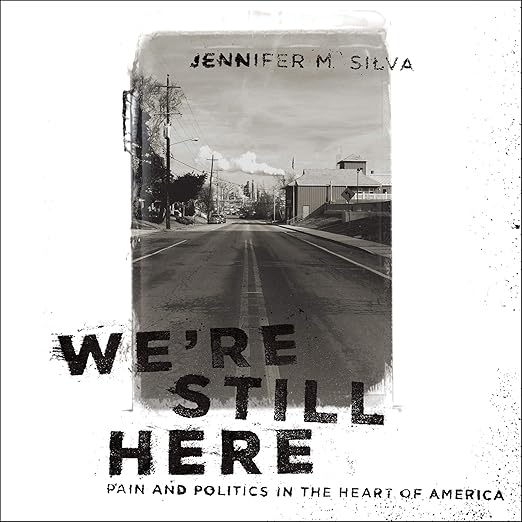
Quick Take
- Narration: Teri Schnaubelt delivers a grounded, unflinching performance that honors the raw testimonies without editorializing, her pacing gives the interview excerpts room to breathe.
- Themes: Working-class identity, political disengagement, deindustrialization
- Mood: Heavy and illuminating, quietly urgent
- Verdict: Readers who want to understand the lived texture of political alienation in America’s forgotten coal towns will find Silva’s fieldwork more persuasive than most op-ed pages.
I finished this one on a grey Tuesday afternoon, the kind of day when you want to understand why the country feels so fractured. Jennifer M. Silva’s We’re Still Here had been sitting in my queue for weeks, and I finally started it during a long train ride through a stretch of post-industrial landscape that felt almost too on the nose. By the time Teri Schnaubelt was reading the first interview subject’s account of a work injury that unraveled an entire family, I had stopped looking out the window. There is sociology and there is testimony, and this book does not let you choose between them.
Silva draws on more than 100 interviews with Black, white, and Latino working-class residents of a declining coal town in Pennsylvania’s southern anthracite region. The result is not a political polemic. It is something harder and more honest: an attempt to understand why generations of Democratic voters have turned away from the social safety net and from organized politics altogether, not out of ignorance, but out of a very specific kind of pain. The routines that once organized working-class life, manual labor, union halls, churches, marriage, have diminished, and Silva wants to know what replaced them, and at what cost.
Our Take on We’re Still Here
What separates this book from the wave of working-class explainers that flooded the market after 2016 is Silva’s refusal to flatten her subjects. She does not treat political disengagement as a pathology to be diagnosed from the outside. Instead, she argues that individualized coping strategies, navigating addiction, surviving family dissolution, managing trauma, have themselves become the primary arena of political meaning for people whose institutional anchors, from unions to churches to social clubs, have all but disappeared. It is a genuinely unsettling argument, and Silva earns it through the specificity of her evidence. She is not extrapolating from a handful of anecdotes; she has done the work.
One reviewer compared her approach favorably to Studs Terkel’s Hard Times, and the comparison is apt in spirit if not quite in method. Where Terkel mostly stepped back and let his subjects speak, Silva interweaves her own sociological analysis, which some listeners may find intrusive. But I thought the combination worked. The analysis gives the testimonies context without diminishing them. What emerges is a portrait of a community that has not given up on meaning, only on the institutions that once delivered it.
Why Listen to This Rather Than Read It
Schnaubelt’s narration is the reason to choose the audio format. She reads Silva’s prose with a steadiness that never tips into affect, and when she moves between academic framing and the voices of real people, the tonal shift is subtle but noticeable, a quiet signal that the register is changing. At eight and a half hours, the listening experience is substantial but never punishing. The book’s argument accumulates gradually, and the audio pacing respects that structure rather than working against it.
What to Watch For in the Political Analysis
Silva is not a neutral observer. Her framing, that progressive politics has failed to speak to working-class pain in ways that feel legible and meaningful, will resonate with some listeners and frustrate others. One reviewer found her policing analysis particularly contentious, noting that her treatment of race and criminalization stops short of where some readers would push it. That tension is real and worth sitting with. Silva is not trying to produce comfortable conclusions. She is trying to explain something complicated, and the places where her analysis strains are often the most interesting parts of the book. Bring your own counterarguments; they will make the listening richer.
Who Should Listen to We’re Still Here
This is essential listening for anyone working in policy, community organizing, or journalism who wants to understand political disengagement from the inside rather than from polling data. It will also resonate with listeners who grew up in deindustrialized regions and recognize the specific texture of the decline Silva describes. Skip it if you are looking for a partisan argument or a blueprint for political revival, Silva is doing ethnography, not advocacy, and the book is stronger for it.
Frequently Asked Questions
Do you need to know Pennsylvania or coal country specifically to connect with this book?
No. Silva’s argument is explicitly about patterns that extend across deindustrialized regions. Multiple reviewers noted that the stories rang true for communities far beyond the anthracite region she studied.
Is this a left-wing or right-wing book politically?
Neither, though it will be read differently depending on your starting position. Silva critiques progressive failures without offering conservative alternatives. Several reviewers across the spectrum found things to agree and disagree with.
How does Teri Schnaubelt handle the interview excerpts versus the academic prose?
She maintains a consistent, measured tone throughout, which works well for the material. The narration does not dramatize the testimonies, which is the right call for a book this serious.
Is this book still relevant given it was published in 2019?
Yes. Silva’s central argument, that working-class political identity is shaped by lived pain and institutional collapse rather than simple partisanship, has only become more relevant since publication. The Trump-era framing in the synopsis does not date the underlying analysis.