- Voice: Kevin Bridges reads his own memoir, so the Glaswegian phrasing and the placement of every pause come from the person who wrote them rather than from an approximation.
- Big ideas: Class and place in Glasgow, shyness turning into performance, the making of a stand-up, family and adolescence
- Atmosphere: Warm, wry and more reflective than raucous
- Worth it?: The right edition of a genuinely good comic memoir, provided you want a life story rather than a set.
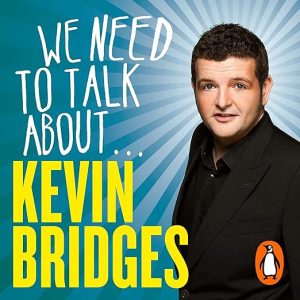
How much of a stand-up comedian survives the move from a stage to an audiobook? It is the only question that matters with a memoir like this one, and the answer here is complicated by the fact that Kevin Bridges reads it himself. Penguin's copy describes an unabridged edition of a book that runs to eleven hours and forty minutes, which is a great deal longer than any stand-up set.
The story it tells has a clean shape. A shy, nerve-ridden schoolboy grows into the class clown, and at seventeen walks onto a stage for the first time with a five-minute set and brings the house down. That night is when he works out he can earn a living from making people laugh. The publisher's own phrasing for the years before it is blunt and good: this was a guy going somewhere, with off the rails looking like the most probable destination.
Attention to Detail Brings Back Childhood
Underneath the comedy the book is doing something more particular than a career chronology. The description promises the trademark social commentary and sharp one-liners alongside reflections on a Glaswegian childhood, and the ordering tells you something. Class, place and the specific texture of growing up somewhere are the raw material; the jokes are how the material gets handled. One five-star reviewer writes that "His attention to detail really brings me back to my childhood", which is the sign of a memoirist getting the small things right rather than reaching for the anecdote that plays best in a room.
A four-star reviewer, and the most thorough voice on the page, found the book "Quite surprising and not what I expected but perhaps it shouldn't have been so surprising". That is a fan revising an assumption in public, and it points to the same thing: this is autobiography that happens to be written by a comedian, not a stage act transcribed. The same reviewer describes finishing an autobiography feeling as though the writer is now personally known, which is a decent description of what a long, self-read memoir can do that ninety minutes of live comedy cannot.
Bridges Narrating Himself Is the Whole Argument
Bridges narrating his own book is the whole argument for this edition. Where a hired reader would be approximating a Glaswegian voice and a comic's phrasing, the author simply has both. Every pause is where he wants it. The rhythm of a sentence that was written to be spoken arrives from the person who wrote it that way. For a memoir whose subject is partly how a particular accent and a particular city shaped a sensibility, the choice is not a nice extra; a version read by somebody else would be a materially different product.
Length works in the format's favor here too. Eleven hours and forty minutes is a lot of memoir, and the material that fills it is not punchlines but childhood, family, school and the slow business of becoming someone. Comic timing carries that better than it carries jokes, because the payoff is a rueful observation rather than a laugh line. A listener gets the version of a story a comedian tells over a long evening rather than the version worked up for a set.
Consider also what the format spares you. A stand-up memoir in print has to describe delivery, and delivery is the one thing print cannot do. When a routine or a heckle or a disastrous early gig turns up in this book, the recording lets it be performed rather than reported. That is the single clearest advantage this edition holds over reading it.
Titters Rather Than Belly Laughs Throughout
Two reviewers flatly disagree about how funny it is, and the disagreement is more useful than either verdict. One calls it hilarious and was sad when it ended. The other, who identifies as a huge fan, reports "A few titters here and there rather than belly laughs" and then defends the book on exactly that basis, noting it was never meant to be a stage show. Go in expecting the second and anything more is profit. Anyone buying eleven hours of comedy expecting eleven hours of laughs has misread the product.
Judge the review pool carefully, because two of the five entries tell you nothing about the book. One consists of a title saying the buyer cannot wait to read it and a body naming Bridges as a favorite comedian, which is enthusiasm logged before reading. Another praises a video and looks forward to rewatching it, which is not this product at all. That leaves three responses of substance, two of them a single line long, on a memoir that has been available since 2014.
Frozen in 2014, With the Rating Unstuck
Vintage matters here as well. Penguin published this in October 2014, so it covers a life up to that point and no further, and the most engaged reviewer on the page was already asking for a sequel a month later. Anyone arriving now, after more than a decade of a career that kept going, should expect the making-of rather than the retrospective. That is not a fault. Memoir written early is often the more interesting form, produced close enough to the events that the writer still remembers being frightened, and the trajectory described here was recent enough at the time to sting.
The ratings display is stranger still. A 4.4 average sits beside a rating count of one, and those two figures cannot describe the same sample: a solitary rating cannot average to 4.4. Something in the listing has come unstuck, and the sensible response is to ignore the score entirely and weigh the written reviews on their own. Regional specificity is the last thing to weigh. A childhood in Glasgow and social commentary rooted in it are the appeal, and for some listeners they will also be the barrier.
An Accent Never Sanded Down for Export
Existing fans are the obvious buyers, particularly of this edition, since the voice is the thing being purchased. It suits listeners who like memoirs about class and place, who want the making of a comedian rather than the finished act, and who enjoy hearing an accent that has not been sanded down for export. Anyone interested in how someone shy becomes a performer will find that transformation is the actual spine of the book.
Leave it if you want a joke book, because the most attentive reviewer here promises titters rather than belly laughs and says so approvingly. Give it a wide berth if unfamiliar British and Scottish reference points frustrate you, or if nearly twelve hours of childhood and adolescence sounds like more origin story than you need. And do not buy it on the strength of the star rating, which on this listing is not describing anything coherent.
Frequently Asked Questions
Is the audiobook actually funny, or is it a straight memoir?
Both, unevenly. One reviewer calls it hilarious. Another, a self-described huge fan, promises mild amusement rather than belly laughs and defends it on the grounds that a memoir was never supposed to be a stage set. Treat it as autobiography with a comedian's timing.
Does self-narration make a difference to this audiobook?
A large one. The memoir is partly about how Glasgow and a particular accent shaped a sensibility, and Bridges delivers both without approximation. Pauses land where he wants them, and early gigs and routines get performed rather than described, which is the one thing a printed version cannot do.