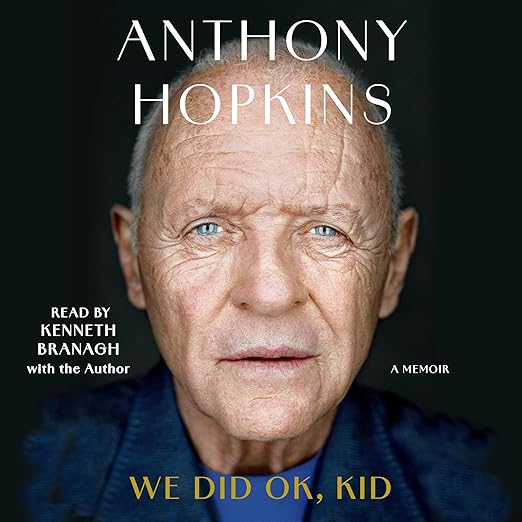
Kenneth Branagh narrating Anthony Hopkins talking about Laurence Olivier is a casting decision that would seem improbable if it were fictional. But We Did Ok, Kid, Hopkins's long-awaited memoir narrated by Branagh across 9 hours and 5 minutes, is a real document, and the pairing is not incidental. Both men trained in the British theatrical tradition, both have navigated the passage from stage to screen to cultural icon, and Branagh has the exact combination of authority and warmth that Hopkins's written voice demands but would have struggled to supply for itself in a studio. The audiobook opens with original music composed by Hopkins himself, and it closes with Hopkins performing selections of his and his father's favorite poems in his own voice. That structural choice tells you something about what the memoir values: it is not a book about accomplishments. It is a book about what survives.
Hopkins grew up in Port Talbot, a Welsh steelworks town, among men who expressed toughness through alcoholism and emotional foreclosure. He was deemed a failure by almost everyone around him and was largely indifferent to formal education. Then, at some Saturday night screening of the 1948 Hamlet, something activated in him that no one saw coming. We Did Ok, Kid traces the arc from that moment forward with the candor of a man who has had decades of sobriety and therapy to understand what he was running toward and what he was running from.
Branagh Understands the World From Inside
Branagh's narration is a genuine asset rather than a celebrity stunt. He does not imitate Hopkins; he delivers the memoir as a sympathetic reader who understands the theatrical world Hopkins describes from the inside. The scenes involving Laurence Olivier, who took Hopkins under his wing after his RADA performance as Iago, carry particular weight in audio, partly because Branagh occupies a comparable position in the British theatrical hierarchy and the mutual recognition reads in his delivery. When Hopkins describes the chance encounter with Richard Burton in an art teacher's apartment, or later the backstage meeting with Burton before a performance of Equus, Branagh's handling of those scenes adds the texture of lived understanding.
The memoir's emotional core is Hopkins's addiction and recovery. He is explicit about the cost: his first marriage, his relationship with his only child, and nearly his life. He has maintained sobriety for nearly half a century, and he writes about it with neither self-pity nor false heroism. Reviewer Lisa W captured the tone accurately: "his story of recovery, growth, and gratitude is honest and uplifting." The word "honest" appears in multiple reviews because the memoir does not construct a flattering narrative. It describes a man who was often absent, sometimes cruel, and consistently terrified of connection, and who found, late, a way to live differently.
Music Opens It, His Own Voice Closes It
The audiobook format adds layers that the printed version cannot include. The original music Hopkins composed as the opening is not a novelty; it sets a tone of interior reflection that carries through the memoir's treatment of loss, creative obsession, and the approaching mystery Hopkins's father called The Big Secret. The closing poetry section, with Hopkins reading in his own voice, creates a kind of conversation across the memoir's entire length that a reader encountering the text alone would not experience in the same way. The 9-hour runtime is the right length: substantial enough to follow the arc of a full life without overstaying its welcome.
Reviewer MinnieBannister noted wishing it were longer, which is a meaningful compliment for a memoir by someone whose career spans over sixty years. Hopkins moves quickly through some periods that a more conventional celebrity memoir would dwell in. The Silence of the Lambs chapters are present but not lingered over; the analysis of how Hannibal Lecter was informed by Bela Lugosi and his acting teacher is brief and fascinating. The memoir is selective in a way that reflects Hopkins's priorities rather than the priorities of his audience, and that selectivity is both a limitation and a mark of integrity. He is writing what he needs to say, not what an audience expects to hear.
More Complex Than the Reviewer Expected
Listeners expecting an insider's tour of Hollywood productions will find the memoir less interested in that territory than in the interior landscape of a man who has spent sixty years trying to understand himself. The film anecdotes are present and often illuminating, and the detail about drawing raw emotion from his father's stoicism for King Lear is particularly striking, but they are always in service of the larger autobiographical project rather than standing as entertainment in themselves.
Reviewer Sunshine noted that Hopkins "is much more complex than I thought," which speaks to how the memoir resists the simplifications that celebrity autobiography often allows. The relationship with his daughter is addressed honestly, and the accounting is not generous to younger Hopkins. That willingness to remain in discomfort rather than resolve it into a tidy arc gives the memoir its credibility and makes it a more demanding listen than the genre typically requires. Listeners who want a comfortable celebration of a great actor's life will find this memoir offers something less comfortable and more lasting.
A Distinctly Superior Audio Experience
This audiobook is essential for listeners interested in the British theatrical tradition of the twentieth century, or in addiction and recovery memoirs that refuse sentimentality. Fans of Hopkins's screen work who want to understand the formation behind performances like Hannibal Lecter, King Lear, and Nixon will find the memoir genuinely illuminating about craft and method. Listeners who prefer celebrity memoirs built around behind-the-scenes Hollywood anecdotes rather than interior reckoning may find the balance weighted differently than they expect. The Branagh narration and the Hopkins poetry bookend make this a distinctly superior audio experience to reading the print version.
Does Anthony Hopkins narrate the audiobook himself?
No. Kenneth Branagh narrates the memoir. However, Hopkins composed the opening music and reads a selection of poetry in his own voice at the close of the audiobook, which creates a meaningful personal frame around Branagh's narration of the main text.
How much of the audiobook covers Hopkins's role as Hannibal Lecter?
The Silence of the Lambs is addressed, including a specific account of how Bela Lugosi's performance in Dracula and his acting teacher's precision informed the character. The memoir does not dwell on the film at length; the anecdotes are illuminating but brief within the larger autobiographical arc.
Is We Did Ok, Kid focused primarily on Hopkins's career or his personal life?
Both, with the personal life, particularly addiction, recovery, and family estrangement, as the emotional core. Career milestones structure the chronology, but Hopkins consistently routes back to the interior questions: what he was afraid of, what sobriety restored, what he still does not fully understand about himself.
Is this audiobook better experienced than read in print?
Significantly better. The original music Hopkins composed opens the listening experience in a way that changes your orientation to what follows, and the closing poetry in his own Welsh voice is something the print version simply cannot replicate. Branagh's narration also adds a layer of theatrical intelligence that makes the memoir's more complex passages land with greater force.