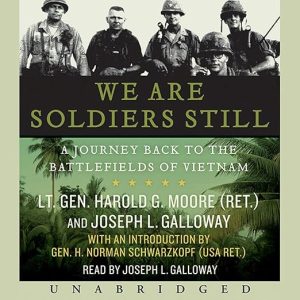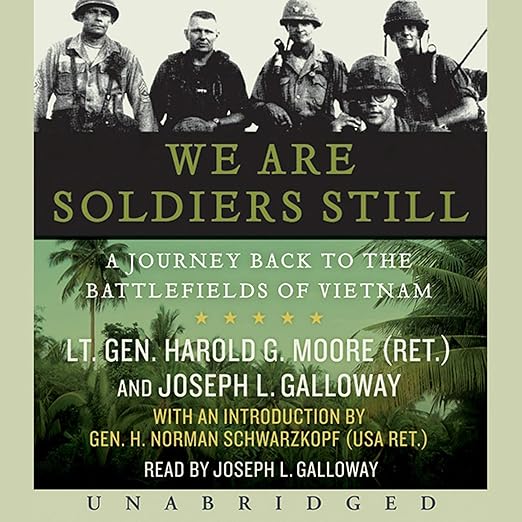
Some books should not be listened to in public. I made the mistake of having We Are Soldiers Still on during a long airport layover, using noise-canceling headphones to block out the terminal. I had to step into a corner near a charging station because I was not prepared for how it landed. That kind of effect is the mark of memoir that has not been softened by the distance from its subject matter, and this book, the sequel to the landmark We Were Soldiers Once, carries that unfiltered weight throughout its seven and a half hours.
The setup is straightforward enough in description. Lt. Gen. Harold G. Moore and journalist Joseph L. Galloway, who together wrote the essential account of the 1965 Battle of Ia Drang Valley, return more than four decades later. They visit the valley itself. They reconnect with ten American veterans. They meet their former enemies. They reflect on what those three days in November 1965 did to everyone who survived them and to the families of those who did not. The introduction by Gen. H. Norman Schwarzkopf signals the seriousness with which the military community received this work.
How We are Soldiers Still Holds Up
What makes the physical return to Vietnam's Ia Drang Valley the emotional center of this book is how specific it is about place. Moore and Galloway are not conducting a general retrospective on the Vietnam War. They are going back to particular ground where particular things happened, and the contrast between memory and present geography is as jarring for the reader as it evidently was for the authors. A reviewer who described crying as the fallout from the deaths of brave men was spelled out understood this: the book does not generalize from individual losses into statistics or lessons. It names names. It follows the trajectories of specific lives over four decades.
One reviewer, writing from Australia, notes that he was living in Darwin at the time of the original battle and could hear portions of it on HF radio. That kind of testimonial, from people whose connection to the Ia Drang battle extends beyond the book itself, speaks to the reach and longevity of the original memoir and to what this sequel inherits from it. We Are Soldiers Still is not comprehensible without We Were Soldiers Once, but it also cannot simply be consumed by people who read the first book for its military history value. This second volume is about what happens after, which is both harder and more essential.
The sections where Moore and Galloway renew contact with former adversaries, North Vietnamese commanders and veterans of the units that fought against the 1st Cavalry Division at Ia Drang, represent some of the most quietly remarkable content in the book. There is no triumphalism here from either side. The conversations that emerge carry the particular tone of people who have had decades to understand what they were actually doing to each other and why. Galloway's journalism background shapes how these encounters are rendered: he reports rather than editorializes, which gives readers the space to respond to the material without being directed toward a predetermined emotional conclusion.
A German reviewer described this as a multilayered work that requires care not to get lost in its timelines. That is accurate. The book weaves between the events of 1965, the subsequent lives of the veterans, the return visits to Vietnam, and broader reflections on American military history and policy. The navigation between these threads is handled competently but not invisibly, and listeners who need clear chronological structure may occasionally need to re-orient.
Weak Spots in We are Soldiers Still
Joseph L. Galloway narrating the book he co-wrote is the right choice for this material, and it would be difficult to argue otherwise. His voice carries the particular flatness of someone who has reported from combat and does not perform emotion about it. The passages describing the original battle, the aftermath, and the return trips are delivered with a restraint that is itself a form of respect for the subject matter. He reads the grief of widows and veterans without softening it and without amplifying it. That calibration is very difficult to achieve and suggests a narrator who understands exactly what kind of book this is.
At just under eight hours, this is not a long listen by military history standards. The brevity is appropriate to the subject. Moore and Galloway are not trying to write a comprehensive history. They are trying to document what was still unfinished after four decades, and they succeed in making that unfinished quality feel present rather than historical.
Who Should Listen to We are Soldiers Still
This audiobook is for people who have already read or heard We Were Soldiers Once, for anyone interested in how veterans process combat over the long arc of a life, and for listeners willing to sit with grief and reconciliation as primary subject matter rather than as footnotes to a military narrative. It is not a comfortable listen. That is the entire point.
Frequently Asked Questions
Why does Joseph L. Galloway narrate rather than a professional narrator?
Galloway was present at the original battle as a war correspondent and is a co-author of both books. His narration carries the authority of direct personal witness. No professional narrator could bring to this material what he does simply by having been there. The delivery is not theatrical, but it does not need to be.
Does the book deal with the political dimensions of the Vietnam War or focus purely on the human stories?
The emphasis is on the human stories: the veterans, their families, and their former enemies. The political failures of the war are present as context and are not ignored, but Moore and Galloway's primary concern is documenting what the war did to the people who fought it rather than relitigating the strategic decisions that shaped it.