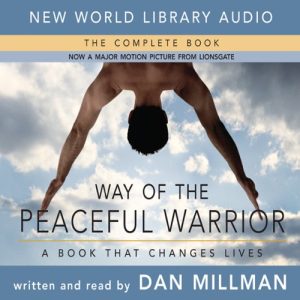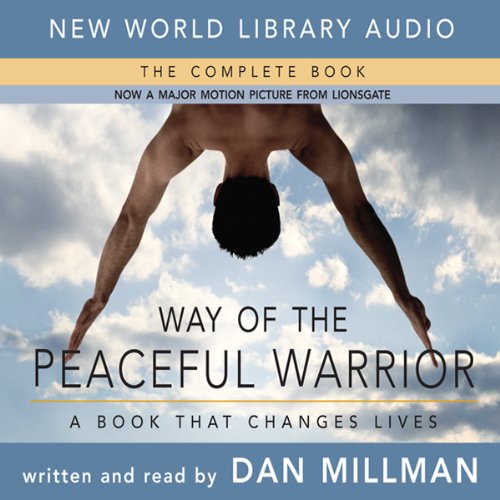
I came to Way of the Peaceful Warrior later than most people seem to. By the time I listened to it, the book had been in print for decades, had been made into a film, and had accumulated the kind of cult reputation that makes you suspicious of it before you begin. A book that has reportedly changed lives tends to arrive wrapped in a halo of expectation that makes honest evaluation difficult. What surprised me was how plainly it worked. Dan Millman reads his own story with the voice of someone who has been sitting with these ideas for a very long time, and that patience is audible throughout the six hours.
The official synopsis for this edition is sparse, but the book's premise is widely known: Millman, a young collegiate gymnast at UC Berkeley, encounters a gas station attendant he comes to call Socrates, a seemingly ordinary man who turns out to be a figure of unusual wisdom and spiritual intensity. Under Socrates's instruction, the young Millman begins a transformation that the book traces through a series of confrontations, exercises, and lessons that blend physical training with philosophical teaching.
Mentor figures are among the most dangerous characters in autobiographical fiction. They tend toward either idealization so complete the character loses humanity, or a kind of pseudo-mystical vagueness that obscures more than it illuminates. Socrates, the character Millman has created around his real-world encounter, avoids both traps more successfully than most. He is demanding, occasionally cruel in the way real teachers can be, and his wisdom arrives in specific, concrete moments rather than in generalized aphorisms. One reviewer noted that the book's teaching language is fast, catchy and easy-to-read while simultaneously being slow and penetrating enough to seep into the pores of consciousness. That tension is exactly what the book manages to sustain across its full runtime.
Millman's narration earns particular credit in the teaching sequences. There is a difference between hearing someone read dialogue they wrote decades ago and hearing someone deliver it with the full weight of having lived what the dialogue describes. The presence of the author's voice in the quiet, pivotal exchanges between student and teacher gives those moments a texture that a professional narrator, however skilled, would find difficult to replicate. The distance between performance and experience collapses in ways that matter.
Highlights
The reviews for Way of the Peaceful Warrior span decades and include responses from readers in radically different life circumstances. A 26-year-old military service member with a failing marriage, chronic pain, anxiety, depression, and insomnia described the book as applying directly to their specific situation. A discriminating reader of spiritual literature who had spent twenty-five years working through Castaneda, Yogananda, and James Redfield called it a book containing genuine knowledge, distinct from the New Age soft focus they had expected. A reader in India called it worth making compulsory reading for young adults to increase their consciousness.
The breadth of that response is not coincidence. Millman's framework is accessible without being shallow, and it meets readers where they are rather than requiring a specific philosophical vocabulary. The present-moment awareness practices, the body-as-teacher philosophy, the questioning of achievement as a proxy for fulfillment, these ideas have become more mainstream in the decades since the book was published, but Millman articulated them with a storytelling clarity that most subsequent presentations have not matched.
Weak Spots in Way of the Peaceful Warrior
The official synopsis for this audiobook edition is minimal, which may mislead new listeners about what the book actually is. Way of the Peaceful Warrior is autobiographical fiction: based on Millman's real experiences but written as a narrative with dialogue, dramatized scenes, and a novelistic structure. It is not a self-help manual with frameworks and bullet points. It is a story, and the lessons arrive through narrative rather than instruction. Listeners expecting a how-to guide will find the book simultaneously more and less practical than they anticipated: more, because the embodied storytelling makes the ideas genuinely internalize; less, because there are no explicit action steps.
The journey element of the narrative, the specific physical and psychological ordeals Millman describes under Socrates's guidance, is also darker and more demanding than the book's gentle reputation sometimes suggests. The teacher is not gentle. The path is not comfortable. Reviewers who describe it as deeply affecting are not responding to warmth alone but to the specific cost of the transformation the book describes. Millman does not pretend it was easy, and that honesty is part of what makes the book trustworthy.
Is This One for You?
People at transitional points in their lives, facing questions about purpose, achievement, or the relationship between physical practice and inner development, will find this book most directly applicable. Athletes and those who use physical training as a contemplative practice will recognize the specific texture of what Millman describes. Listeners who came up on the self-help genre and found it too prescriptive or too shallow will find the narrative approach here a usefully different vehicle for similar territory. Those seeking practical action plans rather than transformed perspective should look for different books in the personal development space. But for everyone else, the six-hour listening time is an invitation to encounter ideas that have genuinely changed the way a very large number of people think about time, achievement, and what a life in motion can mean.
Before You Press Play
- Read by: Dan Millman reading his own autobiographical novel brings an authenticity and earned authority to the teaching sequences that a hired narrator could not replicate.
- At its heart: Present-moment awareness, physical mastery as spiritual practice, the gap between achievement and fulfillment
- Vibe: Quiet and penetrating, with an unhurried pace that asks the listener to slow down
- Short version: A foundational text in the spiritual self-development genre that has changed readers' perspectives for decades and holds its power in audio form.
Is Way of the Peaceful Warrior fiction or a true story?
It is autobiographical fiction. Millman has described it as based on real experiences and a real mentor figure, but written with dramatized scenes and dialogue that make it a narrative rather than a strict memoir. He has described it as more true than factual.
Does Dan Millman narrating his own book add anything specific, or would a professional narrator be equally good?
The author's voice adds measurably to the teaching sequences in particular. Millman speaks from inside the experiences he describes, and that presence is audible. Reviewer responses consistently treat his narration as an asset rather than a neutral choice.
Is this book appropriate for readers with no background in Eastern philosophy or meditation practice?
Yes. Millman's framework is deliberately accessible and does not require prior knowledge of any specific tradition. Readers from various backgrounds, including reviewers with extensive spiritual reading and those with none, have found it equally engaging.