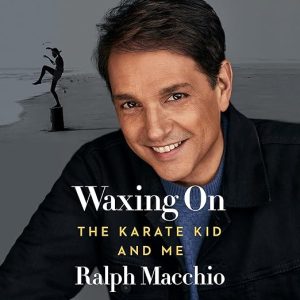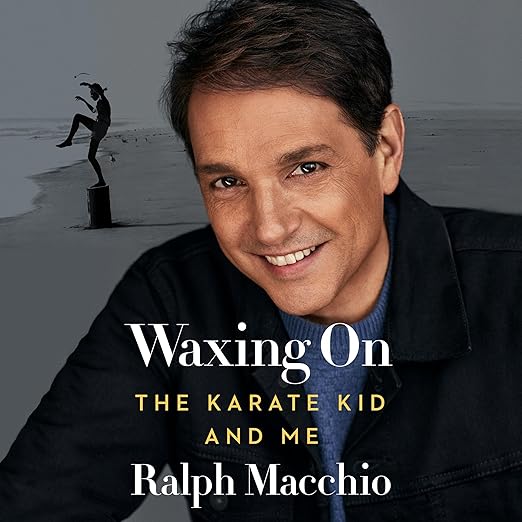
Actor memoirs about one famous role are usually thin and rarely necessary. Waxing On is the exception, and the audiobook has a structural advantage the hardcover cannot match, since the person who threw the crane kick is the one reading it to you. Ralph Macchio spends five hours and thirteen minutes on a single film released in June 1984, and on what four decades of friendly shouting across the street does to a man's relationship with his own younger face. The subject is not fame. It is being permanently seventeen in public.
The Verdict, Briefly
Coverage is narrower than a career retrospective and deeper for it. The copy promises the audition process, the working relationships with Pat Morita, Elisabeth Shue and William Zabka, the invention of the crane kick, and the scenes that opened up Mr. Miyagi's backstory. Cobra Kai is the occasion rather than the subject: reprising Daniel LaRusso decades later gave Macchio both a reason to look back and a vantage point most actors never get, which is seeing a role you finished as a young man become somebody else's childhood and then return as work.
Warmth is what the response column keeps registering. A January 2023 entry, from a fan of fifty-five who finished the book in two sittings, describes the prose as feeling like a direct conversation, honest and self-effacing and completely without performance. That quality is exactly the one that survives the move into audio, because a memoir written in a conversational register and delivered by its own author is the closest this format comes to its natural form. The book was built for a voice before anyone decided to record it.
My own reading is that the strongest passages are about ownership rather than nostalgia. The film belongs to the audience now, and Macchio's account of the gap between the young actor who did the work and the cultural object it turned into is genuinely interesting, particularly around the crane kick and the Miyagi material, where craft decisions made in 1984 became iconography that nobody involved could have predicted. Where the book is weaker is anywhere it stops examining that gap and settles for retelling a good day on set.
Production detail is the reliable pleasure, and the enthusiastic responses go straight to it. An October 2025 entry singles out how much behind-the-scenes work the book uncovers about the making of the films, and that is where the value sits: the auditions, the long wait between being told the part was effectively his and hearing it confirmed, the building of scenes that later became shorthand for an entire decade of popular film. Fans arrive for the anecdotes and stay for the process, which is the right way round.
Format helps too. Five hours and thirteen minutes is a single weekend, Penguin Audio handled the production, and Macchio reads the entire thing himself, which for a memoir written in the first person about a voice everybody already recognizes removes the layer of interpretation a hired reader would necessarily add. Nothing on the record lists a second voice or any archival material, so what you are buying is one man, one film, and the distance between 1984 and now.
Weak Spots in Waxing On
Here is the odd part of this record: not one of the five written entries mentions listening at all. They describe a page turner, reading in two sittings, and the sensation of the author talking to you as you read. So the audio edition of a self-narrated celebrity memoir, which is the version where the reading is arguably the whole product, has no verdict attached to it anywhere on this page. The responses recommend the book warmly. None of them is recommending the thing you would actually be buying.
The sharpest criticism comes from the only entry below full marks, filed in October 2022 by someone who came to the film too old to bond with it and never saw the sequels. It calls the book an accolade for the original's cultural influence, close to spun sugar, and relentlessly positive about everyone and everything. That is a fair charge. Even the genuine frustration of waiting months for confirmation of a part he had all but been given gets folded into an affectionate account with no edges left on it.
Unreliable metadata shows up twice on this record. The rating counter reads one while five separate dated entries sit visible beneath it, so the 4.7 badge is not summarizing the column you can read, and one of those five is purely a note that the item arrived on time and in good condition, which describes a parcel rather than a book. The description also carries a hyphenated word broken mid-line, cele-brate, lifted straight from a printed page, a small tell that this copy was never edited for a listening audience.
Who Will Get the Most From It
Anyone who grew up with the film is the obvious audience, and the affection is mutual: the book is generous with the details fans have wondered about for forty years, and hearing them in the voice attached to the face is a real part of the appeal. It also works for people who came in through Cobra Kai and want the original story from the inside, and for readers interested in how a modest 1984 picture became a permanent piece of the culture.
Set it aside if you want a full account of Macchio's career, an industry expose, or any real criticism of the people involved, because none of that is on offer and the positivity is unbroken. Listeners with no attachment to the source film will get a competent production history and almost none of the emotional payoff. And anyone hoping the response column will tell them how the recording sounds should know that on this record it says nothing at all.
Key Details
- Voice: Ralph Macchio reads his own book, five hours and thirteen minutes of it, with Penguin Audio credited for the production.
- Big ideas: the afterlife of a career-defining role, the making of a 1984 film, growing older alongside a character who never does
- Atmosphere: Fond, chatty, unfailingly generous to everyone involved
- Worth it?: A weekend of good company for anyone who loves the film, and thin material for anyone who does not.
Does the audiobook cover Cobra Kai, or only the original film?
The original film is the subject. Cobra Kai supplies the reason for looking back, since Macchio returned to Daniel LaRusso decades later, but the book concentrates on the 1984 production, its making and its long cultural afterlife rather than on the streaming series or its cast.
Is this a ghostwritten celebrity memoir?
Nothing on the page suggests it. Macchio is credited as sole author and as the reader, and no collaborator, co-writer or as-told-to credit appears anywhere in the metadata. For a memoir this personal that single credit is worth confirming, and it is the only assurance about authorship this record actually provides.
Is a five-hour audiobook enough for a memoir by an actor with a long career?
It would not be, and this is not that book. The scope is one film and its consequences, so the running time fits the subject rather than shortchanging it. Anyone wanting a full account of the roles before and after The Karate Kid should look elsewhere entirely.