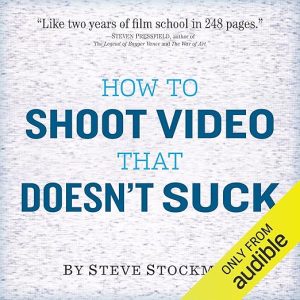
Steve Stockman's audiobook is more useful than its title suggests, and more specific than the competition-guide packaging implies. I say this as someone who spent a significant amount of time dismissing it on name alone, convinced that anything with this kind of casual branding would be surface-level advice dressed up as irreverence. I was wrong, and I say so without qualification. Stockman is a working director with television, music video, and commercial credits, and what he delivers across these six-plus hours of self-narrated content is not a list of tips but a functional education in how professionals think about visual storytelling.
The premise matters: this is a book about communication, not equipment. Stockman states it plainly early on: amateurs think about cameras, professionals think about communication. That reframing shapes everything that follows. Whether you are recording a child's birthday party, a promotional video for a small business, or a short film, the questions that matter are the same: What story are you telling? What does your audience need to feel? How do you capture footage that actually serves the edit rather than just documents what happened?
Zoom With Your Feet, Not the Lens
The structure of 74 short chapters makes this audiobook unusually well suited to the format. Each chapter covers a single concept and closes with an actionable suggestion for immediate practice. That rhythm, learn then apply, then return for the next idea, means listeners do not have to hold an entire framework in their head before any of it becomes useful. You can listen to three chapters on your way somewhere and try one thing the next time you pick up a camera.
Stockman narrates his own work, and the choice pays off. He has the slightly impatient energy of someone who has watched a lot of bad video and developed strong opinions about what goes wrong. His voice is direct without being harsh, and he reads with the authority of someone who has actually stood on a film set and solved the problems he is describing. No gap exists between the narrator's voice and the content's confidence level. That coherence is harder to achieve than it sounds.
The core lessons hit genuine friction points for anyone who has tried to shoot video without formal training. The advice on zoom with your feet, not the lens is delivered with enough context that you understand it is about storytelling proximity, not just aesthetics. The instruction to stop and move rather than pan or sweep lands the same way. These are not stylistic preferences; they are principles derived from a century of cinema, and Stockman traces the reasoning clearly enough that listeners can apply them beyond the specific scenarios he describes.
Stockman's Own Voice Builds the Awareness Efficiently
One thing this audiobook does particularly well is treat non-professional contexts with full seriousness. Stockman does not condescend to the parent shooting a school play or the entrepreneur filming a product demonstration. He applies the same principles he uses on commercial sets to these situations, because the principles actually transfer. The rules for framing a face so it reads clearly on screen are the same whether the camera costs three hundred dollars or thirty thousand.
The reviewer who spent years recommending this to anyone asking about video skills is pointing at something real. This is a book that actually changes how you see footage, not just how you shoot it. After listening, you begin noticing what makes video uncomfortable to watch: the restless zooming, the fixed position that never gives the viewer a new angle, the audio recorded on the camera's built-in mic. Awareness precedes correction, and this audiobook builds that awareness efficiently.
The companion website with video clips illustrating the principles is also worth noting. For a book that is fundamentally about a visual medium, the ability to hear the principle and then see it demonstrated closes a gap that print-only resources leave open. The audiobook works on its own, but the multimedia component makes the learning more complete.
An Orientation, Not a Technical Manual
The age of the source material shows in places. Some of the social media and distribution references feel dated, and Stockman's commercial context predates the creator economy's current infrastructure. The fundamentals hold, but listeners building content for platforms that did not exist when the book was written will need to supplement the strategic advice with more current resources. Stockman's principles are durable; his market observations less so.
The 74-chapter structure that makes the audiobook easy to navigate in chunks also means individual topics get relatively brief treatment. Lighting, audio, editing, and special effects each receive attention, but none of them at the depth a dedicated technical manual would offer. The reviewer who noted that some advice feels like a refresher for someone with experience is right. This is an orientation, not a comprehensive technical training. It gives you the conceptual vocabulary and the correct instincts; you will need other resources to build specific technical skills from there.
For Anyone Who Supervises Video Without the Background
This audiobook rewards people who shoot video regularly without formal training and have a nagging sense that their output could be much better without knowing exactly why it falls short. It is also useful for anyone who supervises video production without a background in it, because Stockman gives you language for articulating what is wrong and what to change. Writers who want to understand how visual storytelling differs from prose will also find genuine value here.
Listeners who already have formal cinematography or film production training are unlikely to encounter many new ideas. And anyone expecting deep dives into specific equipment, color grading software, or platform-specific formatting will need to look elsewhere. But as a reorientation toward professional thinking about moving images, delivered with authority and in a format that rewards active listening, this holds up well.
Questions Listeners Ask
How dated is the social media and distribution advice in this audiobook?
The fundamental filmmaking principles are timeless, but some of the market and distribution references are from an earlier era of digital video. Treat the storytelling and production advice as fully current and supplement the business and distribution sections with more recent resources.
Who is the intended audience for this audiobook?
Self-taught video creators, business owners making their own content, parents who shoot family events, and anyone who supervises video production without a formal film background. People with cinematography training will find the fundamentals familiar.