
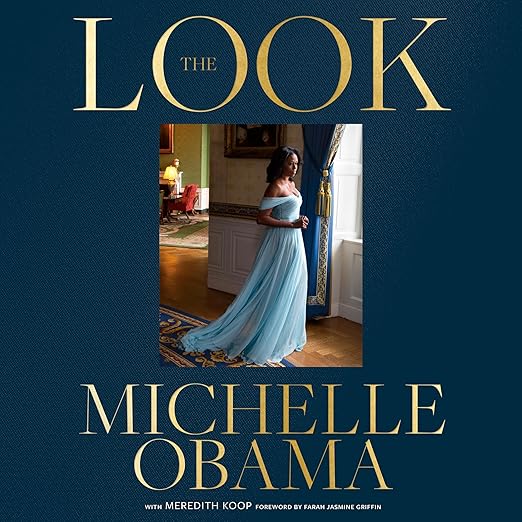
Michelle Obama reading her own book about fashion and self-presentation is an audiobook with a specific gravitational field. The Look arrives as a companion to the photographs in the hardcover edition, and while the downloadable PDF included with the audiobook provides some of those images, listeners who come to this format without the print book should understand what they're experiencing: a personal essay in audio form about the meaning of style, delivered in a voice that has been among the most recognized in American public life for nearly two decades. That voice is, itself, part of the subject.
The book traces Obama's evolution as a public figure through her choices in clothing, hairstyle, makeup, and presentation, from the Senate campaign years through the First Lady period and into her post-White House life. The contributors, stylist Meredith Koop, makeup artist Carl Ray, and hairstylists Yene Damtew, Johnny Wright, and Njeri Radway, provide additional voices and perspectives, as do several of the designers who dressed her for notable events. In the audiobook, these voices are present through Obama's narration of their contributions, giving the production an unusual behind-the-scenes texture.
From Sheath Dresses to Bolder Suits and Braids
Fashion books written by public figures typically take one of two approaches: the coffee table celebration or the personal essay. The Look is both, and the tension between those modes is productive rather than confused. Obama clearly understands that fashion is not a trivial subject, that what she wore as First Lady carried political and cultural meaning beyond aesthetic choice, and the audiobook is at its most compelling when she's explicit about that dimension of her public self-presentation.
The decision to use fashion as a vehicle for discussing confidence, identity, and what she calls 'the best version of yourself' works because Obama doesn't pretend these concerns are superficial. The chapter covering her evolution from the colorful sheath dresses and cardigans of her early White House years to the bolder suits and braids of her post-White House life reflects genuine shifts in who she was publicly allowed to be and who she chose to become. Those are not the same thing, and Obama is clear about the distinction.
Meredith Koop's Role as a Trusted Collaborator
Self-narration gives this audiobook an intimacy that the subject matter requires. Obama's voice is warm and precise, with a quality of considered reflection rather than performed memoir. When she describes the calculation behind a particular outfit for a particular event, you're hearing someone who has spent years thinking about the relationship between clothing and communication, and who is now comfortable enough with that thinking to share it without apology.
The contributions from her creative team add genuine depth. Meredith Koop's role in particular, as a trusted collaborator rather than a simple service provider, comes across clearly through Obama's descriptions of their working relationship. The audiobook makes the collaborative nature of public presentation visible in a way that first-person celebrity fashion books rarely do.
Reviewers of the print edition describe the book as 'a piece of history' and note that 'her stories tell who she really is.' In audio form, the history is present in Obama's voice itself, carrying the accumulated weight of years of public scrutiny and private decision-making. That weight is not incidental to the listening experience.
Discussing and Performing Self-Presentation at Once
At three hours and twenty-six minutes, this is a short audiobook. It covers ground quickly and with considerable personal selectivity. Obama is not writing a comprehensive account of her public life, and listeners expecting memoir depth or political analysis alongside the fashion content will find the scope narrower than anticipated. This is specifically about style and what she learned from it, and it doesn't stray far from that defined lane.
The absence of the print photographs is a meaningful limitation for audio listeners. Obama's descriptions are vivid enough to compensate in many cases, and the downloadable PDF helps, but some of the book's visual argument requires seeing the actual garments in context. This is a case where the audio edition and the print edition serve genuinely different purposes, and the most complete experience requires both.
The context of Obama narrating a book specifically about self-presentation, while being listened to by an audience that has watched her self-present in public for nearly two decades, creates an unusual recursive quality. She is discussing the construction of the public Michelle Obama at the same moment she is performing the public Michelle Obama through her voice. Whether or not this is intentional, the audiobook format makes it audible in a way the print edition cannot. When she talks about the calculation behind choosing a particular silhouette for a particular event, you're hearing someone who is simultaneously explaining the theory and demonstrating the practice. That quality makes the three-and-a-half-hour listen feel denser with meaning than the runtime would suggest.
A Light Entry Point Into Obama's Writing
This audiobook is for listeners who respond to personal essays about self-presentation, identity, and the politics of how we appear in public, and who want to hear those ideas from a specific perspective shaped by two terms in the most scrutinized address in American life. Obama's voice is central to the experience, and her self-narration is the right delivery mechanism for this material.
It also works as an entry point for listeners new to Obama's writing. At three and a half hours, the commitment is light, and the material is accessible without being shallow. Skip it if you want political memoir or a comprehensive account of the Obama years; this is narrower and more personal than that, and intentionally so.
In Brief
- Performance: Michelle Obama's self-narration is the core of this audiobook; her voice carries the history and the personal reflection that the subject requires.
- What it covers: Fashion as political communication, identity and self-presentation, the evolution of a public figure's confidence
- Feel: Warm and reflective, intimate in the way only self-narration can be
- Our call: A focused, personal audiobook about style and identity that delivers something no print version can , Obama's own voice telling her own story.
Frequently Asked Questions
Can I fully appreciate this audiobook without seeing the photographs from the print edition?
Partially. Obama's descriptions are detailed, and the downloadable PDF includes select images. But some of the book's visual argument benefits from seeing the actual looks in context. The audio and print editions serve related but distinct purposes.
Is The Look audiobook a political memoir in disguise?
No. It's specifically about fashion, self-presentation, and what clothing communicates. Political events appear only as context for specific style choices. Listeners expecting the scope of Becoming will find this considerably narrower and more focused.
How does Michelle Obama's narration compare to her performance in Becoming?
The Look is more concise and stylistically focused, and Obama's narration reflects that difference. Where Becoming carries the weight of a full life memoir, The Look is more essayistic and conversational, with a lightness that suits the subject.
Does the audiobook include voices from Meredith Koop, Carl Ray, and the other contributors mentioned in the synopsis?
Their contributions appear through Obama's narration of their perspectives rather than as separate recorded voices. The audiobook is single-narrator, with Obama describing her collaborators' roles and perspectives in first person.







