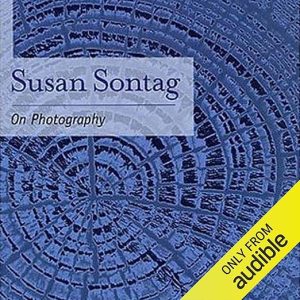
Sontag wrote these six essays for readers who would stop, back up and argue with the paragraph they had just finished. That is an awkward brief for an audiobook, and it is the first thing worth saying about a six-hour recording of a book people have been arguing with in margins since the early seventies. Taken on its own terms, the reward is a set of claims about photographs that have aged into something closer to a warning.
In Plato's Cave Sets the Terms for Six Essays
The premise arrives early and never relaxes: photographic images are continually inserted between experience and reality. Sontag's claim is not that pictures lie, which would be easy to dismiss, but that photography has dissolved the boundaries and definitions of art to the point where a viewer can approach any image freely, with no expectation of discovering what it means. In Plato's Cave, the best known of the six essays, sets those terms, and the rest of the collection keeps pressing on the same idea of transparency. Nothing here is a how-to. Nothing here is about equipment.
What the book does to a reader is the useful part. A five-star entry from December 2015 describes coming out of it with a firm understanding of what the medium is and a better grasp of how to make its own work stand out, which is a strange outcome for a text with no technical content in it at all. That is the standard reaction. The essays do not teach photography, they change what a photographer thinks a photograph is for, and the listener who wants that shift should know it arrives by argument, one long sentence at a time.
Van Dyck Must Pace Sentences That Qualify Late
The strongest argument for listening now is that the book has become more accurate since it was written. A five-star response from August 2014 works through exactly this: on a first reading, Sontag's complaints about the snapshot prints that ended up in photo albums felt remote, because digital was then that reader's new medium. Coming back later, with phones everywhere and what the entry calls the age of selfies, the same complaints regained their force. Criticism rarely survives that test. This does, and it does so without a single line of updating.
Jennifer Van Dyck reads the recording, and the job is unusual. Sontag builds long, clause-heavy sentences that carry their qualification at the end, so the meaning of a first half often depends on something the ear has not received yet, and a reader who paces that wrong turns argument into recitation. Heard aloud, though, the essays sound less like theory and more like a very good, very impatient talker, and six hours and twelve minutes is short enough that the density never turns into a slog. None of the five written entries on the listing is about a recording, so nothing on the page will tell you which way it lands.
One Rating Cannot Average to 4.5
Start with the number, because it does not work. The listing shows a 4.5 average over a rating count of one. A single person grading a title picks a whole star, one through five, and 4.5 is not among the options. Beneath that count of one sit five signed written entries, so the counter is not merely small, it is smaller than the column of opinion printed directly under it. None of this puts the book in question. The field that exists to tell you how many people voted has stopped telling you anything.
The written column carries its own provenance problem. One five-star entry filed in December 2025 opens by praising the seller for prompt shipping and a well-packed parcel, then reports being on page nine and finding the book exceptionally dense. Both halves of that are print. A buyer looking for guidance on whether six hours of Sontag holds up in the ear is instead reading somebody's opinion of a delivery and a ninth page.
Density is the honest warning, and the page supplies it from an unexpected direction. A four-star entry admits to losing the book before finishing it and recommends it anyway, to every photographer and by extension every artist, valuing it for inspiration rather than technique. Not finishing is a common outcome with this text. Audio changes that arithmetic in both directions: you cannot skim, which hurts, and you also cannot set it down on a shelf and forget where it went, which helps. Expect to rewind. Expect an essay or two to slide past you on a first pass.
For Photographers Who Exhausted the Technical Shelf
Photographers who have exhausted the technical shelf are the core audience, along with anyone who works with images professionally and has begun to feel uneasy about it. A five-star entry from September 2025 goes further and calls it perhaps Sontag's best work, one that should be read by everyone regardless of background, which overstates the accessibility without overstating the value. Students of criticism get a second use out of it: this is a model of how to build an argument that does not depend on its examples staying current.
The wrong buyer is easy to describe. Anyone after a history of photography, or a survey of photographers, will not find one, and the essays assume you arrive with your own references to argue against. Listeners who mainly run audio while doing something else will lose this one, because it punishes divided attention harder than almost anything else filed under arts. Whatever the star rating on the page suggested, discount it entirely; the essays are the reason to be here, and they are enough of one.