
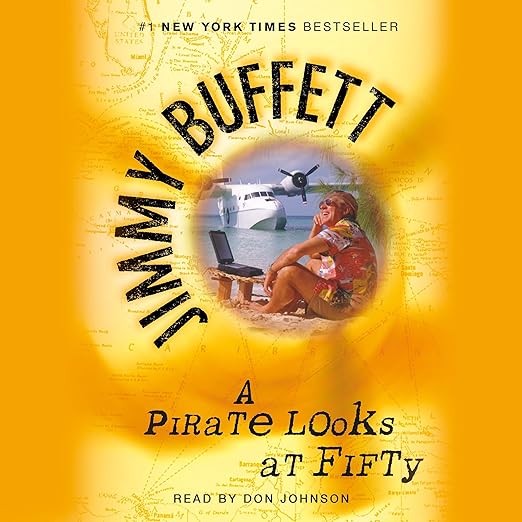
At a Glance
- Narrator: Don Johnson reads with the ease of a longtime friend passing on a good story, unhurried and warm, a natural match for Buffett's conversational prose.
- Subjects: Caribbean adventure and wanderlust, the pirate philosophy of living on your own terms, music and memory
- Tone: Warm and unhurried, like rum drinks at dusk with someone who has lived well
- Bottom line: A long, generous travelogue-memoir that rewards listeners who surrender to its pace rather than waiting for it to arrive somewhere.
Jimmy Buffett was fifty years old and sailing through the Caribbean when he decided to write the book that would capture what his pirate philosophy of life actually looked like from the inside. The result, A Pirate Looks at Fifty, is part travelogue, part memoir, and part valediction for a certain way of being in the world, narrated here by Don Johnson in a performance that matches the material's loose, generous energy. I came to this audiobook as someone who appreciates Buffett more as a cultural phenomenon than a music devotee, and that turned out to be the right distance from which to hear it.
A Near-Death Crash in Nantucket Harbor
The book traces a three-week Caribbean journey, with Buffett using the islands as a frame for the stories he has been saving up for his closest friends. From the pirate coves of the Florida Keys to the ruins of ancient Cartagena, from Costa Rica's jungle outposts to a meandering passage down the Amazon, the geography is richly specific. Buffett is not the kind of travel writer who processes landscape as metaphor; he is more interested in the people he drinks with, the planes he flies, and the near-disasters that make for better stories than the smooth days. His near-death crash in Nantucket harbor gets its own extended treatment, and it is exactly as vivid as you would hope.
At thirteen hours and fifty-four minutes, this is a long audiobook for what is essentially a memoir-as-vacation. But Buffett earns the runtime. The chapters accumulate in the way a long conversation with someone genuinely interesting accumulates: you keep saying you need to leave, and then another story starts. The New Orleans origin story, the discovery of his passion for flying planes, the behind-the-scenes account of how he built his career alongside the radio and concert ecosystem that grew around Parrothead culture: these are the chapters that reveal more than the travel sequences.
Johnson Reads Like a Letter From a Beach
Don Johnson's narration is worth addressing directly. He is not a trained audiobook narrator in the conventional sense, and some listeners will notice that his interpretation prioritizes comfort over precision. But for this particular book, that turns out to be the right call. Buffett's prose is conversational, anecdotal, and built for an audience that already trusts the storyteller. Johnson matches that register without pushing for theatrical colour. He sounds like a man reading from a letter you found on a beach, which is pretty much exactly what this audiobook calls for.
One reviewer described the experience as 'sitting with Buffett at a beachside bar, listening to him spin tales.' That comparison originated with Time magazine and it holds. The book is not structured like a conventional memoir with a crisis arc and a redemptive resolution. It meanders, because Buffett's life meanders, and because the whole philosophical argument of the book is that the meandering is the point. For readers who want narrative drive and forward momentum, this is a mismatch. For listeners who want to spend nearly fourteen hours in the company of someone who has figured out how to enjoy being alive, it delivers exactly what it promises.
Amazon and Cartagena Outshine the Caribbean Stops
The book was written in the late 1990s, and it carries the cultural assumptions of that moment without apology. Buffett's world is very male, very boating, and very specifically calibrated to a kind of wealthy tropical freedom that not everyone will find relatable. Some of the celebrity name-dropping and music industry reminiscence is dated, and listeners without background knowledge of the Parrothead community may occasionally feel like they are missing context.
The travelogue sections are uneven. The Amazon passage and the Cartagena sequences are alive with specific observation, but some of the shorter Caribbean stopovers feel like notes from a logbook rather than chapters from a book. This is a consequence of the diary-style structure, and it is not fatal, but it does mean the audiobook has pacing dips in the middle that a more disciplined editor might have tightened.
Buffett Genuinely Likes His Life at Fifty
What grounds the audiobook across its full runtime is not the celebrity name-dropping or the nautical adventure, as pleasurable as both are, but Buffett's evident contentment with who he is at fifty. Most midlife memoirs are secretly crisis narratives in disguise. This one is not. Buffett at fifty genuinely likes his life, and his account of it is generous rather than defensive. Whether you find that disposition aspirational or frustrating will determine how much of the thirteen-plus hours you spend with a smile rather than a raised eyebrow.
The book also holds up as a record of a specific cultural moment: the late 1990s, when the Parrothead phenomenon was at its commercial and communal peak, when Key West still had the character Buffett mythologized, and when a musician could build a genuine lifestyle brand around the philosophy of the tropics without it feeling like a marketing exercise. That moment has passed. Reading this audiobook now is partly an exercise in nostalgia for a pre-digital version of escapism, and that quality adds a layer of interest that was probably not intended when Buffett wrote it.
A Backstage Pass for Devoted Parrotheads
Parrotheads and devoted Buffett fans will find this essential. The audiobook functions as a backstage pass to stories that do not appear in interviews or concert banter, and that alone is worth thirteen-plus hours for anyone invested in the mythology. Armchair travel listeners who like company more than information, and who are comfortable with an unhurried conversational pace, will also find it rewarding. Listeners expecting a structured narrative memoir with a clear emotional arc, or those with no prior interest in Buffett's musical or pirate-philosopher persona, may find the runtime asks more than the content gives.
Do you need to be a Jimmy Buffett fan to enjoy this audiobook?
Prior affection helps considerably. The book is built around inside stories from Buffett's personal and professional world, and some of the music industry and Parrothead culture references assume familiarity. That said, the Caribbean travel sections and the pure storytelling work for non-fans too.
How does this audiobook hold up for a modern listener, given it was written in the 1990s?
The Caribbean geography and the core stories remain vivid. Some of the cultural references and the music business context are dated, and Buffett's world reflects the assumptions of a certain era. For historical memoir lovers, that is part of the appeal; for others, it may require patience.







