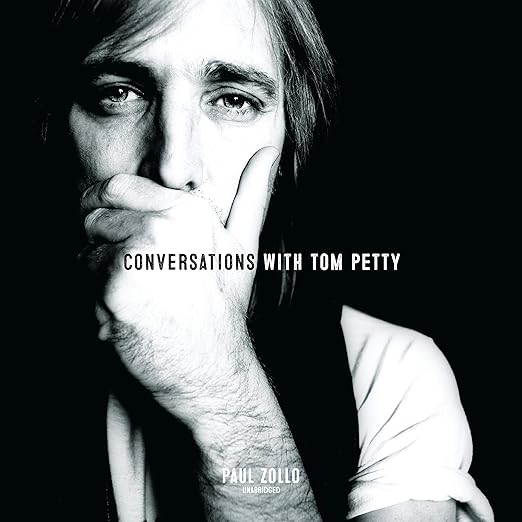
Paul Zollo's approach in this audiobook is the rarest kind of restraint: he steps back and lets Tom Petty talk. Conversations with Tom Petty (Expanded Edition) is not a biography with a thesis, not an authorized hagiography polished to remove all rough edges. It is closer to seventeen hours in a room with one of American rock's most instinctive songwriters, listening to him think out loud about craft, commerce, collaboration, and the strange alchemy of making songs that last. Jim Meskimen's narration holds the conversational register throughout without forcing drama onto material that generates its own.
The Oral History Method Petty Actually Trusted
Zollo's method here is essentially oral history, and it is the right choice for this subject. Petty was famously resistant to the idea that his songwriting could be analyzed from the outside; he trusted instinct over theory. Letting him narrate his own career in his own words is the only approach that could have worked. The conversations, conducted over multiple sessions and reprinted with minimal editorial intervention, have a quality of intimacy and spontaneity that you cannot manufacture in retrospect.
What comes through most powerfully is Petty's particular combination of stubbornness and generosity. He was fiercely protective of his music and his band, the legal battles with his label over record pricing, his refusal to let MCA raise the price of Hard Promises in 1981, are described with characteristic directness. But he was equally generous in crediting his influences, his bandmates, and the random accidents of inspiration. When he explains which song was sparked by hearing Wilson Pickett's 'Land of a Thousand Dances,' or how 'Free Fallin'' arrived almost as a joke that turned serious, you feel the way great songs happen: not through calculation but through a kind of alert receptivity.
What the Expanded Edition Adds After Petty's Death
The expanded edition adds interview material that deepens the picture, particularly around the later period of Petty's career. Dana Petty's approval of this edition, and the inclusion of material from Petty's final live performance, gives the audiobook an elegiac quality that the original did not carry. Listening now, after his death in 2017, sharpens every moment of honesty he offers about aging, creative identity, and the cost of integrity in the music business.
The range of songs covered is excellent. From the early Gainesville years through the Heartbreakers' formation, the Mudcrutch detour, the Traveling Wilburys, and the late-career resurgence of Mojo and Hypnotic Eye, Petty discusses virtually every significant chapter of his work. For fans, this is extraordinary access. Even for listeners who are more casual in their relationship with his music, the specificity of how individual songs were written makes for compelling listening.
Meskimen Reads Petty, Never Tries to Impersonate
Jim Meskimen is well-suited to this material. His performance captures the conversational quality of the text without overcooking it, he does not try to impersonate Petty, which would have been a disaster, but instead reads with a directness and ease that matches the unpretentious quality of Petty's own self-presentation. At nearly seventeen hours, this is a commitment, but it rewards that commitment consistently. The rhythm of the book mimics good conversation: it wanders, doubles back, makes unexpected connections, and lands on insights that feel earned.
The audiobook format suits this material particularly well because it preserves the spoken quality of the original conversations. Reading Petty's words on a page is one experience; hearing them delivered with the cadence of speech is another. The absence of heavy editorial framing means you must do some of the work of synthesis yourself, but that is appropriate for a subject who resisted being summed up.
An Authorized Portrait With No Hard Questions
This is not a neutral account. Zollo admired Petty, and the conversations reflect that mutual trust. No journalistic pressure applied, no uncomfortable questions pushed past the point where Petty was comfortable. Listeners hoping for revelations about the harder aspects of his personal life or the internal tensions within the Heartbreakers may find the account more guarded than they expected. This is the authorized version of Tom Petty's story, and that authorization has a cost.
The format also means the book does not read chronologically in any strict sense. The conversations loop and circle, returning to themes and periods from different angles. Listeners who prefer linear narrative structure may find this disorienting initially. Give it time, the accumulative picture that emerges is worth the non-linear path.
One thing that distinguishes this audiobook from most rock biographies is the absence of the usual retrospective shaping that turns a career into a clean narrative of growth and vindication. Petty does not narrate his life as though he always knew where it was going. He describes decisions that looked like risks at the time and accidents that turned out to matter enormously. The refusal to impose a too-neat pattern on the conversations means the audiobook captures something closer to how a creative life actually feels from inside: contingent, collaborative, and shaped as much by what you refused as by what you chose.
Why Aspiring Songwriters Get as Much as Fans
Dedicated Petty fans will find this essential. Listeners interested in the craft of songwriting more broadly will find it one of the more honest accounts of how popular music actually gets made, through collaboration, accident, stubbornness, and luck. Music journalists, aspiring songwriters, and anyone who wants to understand how an artist maintains integrity over a forty-year career in a industry that punishes it will all find specific value here.
- Narration: Jim Meskimen reads with appropriate restraint, preserving the conversational quality of the material without trying to impersonate Petty.
- Themes: The craft of songwriting, integrity in the music industry, creative collaboration, the arc of a long artistic career.
- Mood: Warm and candid, like a long conversation with someone who has figured out what matters and is willing to say so.
- Verdict: Essential for fans, genuinely illuminating for anyone interested in how great songs get made.
Frequently Asked Questions
Is this audiobook suitable for someone who is not already a Tom Petty fan?
Yes, with a caveat. The discussion of individual songs assumes some familiarity with the catalog. But the broader material, about craft, integrity, and the music business, translates even for casual listeners. I would suggest familiarizing yourself with a dozen or so Petty songs before starting, which will significantly deepen the experience.
What does the expanded edition of this audiobook add compared to the original?
The expanded edition includes additional interview material from later in Petty's career, an extended introduction, and photos from his last ever live performance. Dana Petty approved the additions, giving the expanded version an additional layer of authority and, given his 2017 death, an elegiac weight the original did not carry.
How does the audiobook handle the interview format?
Zollo reprints the conversations with minimal editorial framing, which preserves their spontaneity but also means the structure is non-linear and associative rather than chronological. The audiobook format suits this well, the rhythm of speech makes the back-and-forth feel natural rather than choppy.
Does the audiobook cover the Traveling Wilburys and Petty's solo work as well as the Heartbreakers?
Yes. Petty discusses the Traveling Wilburys, his solo albums, and the Mudcrutch reunion alongside the core Heartbreakers material. The coverage is comprehensive across his full career without feeling encyclopedic.