In Brief
- Narration: Ana Clements reads with elegant precision, matching the brand's aspirational register without tipping into reverence.
- Themes: Luxury fashion history, craft and exclusivity, celebrity culture, generational brand evolution
- Mood: Polished and efficient, suited for focused listening rather than extended immersion
- Verdict: A well-produced audiobook introduction to Hermes history at under two hours, though the format's limits are real for a subject this visually dependent.
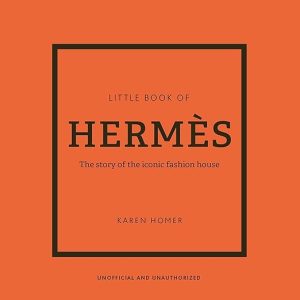
Fashion house histories occupy a peculiar niche in the audiobook landscape. They are often companion objects to visually rich print editions, books designed to be held and looked at as much as read. Karen Homer's entry in the Little Books of Fashion series, covering the house of Hermes, runs just under two hours, which tells you something important before you press play: this is a listening object that positions itself as an introduction, a concentrated account of a brand whose history spans nearly two centuries, rather than a comprehensive scholarly treatment. Ana Clements's narration handles that brevity well.
Hermes has an origin story that the fashion world loves to tell. A saddlery workshop in nineteenth-century Paris, generations of family ownership, the evolution from equestrian equipment to the luxury accessories that now command five-figure price tags and years-long waiting lists. Homer covers that arc across a brisk runtime, touching on the Kelly and Birkin bags, the silk scarves that became cultural artifacts, and the celebrity clientele from Grace Kelly and Jane Birkin to contemporary figures like Victoria Beckham. It is familiar territory for anyone who follows fashion history, but Homer assembles it with the authority of someone who has spent genuine time with the primary sources rather than summarizing other summaries.
Engineered by Blake Rook in Brattleboro, Vermont
The tension at the center of any audiobook version of a visual fashion history is that the format strips away the images that carry significant meaning in print. Homer's text was written with those images in mind, and Clements's narration does its best to compensate through descriptive language. She succeeds more often than not. When Homer writes about the distinctive orange box, the particular weave of the Hermes canvas tote, the evolution of the Kelly bag's hardware across decades, the narration makes the visual information translatable. But listeners who want to see the objects under discussion will want access to the print edition alongside the audio.
The production note is worth including: this audiobook was engineered by Blake Rook and published by Echo Point Books and Media, an independent operation in Brattleboro, Vermont. The audio quality is clean and well-balanced, which is not always guaranteed with smaller independent productions. Clements reads with a polish that suits the material's aspirational tone without tipping into parody or breathlessness about the brand. The restraint is appropriate for a subject that can easily tip into hagiography.
Under Two Hours, Alongside Chanel and Dior
At under two hours, this audiobook fits cleanly into the kind of listening session that a long commute or an evening walk would accommodate. For fashion history enthusiasts who want a structured overview of Hermes rather than the deep archival work of a full biography, Homer's account covers the essential narrative efficiently. The house's evolution from working saddlery to luxury conglomerate, its resistance to licensing strategies that diluted other brands, its particular relationship to handcraft and scarcity, are all present and clearly explained in sequence.
Reviewers described the physical book as reflecting the brand's 'rich history, iconic designs, and craftsmanship' with 'attention to detail' that is 'impressive.' Those qualities translate reasonably well to audio through Clements's delivery, which carries the same care. The series context also helps: as part of the Little Books of Fashion, this audiobook sits alongside comparable treatments of Chanel, Dior, and others, making it a useful addition to a fashion history listening library rather than an isolated purchase.
For Anyone Who's Stood in the Store, Wondering
The runtime is the most significant limiting factor. Under two hours does not accommodate nuance about the internal politics of the house, the controversies that have shadowed the brand's expansion into different markets, or the deeper cultural debates about luxury consumption that a longer treatment might engage with. Homer's account is positive in tone, and while it is not hagiography, it does not substantially challenge the brand mythology it is largely reproducing. Listeners looking for a critical perspective on how luxury brands construct exclusivity will need to supplement this with other sources.
For listeners who are already deeply familiar with the brand's history, the audiobook may cover ground that feels well-trodden. Its value lies in the quality of the organization and narration rather than the novelty of the information. First-time listeners to fashion house histories will get the most out of it. Those coming in with years of Hermes knowledge will find the overview level appropriate for the series format but unlikely to surprise.
For listeners who have visited a store and wondered about the context behind what they were looking at, Homer's account provides useful scaffolding. The specific decisions the house made to remain family-controlled, to limit licensing, to anchor production in France, are presented as choices with consequences rather than simply as brand mythology. That contextualization is more useful than it might sound in a sub-two-hour format.
Exactly What a Sub-Two-Hour Introduction Promises
This audiobook suits fashion history enthusiasts who want a well-narrated overview of the Hermes house, listeners who are new to fashion history and want an accessible entry point, and anyone building a listening library around the Little Books of Fashion series. It also works as background listening for people who follow contemporary luxury fashion and want the historical context organized for them. Listeners who already follow the brand closely or who have read longer treatments of its history will find the brevity limiting. Those who need visual accompaniment to engage with fashion objects meaningfully should access the print edition alongside. For a sub-two-hour introduction to one of fashion's most storied institutions, it delivers exactly what the format promises.
Common Questions
Does this audiobook work without access to the photographs in the print edition of The Little Book of Hermes?
It works as a standalone listen, but Homer's text was written with images in mind. Listeners who want to see the objects under discussion will get more from accessing the print edition alongside the audio.
Who is the target listener for this audiobook, and is it suitable for people new to fashion history?
It works well as an accessible entry point for listeners new to fashion history. Those already familiar with Hermes history in depth may find the brisk treatment covers ground they know, but the narration quality makes it a worthwhile listen either way.