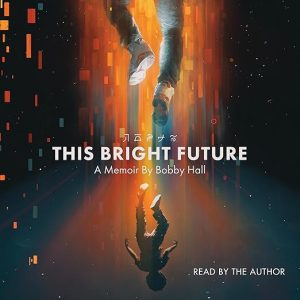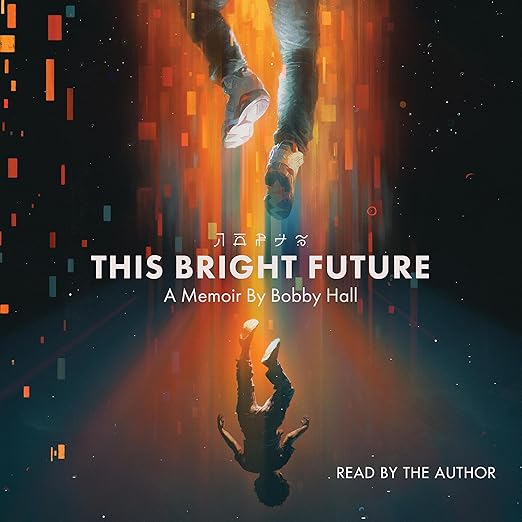
- Narrator: Bobby Hall's self-narration is essential to this memoir's power; his delivery is unguarded and specific in ways no hired narrator could match.
- Subjects: Childhood trauma and survival, identity formation through creative work, the cost of fame
- Tone: Raw and emotionally demanding, with genuine moments of absurdity
- Bottom line: Hall's self-narrated memoir earns its honesty through specificity, not sentiment, and it stays with you long after the final chapter.
Logic's memoir This Bright Future is the kind of audiobook that makes you pull over and sit in a parking lot rather than stop listening. I came to this one skeptical, I'll admit. Celebrity memoirs from musicians have a reputation for being polished self-mythology, carefully shaped by ghost-writers to smooth the roughest edges into something palatable. Bobby Hall's account of growing up as Sir Robert Bryson Hall II, the only child of an alcoholic mother and an absent crack-addicted father in Gaithersburg, Maryland, is not that. It is raw in a way that makes the word feel insufficient.
The memoir, narrated by Bobby Hall himself in the audiobook edition, opens in the middle of the wreckage: a childhood defined by neglect, violence, and the kind of unpredictability that rewires how a person relates to safety. Hall does not aestheticize the suffering, and that restraint is what gives the book its weight. Reviewers have described it as something that 'would be unbelievable even by Hollywood standards,' and the disbelief is not the hyperbolic kind. It is the cognitive friction of a story that sounds impossible because it is actually true.
How This Bright Future Holds Up
What separates this from most music memoirs is the specificity of the emotional logic. Hall does not just recount what happened to him. He tracks, with considerable psychological insight, how the things that happened shaped the way he processed reality as a teenager and young adult. The account of how he found hip-hop, not as a career plan but as literally the first thing that made him feel like he had a language for his experience, carries genuine urgency. He ran away from home with a discarded laptop and a ninth-grade education and built a career that would eventually put him on the same stages as artists he had grown up idolizing. The trajectory is not presented as a triumph-of-will story. It is more complicated than that, and the complication is the point.
Why Listen to This Bright Future
Bobby Hall's self-narration is the correct choice for this material. His voice carries a quality that a professional narrator could not replicate: the specific timbre of someone recounting events that cost them something to remember. He is not performing pain or performing recovery. The audiobook version runs just over ten hours, and the pacing reflects someone who has thought deeply about what deserves to be said aloud. The sections covering the height of his fame as Logic, and particularly the period when the wounds of his childhood and the pressures of internet celebrity nearly undid everything he had built, are delivered with a kind of steady-eyed honesty that is genuinely difficult to sustain. One reviewer described it as having 'impacted me deeply in a profound, spiritual sense.' That is not an overstatement. Hall has a gift for making his particular experience feel like something the listener is processing alongside him rather than watching from a safe distance.
The memoir covers his relationship with his mother and father in ways that resist easy resolution. He does not arrive at forgiveness as a neat conclusion, or at condemnation either. He arrives at something more difficult: understanding the mechanisms of damage well enough to name them, without pretending that naming them makes them stop mattering. The photographs described in the text, his early career documentation, provide a kind of visual anchor to the timeline that gives the audio version additional texture when he references them.
What to Watch For in This Bright Future
Listeners who come to this audiobook primarily as fans of Logic the musician may find some sections demanding. Hall does not spend a great deal of time on the technical craft of making music or on industry gossip. This is a book about what formed him, not about what he produced after he was formed. The sections that discuss his platform period, when his songs about suicide prevention attracted enormous online attention and then attracted the particular cruelty that internet fame applies to sincerity, are among the most revealing passages. He is honest about the gap between the message he was putting out and the state he was in while putting it out, and that honesty is uncomfortable in the best possible way.
The humor is also real and necessary. Hall has a gift for lacerating self-awareness that keeps the memoir from collapsing into pure trauma narrative. The moments of absurdity in his account of becoming famous, the dissonance between the child he was and the public figure he became, are genuinely funny. Ernest Cline described the book as 'fearless, funny, and full of heart,' and the funny part is not decoration. It is structural. The humor is how Hall keeps himself, and the reader, from drowning.
Who Should Listen to This Bright Future
This audiobook rewards listeners who are drawn to memoirs about survival and transformation, particularly those where the author is willing to implicate themselves honestly in their own story. Prior familiarity with Logic's music is not required. Several reviewers who described themselves as casual or non-fans found the memoir completely compelling on its own terms. If you have read memoirs like The Glass Castle, Educated, or Born a Crime and found that genre genuinely moving, Hall's book belongs in that company.
Listeners who want a music industry insider account, with studio sessions and collaborator anecdotes, may want to manage expectations. And listeners who find raw accounts of childhood abuse and mental illness difficult, without a distancing frame of humor or time, should be aware this book does not soften those passages. But for those who can sit with discomfort in exchange for honesty, this is one of the more authentic pieces of writing to emerge from the music world in recent memory.
Questions Listeners Ask
Do you need to be a Logic fan to enjoy this audiobook?
Not at all. Multiple reviewers who described themselves as casual or non-fans found the memoir compelling entirely on its own terms. The book is about what shaped Bobby Hall as a person, and the music is context rather than subject matter.
How graphic is this audiobook in its depiction of childhood abuse and neglect?
Hall recounts the specifics of his upbringing without softening them, including accounts of violence, alcoholism, and severe emotional neglect. The passages are direct but not gratuitous. Listeners who find this kind of material difficult should be prepared.
How does this audiobook compare to other musician memoirs?
It sits closer to the literary memoir tradition than the music industry tell-all. The closest comparisons are books like Born a Crime by Trevor Noah or The Glass Castle by Jeannette Walls, rather than standard rock biography fare. The music is present but the book is fundamentally about survival and self-formation.