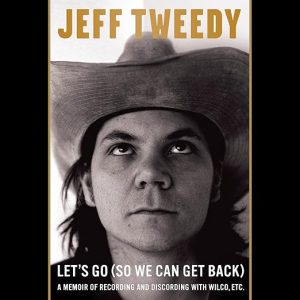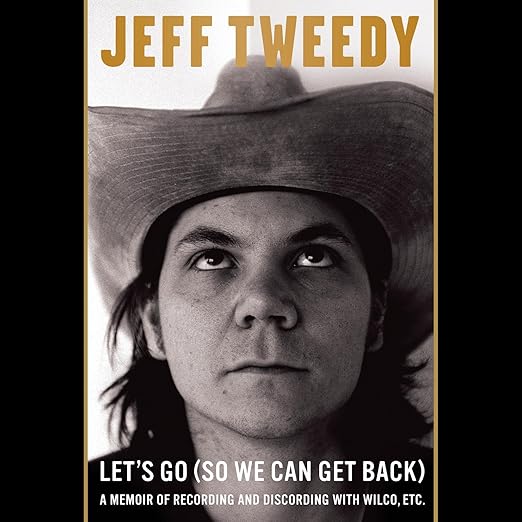
Penguin Audio still advertises a comic strip on this record. The description signs off by promising a bonus containing a comic strip and song lyrics, which is a generous inclusion in a printed book and an odd thing to find at the bottom of an audiobook listing, where a drawing has nowhere to go. Eight hours and twelve minutes is the runtime, Jeff Tweedy reads it himself, and the release is dated November 2018. Two of those are exactly what a Wilco listener would want. The bonus is the outlier.
First, the Big Picture
Tweedy's memoir moves through the places that made him rather than the records that made him famous. Belleville, Illinois, where he grew up. The St. Louis record store, the rock clubs and the live circuit that turned a listener into a performer. The Chicago scene that eventually held all of it together. He writes about his collaborators in Uncle Tupelo and Wilco, and about his parents, his wife Susie and his sons Spencer and Sam, which is a set of subjects a musician can very easily handle badly and which this book is repeatedly praised for handling well.
The shape is looser than a life story. A five-star filed in November 2018 describes it as roughly chronological but not a chronological record, closer to a collection of thoughts about his life, songwriting, music and relationships, and singles out a writing style that is not trying to impress us. That last phrase is the useful one. A memoir by a well-known songwriter carries an enormous temptation toward performance, and the consensus in this column is that the temptation was declined.
Rarely is the word the description leans on: his songs and music have been endlessly discussed and analyzed, it says, while Jeff has seldom talked this directly about his own life and his own process. That framing sets the terms for the whole book. What is on offer is access rather than interpretation, and it explains why the passages that land hardest tend to be the ones where nothing famous is happening. Anyone hoping to have a favorite lyric decoded will be handed the circumstances around it instead, which is both less than asked for and considerably more.
Why Listen to Let's Go (So We Can Get Back)
Self-narration is the whole argument for choosing this format. Tweedy holds the reader credit, and a book that spends its length on how particular songs arrived, what a lyric was trying to do and which rooms he was standing in belongs in the voice that made those songs in the first place. The description promises stories about his artistic process rather than a discography walkthrough, and process talk is conversational by nature. Eight hours is a modest commitment for the company of somebody you already wanted to hear talk, and it is close to the ideal delivery system for this material.
A February 2019 five-star gets at the tone by comparison, having read another musician's memoir a few months earlier and found it stiffer and more academic than expected. Against that, this one registers as conversational and hard to stop. The same entry makes the point that Tweedy already had a book of poetry behind him, so the prose arriving in decent shape was not a surprise. Reading order matters less than register here: someone who has never heard Uncle Tupelo can still follow a chapter about a father, a job and a guitar.
Later entries confirm the same thing from a different angle. A five-star from September 2025 notes that he avoids both the mysterious-songwriter pose and the straight cradle-to-middle-age autobiography, and that a good deal of musing about art, family and trauma runs alongside the events. That is the honest description of what you get: not a chronicle, not a confession, but a musician thinking out loud at a length he clearly enjoys. The bonus of that approach is that individual chapters stand up on their own.
A Few Reservations
Nothing about the numbers on this listing works. A 4.7 average sits above a vote counter reading one, while five written entries are plainly visible underneath, one of them filed in Germany. Whatever the counter is measuring, it is not the column beneath it, and a buyer using the vote count as a proxy for popularity will read this as a book nobody has touched. It is the opposite: a memoir with a devoted following, undersold by a broken field.
The one dissent is worth more than the four praises. A four-star from November 2019 grants that Tweedy is deep, grateful, witty and authentic, then draws the line plainly: he is a fabulous songwriter and not an author, so do not expect the same level of brilliance in prose, and the grade drops accordingly. That entry also calls the book an easy, casual read. Anyone coming from serious literary memoir should take both halves of that seriously, because the qualities being praised elsewhere are warmth and candor rather than sentences.
The comic strip question deserves an answer nobody has given. A bonus of artwork and printed lyrics cannot be heard, and the listing does not say whether it arrives as a companion file, a booklet or nothing at all. The description also still speaks in the future tense, telling you what Jeff will write about and what the memoir will bring readers, which is announcement copy that was never updated after publication. Neither is fatal. Both suggest a page description dropped onto an audio product without a second pass.
Should You Listen to Let's Go (So We Can Get Back)?
Anyone who has spent years with Wilco or Uncle Tupelo is the obvious buyer, and the format upgrade is real for that listener: the stories about how songs got made arrive in the voice that made them. Memoir readers with no stake in the band are the second group, and they are better served here than in most music books, because the through-line is family, work and staying functional rather than tour anecdotes. Eight hours passes quickly, and the chapters break cleanly enough to listen in short pieces.
Give it a miss if you want a Wilco history with dates, sessions and lineup changes, because that is a different book and this one keeps refusing to become it. Listeners who want prose to be the reason they came should adjust expectations before they start. And anyone buying specifically for the printed extras should get confirmation about what arrives with this edition before paying, because nobody on the listing has explained it.
Does the audiobook cover Wilco's albums in order?
No. The organizing principle is formation rather than output: a childhood in Belleville, a record store education, the clubs, then the Chicago scene that held it together. Albums surface when a story needs them. Listeners hoping for a record-by-record account of the catalog will notice the structure working against them within an hour.
Does he talk about the songs themselves or only the life around them?
Both, deliberately mixed. The description promises he opens up about his past, his songs, the music and the people who inspired him, and that the memoir brings listeners inside his musical process. Expect craft talk threaded through biography rather than parked in a separate section, which suits a spoken delivery better than an analytical chapter would.
Do you need to know Wilco's music to enjoy this audiobook?
Not really. Enough of the running time sits with a family, a job and a set of rooms that a listener who has never played a Wilco record can follow it as a straight memoir. Familiarity buys recognition and a few extra jokes. It is not the entry requirement, and the book never assumes you arrived already convinced.
How long is the recording and how does it break up?
Eight hours and twelve minutes, in chapters that mostly function as standalone pieces. Because the structure is thematic as much as sequential, stopping and resuming across a week costs less than it would in a strictly chronological life story, which makes this an unusually forgiving listen for interrupted schedules.