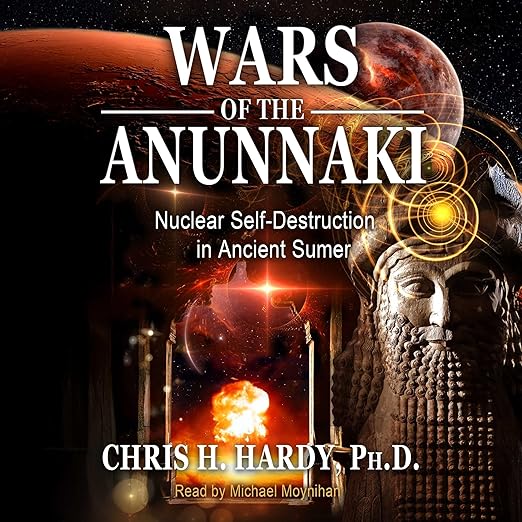
Quick Take
- Narration: Michael Moynihan reads the dense speculative material with composed authority, neither overselling the sensational claims nor undermining the internal logic of the argument.
- Themes: Ancient nuclear warfare, Sumerian mythology as history, humanity’s origins and consciousness
- Mood: Dense and assertive, written for believers in Sitchin’s framework rather than skeptics
- Verdict: If you approach Wars of the Anunnaki as speculative ancient history rather than peer-reviewed archaeology, the synthesis is thorough and the argument internally consistent, but its relationship to established evidence is strained throughout.
I want to be upfront about something before I say anything else about Wars of the Anunnaki: this book operates in a tradition of alternative archaeology that mainstream scholarship regards with significant skepticism, and if you are coming to it expecting peer-reviewed historical analysis, you will be disappointed. Chris H. Hardy’s synthesis draws heavily on the work of Zecharia Sitchin, whose interpretations of Sumerian clay tablets are not accepted by Assyriologists or archaeologists, and the book builds its entire argument on that foundation. I am noting this not to dismiss the book, but because listeners deserve to know where the intellectual territory sits before they commit ten hours to it.
With that framing established: Wars of the Anunnaki is a genuinely ambitious piece of speculative synthesis, and as a document of one particular tradition of alternative thought, it is thorough and internally consistent. Hardy draws on the Book of Genesis, Sumerian clay tablets, the archaeology of the Jordan plain, and what she describes as ancient radioactive skeletons to argue that the destruction of Sodom and Gomorrah represents a nuclear event carried out by the Anunnaki gods in the course of their power struggles on Earth. The argument is laid out with systematic care, and the narrative of Enki, Enlil, and the Assembly of the Gods has a genuine mythological sweep to it.
The Framework Hardy Inherits from Sitchin
Hardy’s starting premise is Sitchin’s: the Anunnaki came to Earth from the planet Nibiru seeking gold, used genetic engineering to create modern humanity as a labor force, and installed themselves as humanity’s kings and gods. From this foundation, Hardy develops her own analysis of the power struggles between Enlil and Enki, the clan dynamics that led to the nuclear event, and what she argues is the subsequent suppression of humanity’s true origins. The writing is dense with proper nouns and relationships, Enlil, Enki, Ninmah, Hermes, the Assembly of the Gods, and listeners who come to this without prior familiarity with Sitchin’s framework may find the first hour or two requires focused attention.
Several reviewers note this challenge directly. One reviewer called for a map of ancient cities and a character reference list, which would genuinely help. The audiobook format adds a layer of difficulty here: in print you can flip back to reorient yourself in the character relationships, and in audio you simply have to hold the framework in your head. Michael Moynihan’s narration is clean and assured, which helps, but the material does demand active listening.
What the Archaeological Evidence Actually Shows
This is where the book requires the most critical distance from the listener. Hardy cites archaeological evidence for her nuclear war thesis, including ancient radioactive skeletons and evidence of high-heat events at specific sites. These claims are real in the sense that they are found in alternative archaeology literature, but the mainstream archaeological interpretation of the relevant sites is very different. The radioactivity levels at Mohenjo-Daro, for instance, which Sitchin-aligned writers frequently cite, are explained by conventional geochemistry without requiring nuclear warfare as a cause.
I raise this not to dismiss Hardy’s argument entirely but to suggest that listeners approach the evidence citations with some care. The book is internally consistent and the synthesis is genuinely impressive in its scope. Whether the evidence actually supports the claims it is asked to support is a separate question, and the answer from mainstream scholarship is largely no. One reviewer described the book as offering a clear and straightforward paradigm shift, and it is that, for listeners open to the framework. For those who are not, the evidence base will be the sticking point.
Hardy’s Original Contribution: Consciousness and Technology
The most interesting element of Wars of the Anunnaki that goes beyond Sitchin is Hardy’s argument about consciousness. She argues that the Anunnaki’s reliance on technology and their recurrent wars caused them to lose touch with what she calls cosmic consciousness, and that humanity is at risk of repeating this dynamic. This is a philosophical claim rather than an archaeological one, and it gives the book a dimension beyond the historical argument. Whether you find it persuasive depends largely on your prior commitments, but as a framing device it elevates the book above a simple catalog of ancient events.
At ten hours and two minutes, the book is substantive. Listeners who are already within the Sitchin tradition will find it a satisfying synthesis of material they likely know. Those who are encountering the framework for the first time will find it a thorough introduction to the tradition, presented with more philosophical depth than most Sitchin-adjacent works manage.
Who Should Listen, Who Should Skip
Listen if you are interested in Sitchin’s framework or alternative ancient history as a genre, if you approach this kind of speculative synthesis with open curiosity rather than expecting peer-reviewed sourcing, or if you want a thorough account of the Anunnaki narrative and its implications for human origins and consciousness. Skip if you require mainstream archaeological standards of evidence, if Sitchin’s interpretations of Sumerian tablets are not something you find plausible as a starting premise, or if the logical architecture of alternative archaeology tends to frustrate rather than engage you.
Frequently Asked Questions
Is Wars of the Anunnaki based on accepted archaeological or historical scholarship?
No. The book draws heavily on the work of Zecharia Sitchin, whose interpretations of Sumerian texts are not accepted by mainstream Assyriologists or archaeologists. Readers who require peer-reviewed sourcing will find the evidence base unsatisfying. The book is best approached as speculative ancient history rather than mainstream scholarship.
Do I need to know Sitchin’s work before listening to this book?
Prior familiarity with Sitchin helps significantly, as Hardy builds on his framework without fully explaining it from scratch. The first few chapters establish the key premises, but listeners unfamiliar with the Anunnaki narrative may find the early character relationships and cosmology difficult to track. Several reviewers suggest a character reference list would help.
What specific archaeological evidence does Hardy cite for the ancient nuclear war thesis?
Hardy cites radioactive skeletons at ancient sites, evidence of high-heat events in the Jordan plain, and Sumerian texts describing the destruction of cities. Mainstream archaeology offers different explanations for these same findings, and the Sodom-Gomorrah nuclear event theory is not accepted in conventional scholarship.
How does Michael Moynihan’s narration handle the dense mythological and speculative material?
Moynihan reads the material with composed authority, treating the speculative claims with the same seriousness as the historical ones. He does not sensationalize or undermine the argument, and the result is a narration that serves the book’s internal logic well, whatever you think of that logic.