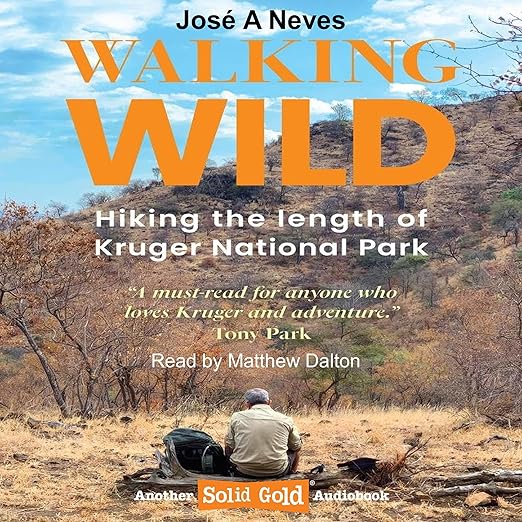
A missing space opens the description of this audiobook, welding the title to the sentence that follows it, and the small collision is a fair introduction to what kind of release this is: independent, unpolished at the edges, and much more interested in the walk than in the packaging. Nine hours and forty minutes cover 605 kilometers on foot through Kruger National Park, from the far north to the deep south, carried out over six stages and three years by a group of people who mostly did not know each other when they started.
Dalton Reads It, and the Distance Shows
Six stages across three years is the structural fact that makes this book work. A single continuous thru-hike would be a different story, one about endurance and depletion. This one is about return: going back into the same park repeatedly, at intervals, with the same handful of people, and slowly learning to read a landscape rather than merely surviving it. The description tracks that progression explicitly, from the smallest antlion to the distant roar of a lion, which is as good a summary of the arc as any critic could write. Attention of that kind is learned slowly, and a book that takes three years to reach its end has the room to show it being learned.
Matthew Dalton reads it rather than Neves, and the description gives you no way to tell what that changes. The copy stays in the third person throughout, describing what they walked and what they drank and where they slept, so whether the book itself is told from inside the group or observed from a step outside remains unclear from this page. On a first-hand account of walking through a place where lionesses come through camp at night, the distance between I and they is not a small matter.
Mike, in Australia, wrote the only response this listing carries. It awards one star, calls the content good, and complains that the item arrived all bent and twisted after poor packaging. That is a review of a parcel. It sits on a page selling a download, and it is the sole written evidence available about a book that took three years to walk and nine hours to record. Filed at the same time, the star it left behind is now part of whatever average the page displays.
Lionesses That Simply Walk Through Camp
Kruger on foot is genuinely different from Kruger in a vehicle, and the description understands why. No game drives, no sundowners, no fences: the promise is proximity without the metal shell that normally guarantees your safety. Two armed guides, blistering heat, violent storms, hyenas nosing at the tents, and a night camp that lionesses simply walk through. Some of the group slept anyway. Others lay awake waiting for dawn, and the copy is honest enough to include both reactions instead of pretending everyone was brave.
Crooks' Corner to Malelane is the route, and the specificity of that line is the reason to trust the rest. This is not a book about wilderness in the abstract. It names its start and its end, averages 20 kilometers a day under heavy backpacks, and puts its walkers into thick riverine bush teeming with hippo, buffalo, and crocodiles, drinking from murky trickles in dry riverbeds. Details of that kind survive editing only when somebody was actually there taking notes. The copy also resists the temptation to make every day dramatic, admitting to murky water and dust and the ordinary grind of 20 kilometers under load, which is what separates a walking book from a highlight reel.
Jose A Neves appears in the publisher line alongside Solid Gold Audiobooks, while the author credit reads José Neves. Same person, two spellings, one of them carrying a middle initial and the other a diacritic. It is a trivial inconsistency and a useful signal: this is a self-published audiobook, produced by the author with a small partner, which explains both the unedited description and the fact that a book with this much material has almost no visibility behind it.
A 3.7 That Cannot Come From Five Votes
The 3.7 average on this page cannot be built from the five votes the counter claims. Whole-star ratings cannot average out to 3.7 across five people, however the total is rounded, so the figure is reporting something other than five readers' verdicts, and the single visible entry is a one-star complaint about shipping. Between a broken average and a review about a bent parcel, the quantitative evidence here is worth nothing. Judge the book on its description, which is at least specific about what it contains.
Poachers occupy a section of the copy, and they signal a tonal shift worth preparing for. Criminal syndicates and bushmeat hunters moving through the shadows, pollution arriving in the rivers from beyond the park's borders, conservation battles that have no clean ending: this is not purely an adventure narrative. Listeners who come for camaraderie and campfire storytelling will also get the political and ecological reality of a park under pressure, which is more honest than the alternative and less comfortable. A book that walked the same park over three years could hardly avoid noticing what was changing in it.
Stacked against a US listener's habits, two practical notes. Everything is measured in kilometers, the spelling throughout leans British, and the terrain vocabulary assumes some familiarity with southern African bush. None of it obstructs comprehension, but a listener expecting miles and a domestic frame of reference should know the book is not written for them. The description also concludes with the language of a sales pitch, calling itself a ticket to the trail, which sits oddly beside its own account of drinking from a muddy riverbed.
Unmediated by Any Publishing House
Walk into this one if wilderness travel writing is your form and you prefer it unmediated by a publishing house: the long-distance hikers, the safari veterans who suspect they have been seeing the place from behind glass, and anyone who reads conservation reporting and wants it delivered from ground level. Under ten hours is a reasonable price for 605 kilometers you will never have to carry a pack for.
Set it aside if you need a professional production with a sample you can audition first, since this listing offers neither, or if unhurried nature writing bores you, because six stages of walking is a slow shape by design. One bent parcel and a broken average are a thin showing for a walk that took three years to finish.
The Short Version
- Read by: Matthew Dalton reads an account credited to José Neves, and the third-person description gives no clue whether the book speaks from inside the group or observes it.
- At its heart: A 605-kilometer walk through Kruger, strangers becoming a party, poaching and pollution, learning to read a landscape.
- Vibe: Dusty, patient, occasionally frightening.
- Short version: Specific and hard-won travel writing, let down by a listing that offers no usable evidence about the recording.
What is the walk described in this audiobook?
The full length of Kruger National Park on foot, 605 kilometers from Crooks' Corner in the far north to Malelane in the south. The group covered it in six stages over three years, averaging 20 kilometers a day with heavy backpacks and two armed guides, sleeping in tents rather than lodges.
Does the author narrate the audiobook?
No. Matthew Dalton holds the narrator credit, while the book is credited to José Neves, who also appears in the publisher line alongside Solid Gold Audiobooks. That makes this a self-published production with a hired reader, and the page offers no sample of the performance.