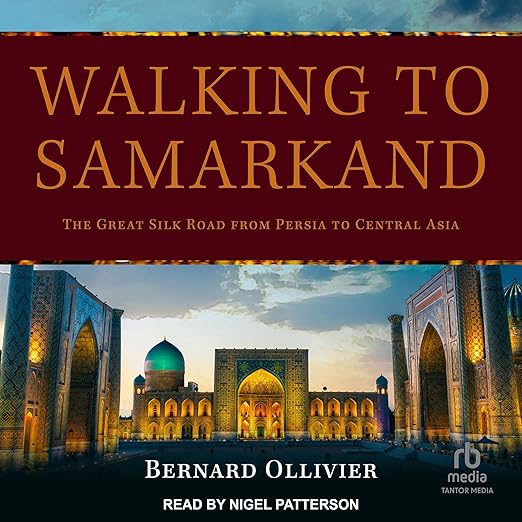
Quick Take
- Narration: Nigel Patterson reads Ollivier’s translated prose with a patient, measured quality that suits the book’s walking pace and reflective tone.
- Themes: Solitude and fellowship, the hospitality of strangers, the physical dimension of historical imagination
- Mood: Contemplative and quietly adventurous, like reading dispatches from someone who has found a way of moving through the world you half-want and half-fear
- Verdict: One of the stronger travel memoirs available in audio, with a Silk Road setting that gives it historical gravity elevating it beyond the personal journey genre.
There is a particular kind of travel writing that I find myself returning to, the kind where the journey is genuinely difficult and the author’s honest uncertainty about why they are doing it is part of the text rather than tidily resolved by the end. Bernard Ollivier’s account of walking the Silk Road from Istanbul to Xi’an belongs to that tradition. Walking to Samarkand covers the second leg of a four-volume journey, roughly Turkey and Iran, and was published in French before this English translation arrived. I listened on a long weekend, doing some walking of my own, which felt appropriate, and Nigel Patterson’s narration was good company for several miles of coastline that bore no resemblance whatsoever to the Karakum Desert.
Ollivier is a journalist who undertook this walk in his sixties, and his motivation is part of the book’s texture. He describes it as the pursuit of a childhood dream, seeing for himself the golden domes and turquoise skies of Samarkand, one of Central Asia’s most ancient cities. But the walk itself is as much about the people encountered along the way as about the destination, which is where the book earns its distinction as travel writing rather than travelogue. He passes through Tabriz, Tehran, Nishapur, and the holy city of Mashhad, crosses Iran’s Great Salt Desert and then Turkmenistan’s forbidding Karakum with its relentless sun, snakes, and scorpions, and arrives in Uzbekistan changed in ways that the book articulates with restraint rather than proclamation.
The People, Not the Monuments
Reviewers who know the series consistently note that this second volume is the strongest not because of writing quality but because of the people Ollivier encounters. One reader who had been to Turkey and Uzbekistan themselves described Ollivier as a born storyteller who humanizes lives we would never get to see. His status as a Frenchman matters here: he travels with a European neutrality that is neither the American abroad nor the former colonial power navigating post-imperial awkwardness, and that positioning allows for a particular kind of access and rapport that other nationalities might not have achieved on the same route in the same period.
The characters he names stay with you: Askar, the hospitable gardener, Mehdi and Monir who become his knights in shining armor at crucial moments. Ollivier is honest that he set out alone and intended to remain alone, and that the walk itself, through a kind of alchemy, surrounded him with friends and fostered fellowship. That word alchemy is precisely right. He does not explain how it happens, because it does not lend itself to explanation. One reviewer noted the book reinforces some stereotypical ideas concerning certain people groups but also illustrates that there are many individuals in these groups who are kind and generous and lovely, which is an honest and appropriately ambivalent observation about travel writing’s relationship to generalization and encounter.
The Physical Reality of the Walk
Ollivier does not romanticize the conditions. The Karakum’s relentless sun, snakes, and scorpions pose continuous challenges, and he describes them with the matter-of-factness of someone still processing the experience while writing it down. He is not performing suffering for narrative effect. One reviewer who described themselves as not a walker noted feeling that Ollivier was a bit of a glutton for punishment, and the observation is affectionate rather than critical. The physical difficulty is real and documented rather than dramatized, which is exactly what distinguishes serious travel writing from adventure content.
At eleven hours and ten minutes, this is a book that rewards the kind of listening that travel itself rewards: sustained attention, willingness to dwell in uncertainty, and patience for the parts that do not resolve cleanly. The book is structured around the walk rather than around dramatic peaks and valleys, which means the pacing is more even than most narrative nonfiction and will suit some listeners better than others. The lack of conventional dramatic architecture is a feature of the form, not a flaw in the execution.
Nigel Patterson’s Translation of a Walking Pace
Patterson reads Ollivier’s translated prose with a steadiness that fits the subject. There is nothing theatrical about his delivery. He reads as though he is walking alongside you rather than performing from a stage, which is exactly what this material requires. The translated prose has a quality of careful observation that Patterson preserves, neither rushing through the landscape descriptions nor dwelling in them past the point the material supports. The French original’s voice comes through the English translation intact, and Patterson’s narration respects the quietness of Ollivier’s fundamental style throughout.
What the Silk Road Adds to the Travel Memoir Form
Travel memoirs are numerous, and the genre has specific conventions around personal transformation, dramatic incident, and epiphanic resolution. Ollivier does not fully follow those conventions, and the Silk Road setting is part of why his divergence from them feels earned rather than evasive. The road itself carries so much accumulated human meaning, so many centuries of trade, conquest, religious transmission, and cultural exchange, that simply being present on it and attentive to what that presence feels like becomes its own form of content. Ollivier does not need manufactured drama because the historical resonance of the route provides a constant undertow of significance that most travel memoir subjects simply do not have. When he crosses into Uzbekistan and sees Samarkand for the first time, the weight of that arrival has been building since the moment he left Istanbul.
This is a free audiobook available on Audible, and it stands as a reminder that some of the strongest travel writing happening in any language is frequently not the most visible in the anglophone market. Ollivier’s complete Silk Road journey across four volumes is one of the more sustained achievements in the contemporary travel memoir, and this second installment is the ideal entry point if you want to test whether the series is worth following to its end.
Frequently Asked Questions
Do you need to read the first volume, Out of Istanbul, before Walking to Samarkand?
It helps but is not strictly required. The walk is continuous across the volumes but each book covers a distinct geographic and cultural section. Starting with the first volume gives you Ollivier’s background and the walk’s early character, but Walking to Samarkand introduces itself clearly enough that new readers can orient themselves.
How does Ollivier handle the political and cultural sensitivities of traveling through Iran?
With the journalist’s habit of specific observation rather than broad political commentary. He documents what he sees and the people he meets without constructing a thesis about Iran as a place. Reviewers noted that the book illustrates both real kindness in unexpected places and the complexity of any sweeping generalization.
Is this audiobook the English translation of a French original?
Yes. Ollivier wrote the series in French, and this is the translated English edition published by Tantor Audio. Reviewers specifically praised the quality of the translation alongside the writing itself, noting the voice of the original comes through clearly in English.
How does Walking to Samarkand compare to other contemporary travel memoirs?
It sits closer to Patrick Leigh Fermor or Robert Byron than to the confessional American travel memoir. The emphasis is outward, on landscape and people, rather than on the author’s psychological transformation. What makes it distinctive is the combination of genuine physical difficulty, the Silk Road’s historical resonance, and Ollivier’s quality of attention to specific human encounters.