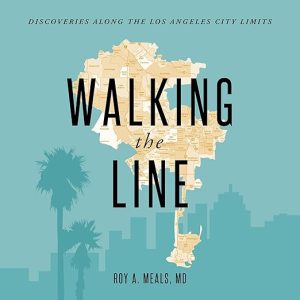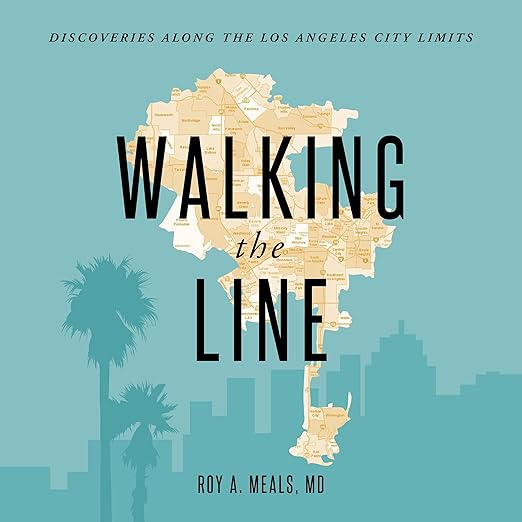
Three hundred forty-two miles is the length of the border around Los Angeles, and Roy A. Meals MD walked all of it in ten-mile segments, twice a week, starting from the top of a 5,000-foot mountain and dropping to sea-level beaches along the way. This audiobook is the report. It runs seven hours and two minutes, the author reads it himself, and the premise is so simple it takes a moment to register how strange it is: trace the administrative outline of a city on foot and see what the line runs through.
It runs through everything the postcards leave out. Meals "samples ethnic delicacies, races go-karts, pets a giraffe, suffers landfill ejection, paints graffiti, and takes hang gliding and fencing lessons", moving through residential, commercial and industrial ground that no visitor would ever choose. Thirty-seven ratings average out to 4.7, and Border Line Books released it in October 2025.
The Verdict, Briefly
The device is what makes this work. A perimeter is an arbitrary line drawn by administrators, which means following it guarantees you will end up in places no curated route would ever send you. That constraint does the job a good travel writer normally has to do by instinct, and it explains why the discoveries in this book skew so far from the obvious. Sandy Brown's list captures the flavor: you "visit Venice, learn what happens to our poop, stain some glass, eat at Big Momma's Bayou Shack, paint a mural, go to jail or a fire station museum".
Self-narration is more than a budget decision here. This is a first-person account of a physical feat, written by the only person who performed it, and the pleasure of the thing is partly the tone of a man in his own city being repeatedly surprised. MJ names the quality directly, crediting "an appreciation for the city's history along with an adventuresome spirit and engaging sense of humor". Humor is the element most dependent on delivery, and here the author who wrote the jokes is the one delivering them.
Place names matter too, and they arrive in volume. Hundreds of Los Angeles neighborhoods, streets and businesses pass through this book, and a longtime resident pronounces them the way residents do without having to think about it. That is a small thing in print and a constant one in audio.
Why Listen to Walking the Line
Being shown your own city is the effect this book reliably produces, and the pool is emphatic about it. MJ opens with fifty years of residency and admits "I've bought guides for cities in Europe and Asia but didn't think I needed one for my hometown. Who knew what I was missing?!" Lynette Berg Robe, who reports fifty-five years in the city and describes being an avid walker, still found "so many unfamiliar areas in a place I thought I knew well".
Specifics never let up, and they supply the second reason to buy. Chris lists a guinea pig rescue and warehouses full of movie props among the discoveries. Lynette Berg Robe, whose father flew out of LAX for Western Airlines after the war, had never heard of the Flight Path Museum or the Proud Bird restaurant. Gary M Reuben mentions the architecture of different LA communities, the animal sanctuaries and "the famous grunion runs". None of that is in any guidebook, and that same notice puts the value in exactly those terms, describing a roadmap made for "Angelinos and our visitors". My own instinct with books like this is to distrust the enthusiasm of locals, and I could not sustain it here; the specifics are too odd to be invented.
Best of all is the argument the book makes about itself, which generalizes past Los Angeles entirely. The description says it "encourages listeners to escape their own neighborhoods wherever they live, venture forth on foot, and make interesting discoveries". Chris's notice adds a detail the publisher does not: the author made the walk at seventy-five, after retiring. Whether or not you ever set foot in Los Angeles, that is a usable idea. Sandy Brown supplies the comic version of the same offer, promising that "You won't need your hydration bladder" to cover the 342 miles, which is precisely the bargain a listener is being handed.
Points to Consider
Format is the real caveat, and a specific one. One of those local notices carries the title Not Your Ordinary Guidebook and reports that the author "has organized the text into interesting walks" you can choose among. A book organized into walks invites you to follow one, and an audio file is the worst possible thing to consult at a street corner. If you intend to actually walk any of these routes, plan on a print or digital copy alongside the recording.
Consider who is doing the recommending. Los Angeles residents wrote four of the five notices you can read, and three of them volunteer that they have lived there for fifty years or more. That is a cohort of people delighted to be shown their own city, and their enthusiasm is genuine, but it is enthusiasm about recognition. A listener with no connection to Los Angeles is buying a different book from the one those four reviewed.
Scores reflect that same tilt. All five visible grades are five stars while the page averages 4.7 over 37 ratings, which puts the thirty-two silent raters somewhere near 4.6 between them. And a note on filing: this sits under travel and tourism, which is roughly right and slightly misleading, since it is a memoir of a walk rather than a resource for planning a trip. Nobody visits a landfill on vacation.
Who Should Pick Up Walking the Line
Los Angeles residents are the obvious buyers and the reviews prove it, particularly anyone who has lived there long enough to assume the city holds no surprises. Beyond them, this suits people who like walking books, urban curiosities and the kind of nonfiction where the structure is a rule the author agreed to follow. It also suits anyone weighing what to do with retirement.
Weigh it carefully if practical planning information is what you want from a travel book, since this is a narrative account with jokes rather than a route book with logistics. Weigh it carefully too if unfamiliar place names by the hundred are tiring rather than atmospheric. Pair it with a map on your phone and it becomes considerably more useful than either one on its own.
In Brief
- Performance: Roy A. Meals MD reads his own account, which puts the humor and the hundreds of Los Angeles place names in the hands of the man who walked them.
- What it covers: A city traced along its administrative edge, small discoveries in overlooked ground, walking as a retirement project.
- Feel: Curious, companionable and quietly funny.
- Our call: A delight for Angelenos and a persuasive argument for walking your own city if you live anywhere else.
A Few Questions About Walking the Line
Do I need to know Los Angeles to enjoy this audiobook?
It helps a great deal. Four of the five readable reviewers are local, three with fifty or more years in the city, and their delight is largely the pleasure of recognition. An outsider still gets a good walking memoir and a portable idea, but a noticeably different book from the one those reviewers describe.
Can I use this as a guide to actually walk the routes?
Not from audio alone. One reviewer notes the text is organized into walks you can pick among, which sounds practical until you try consulting a recording on a street corner. If you plan to follow any segment, buy a readable copy alongside and treat the audiobook as the narrative version.
How was the 342-mile route actually walked?
In ten-mile segments, twice a week, according to the publisher. The line begins atop a 5,000-foot mountain, drops to sea-level beaches and continues through residential, commercial and industrial areas. One reviewer adds that the author made the walk at seventy-five, after retiring, a detail the description leaves out.
Does the author narrate the audiobook himself?
Yes. Roy A. Meals MD carries both the byline and the narration credit for all seven hours and two minutes. Given that the book is a first-person account of his own walk, and that one reviewer singles out an engaging sense of humor, having the person who made the walk deliver it is a sensible piece of casting.