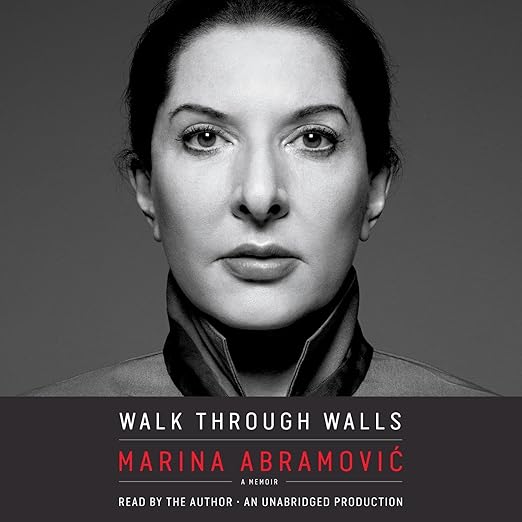
I came to Marina Abramovic's memoir the way most people come to her work: slightly uncertain what I was walking into, aware that it would demand something of me, and not entirely sure I had what it required. What I found was one of the most absorbing fourteen hours I have spent with an audiobook in recent memory. Not because Abramovic is comfortable or easy company, but because she is relentlessly honest in a way that very few artists writing about their own work manage to sustain for an entire book.
Walk Through Walls, published in 2016, covers the full arc of Abramovic's life from her childhood under Tito's Yugoslavia, where both parents were Communist war heroes and her mother enforced a 10 p.m. curfew well into Abramovic's young adulthood, through her emergence as one of the most significant performance artists of the twentieth century, and culminating in the legendary MoMA retrospective of 2010, where more than 750,000 people stood in line to sit across from her in silence for a moment she sustained for more than 700 hours.
The book works on multiple levels simultaneously, which is characteristic of Abramovic's best work. As biography, it documents a life organized around the principle that the body can be the primary medium of artistic expression, which requires her to account for a series of performances that were sometimes genuinely dangerous and occasionally resulted in significant physical harm. She recounts these without apology or revisionism, which is bracing. As a portrait of a cultural moment, it is extraordinarily good on the Belgrade and Amsterdam art scenes of the 1970s, the period when performance art was establishing its theoretical and institutional foundations. And as a love story, it is devastating.
The twelve-year collaboration with fellow artist Ulay, which she describes as the central relationship of her creative life, runs through the book's middle section like a current. They lived in a van, they made work together that required sustained endurance and mutual trust, and then the relationship ended on the Great Wall of China, where they walked toward each other from opposite ends and met in the middle to say goodbye. That image has entered the cultural vocabulary of performance art as a kind of defining gesture, and reading about its origins and its context in the full relationship makes it both more and less than the symbol it has become.
What Works
Multiple reviewers insist on the audio version, and they are right. One wrote simply that Abramovic's voice is itself a work of art. Her Serbian-accented English, her deadpan delivery, her willingness to let silence sit for a moment before she continues: these are not incidental qualities. They are the difference between reading a transcript of a performance and watching it. When she describes pushing her body past fear, pain, and exhaustion, hearing her voice render those words changes what they mean. The humor, which runs through the book in unexpected places, lands much better in her own delivery than it would in any narrator's interpretation.
Things to Know Before Starting Walk Through Walls
Her accounts of working with Aboriginal communities in Australia and with Tibetan monks carry the same curiosity and openness that characterizes her artistic practice, but they also reflect assumptions of the 1970s that contemporary readers will find worth examining. The sections on her mother are among the most psychologically complex in the book: Abramovic understands her mother with a clarity that does not require either forgiveness or condemnation, which is a difficult register to sustain. Watch also for the moments of genuine comedy, particularly around the logistics of extreme durational performance; she has a gift for the absurdity of her own situations.
Who It's For
Anyone with an interest in contemporary performance art or art history of the late twentieth century will find this essential. Memoir readers who appreciate rigorous self-examination over comfort will be well served. The book rewards listeners without prior knowledge of Abramovic's work, though familiarity with her major pieces enriches the reading considerably. Those who prefer memoirs organized around conventional narrative arcs of struggle and triumph may find the structure less satisfying: this is a life rendered as a series of encounters with the limits of endurance, which is its own kind of shape.
Key Details
- Narrator: Abramovic reading her own memoir is itself a performance; her Balkan cadences, dry wit, and pauses carry the same intentionality as her durational art.
- Subjects: The body as artistic medium, the politics of the Yugoslav art world, love and collaboration as creative destruction.
- Tone: Dense, hypnotic, and occasionally very funny, like sitting across from someone who has survived things you have not imagined.
- Bottom line: The self-narrated format transforms this from memoir into something closer to a live event; seek out the audio over the print version.
A Few Questions About Walk Through Walls
Do I need to know Marina Abramovic's art before reading this memoir?
No prior knowledge is required, though the memoir will likely send you searching for documentation of specific performances as you listen. Abramovic describes her major works with enough context that newcomers can follow, and the descriptions are often more affecting than the visual documentation.
What was the MoMA retrospective that the synopsis references?
In 2010, the Museum of Modern Art staged a retrospective of Abramovic's nearly fifty years of performance work. The centerpiece was a durational piece called The Artist Is Present, in which Abramovic sat silently at a table and invited visitors to sit across from her one at a time. She did this every day for over two and a half months.