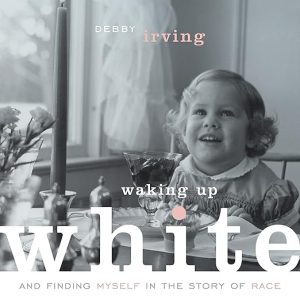
The Short Version
- Performance: Debby Irving reads her own admissions, so the discomfort in the copy passes through the person who owns it, at speaking pace.
- What it covers: unexamined whiteness, an arts administrator's blind spots, race in schools and neighborhoods, one late awakening
- Feel: plain, confessional, unhurried
- Our call: A short self-read memoir that works as a starting point and says so, issued under a storefront imprint with a thin description.
Debby Irving spent twenty-five years sensing racial tensions she could not explain, in her friendships, in her work as an arts administrator, and in her classroom. Then, in 2009, a single moment rearranged all of it. What makes this audiobook unusual is not the story, which has become a familiar shape, but who tells it: Irving reads her own account, including the passages the publisher describes as often cringe-worthy. Confession is easy to write and hard to say out loud, and nine hours and twenty-three minutes of it arrives in the voice of the person doing the confessing.
Why a Hired Narrator Could Not Deliver This Confession
Irving's method is embarrassment, deliberately deployed. The publisher pitches a story told with enough openness that listeners will be rooting for her, and the responses confirm the technique works. S. R. Schnur, writing in April 2017, describes growing up in what the review calls the white bubble, where you do not know what you do not know, and credits Irving with the advantage of being able to take courses and seminars to find out. Betsy, in December 2021, calls the book more relatable than White Fragility, less guilt-inducing than others, and better at showing how easy life had been.
Nothing about this recording separates the writer from the reader. Irving performs her own admissions, meaning the discomfort in the material passes through the person who owns it, live, at speaking pace. Nine hours and twenty-three minutes of that is a real ask of any author, and it is also the whole argument for choosing the audio edition of a book built like this one. A hired narrator would deliver the sentences; the author has to deliver the recognition, and those are two different jobs.
Easier to Finish Than to Underline Before Book Club
Betsy grades it four, the sole score below five here, and does the most useful comparative work anywhere on the page. White Fragility gets named as the reference point, and this book is described as more relatable, less guilt-inducing, and better at getting a white reader to find their own stories that support the argument. That is a precise account of what the book is for. It uses one life as a worked example and not a theory, and whether that appeals to you is the entire decision. Nobody comes out of this book with data; they come out of it having watched somebody else notice things late.
One reviewer describes himself as a middle-aged white man who had just finished a communication degree, with coursework in equity, culture, intersectionality and identity behind him, and still calls the book terrific. That is a useful data point, since it suggests the material lands even on people who arrive already briefed. The same response mentions a school encouraging parents to read it as part of a new book club, the natural habitat of this title: read in groups, assigned, discussed afterward. An audio edition serves that use badly and well at the same time: easy to get through on a busy week, impossible to underline before the meeting.
The Reviews Carry the Book the Synopsis Won't
Schnur's phrase, the white bubble, is the concept the whole book turns on, and it arrives in a review, not in the description. The synopsis is thin: twenty-five years of unexplained tension, three professional contexts, one aha moment in 2009, and a promise about openness. That is the whole of what a buyer is given. The reviews carry the actual content, from Schnur's bubble to Betsy's comparison to the ancestral New England detail in another response. Read the column before the copy here, because the column tells you more.
At nine hours and twenty-three minutes this is a compact memoir with an argument attached, and the brevity works as a feature. The book is not a history and never pretends to be; it is one woman noticing, in sequence, things she had been trained not to notice. The publisher field repays a glance too: it reads Audiobooks.com Publishing, a storefront name doing duty as an imprint. Nothing sinister in that, but it means the label tells you nothing about editorial provenance, and on a book about race some buyers will want that answered.
From a Platitude to White Is a Race Too
Where this book loses people is predictable and worth naming. J.Ford's May 2025 response reduces the whole thing to the idea that we are all human and ought to respect one another, a reading that flattens the argument into a platitude. The reviewer signing as Different, whose handle is genuinely that word, describes an ancestral WASP background from New England and the moment of realizing that white is a race too, and not merely a culture or an economic class. Those two responses to one book sit very far apart.
Five Different Reasons Five Readers Found This Useful
White readers who suspect they are missing something and cannot name it are the explicit audience, and Schnur's bubble is the best short description of that position anybody here offers. Book clubs and school parent groups are the natural setting, and one reviewer arrived by exactly that route. The audio suits a walk or a drive, but it suits the annotation this material invites rather poorly, and Irving's structure moves through episodes that reward stopping to think about each one.
Readers already fluent in the literature will find little new, and Betsy's comparison says as much: this sits below White Fragility in difficulty by design, not by accident. Anybody wanting scholarship, statistics or policy will find a memoir waiting instead. And anybody allergic to the confessional register should understand that the confession is the method here, not a frame around a thesis, so nine hours of it is nine hours of one person noticing. Whether that is illuminating or exhausting depends entirely on how much of the noticing you have already done yourself.
Twenty-five years of not understanding something, then a single moment, then a book: that is the shape, and the shape is honest about how slow the process was. The description is thin and the publisher field is a storefront name. What survives all of that is a short, plain, self-read account that five separate readers found useful for five different reasons. Irving is honest about the cringing, and that honesty is the only thing that earns a book like this a hearing.
A Few Questions About Waking Up White, and Finding Myself in the Story of Race
Does Debby Irving narrate the audiobook herself?
She does, which is the strongest single reason to choose audio here. The description calls the story often cringe-worthy, and hearing an author deliver her own embarrassment aloud is a different proposition from reading it silently. Nine hours and twenty-three minutes in a single voice, and no other name credited at all.
Would this audiobook serve as a first book on race for a white listener?
That is exactly what it was built for. Betsy calls it more relatable and less guilt-inducing than White Fragility, and another reviewer describes a white bubble whose occupants cannot see its edges from inside. Somebody who already has the literature behind them will find familiar ground.
Who publishes this audiobook and does it matter?
The publisher field reads Audiobooks.com Publishing, a storefront name serving as an imprint. It matters only in that it tells you nothing about editorial provenance, which some buyers weigh on a book about race. The recording itself is plain: one author, one voice, nine hours and change, no production credits listed.