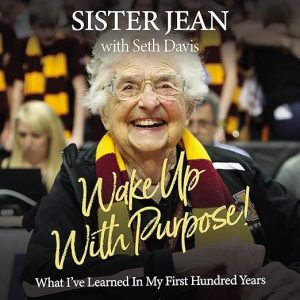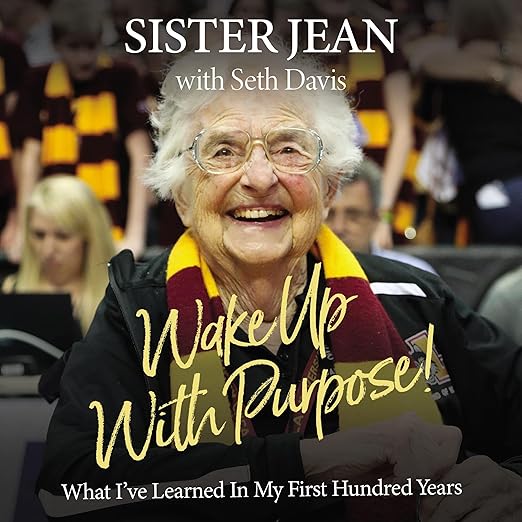
Loyola Chicago knows Sister Jean best as the wheelchair-bound chaplain who became a folk hero during the 2018 men's basketball tournament, and Wake Up with Purpose! makes the case, convincingly, that the basketball fame was never really the point. Jean Dolores Schmidt spent more than a century finding purpose in ordinary, repeated acts of attention: teaching during the Second World War, decades on a Chicago college campus, and, even past her hundredth year, keeping her office door open daily to any student who wanted to talk. This audiobook, co-written with Seth Davis and narrated by Devon O'day, runs just over six hours and reads far closer to a philosophy of living than a sports memoir.
The Thesis Buried in Her Own Quoted Line
The book is more memoir and philosophy than sports story, and that balance is deliberate. Basketball functions as the hook that made Sister Jean famous late in her life, not the book's actual center of gravity, which instead organizes around life lessons and spiritual guidance drawn from a century of specific, lived experience rather than a single viral tournament run.
Her own quoted line from the synopsis, "I've seen so many changes in the last 102 years, but the important things remain the same," functions as the book's actual thesis statement, worth treating as such rather than a passing quote. Everything else in the memoir circles back to what she means by "the important things," attention, service, and consistency across a genuinely enormous span of change.
The specific span of that century deserves a moment's real thought: a life running from the era of rotary telephones and the Second World War through to smartphones and a viral college basketball tournament clip, with continuous institutional service the entire way through. Very few living memoirists can claim direct, lived testimony across a technological and social gap that wide, which is a large part of what gives her "the important things remain the same" claim its earned authority rather than sounding like a platitude, a conclusion reached only after actually living through the alternative.
The 2018 tournament run itself is worth understanding for readers who only know the headline version: Loyola Chicago, a low-seeded team few expected to advance far, went on an improbable postseason run, and Sister Jean's genuine scouting reports and on-camera warmth turned her into a national figure almost overnight, well into her nineties at the time. The book treats that moment honestly as a late, unexpected chapter rather than the culmination of everything before it.
The synopsis's own list of what the book delivers, her words and spirit, her sharp sense of humor, life lessons gleaned from a century of living, universal themes, priceless wisdom, reads almost like a table of contents for a life rather than a book, and that's a genuinely accurate way to think about the structure. Each element gets built out through specific memory and anecdote rather than staying at the level of the list itself, which is what keeps a summary that broad from feeling generic once the actual stories arrive.
O'day Balances Gentle Authority With Dry Humor
Devon O'day's narration is warm and carefully calibrated for Sister Jean's specific register, gentle authority paired with dry humor, a combination that would fall flat if either quality overwhelmed the other. That balance carries the material across its full runtime without ever tipping into either saccharine sentimentality or dry recitation.
Reviewer mavo's cited line, "it only took me 98 years to become an overnight sensation," captures the exact dry comic register the book maintains even while covering serious ground, and Seth Davis's own credentials as an established, bestselling sports journalist and broadcaster lend real structural discipline to a subject who, without a skilled collaborator, could easily have produced something shapeless.
Davis has spent decades covering college basketball specifically, which matters for a book that needs to render the 2018 tournament run with real insider specificity rather than generic sports-underdog framing. That expertise shows up less in play-by-play detail than in knowing which moments of Sister Jean's sudden fame actually mattered and which were just noise, a genuine editorial skill a less experienced collaborator might not have brought to the project.
Boys' Basketball Practice Long Before the Chaplaincy
The book was written and published while Sister Jean was still alive, but the synopsis itself already refers to "the late Sister Jean," meaning listeners are encountering this as something closer to a parting document than a straightforward celebrity memoir. That emotional register is worth naming honestly upfront rather than discovering partway through.
Reviewer Frances's detail, that Sister Jean was running boys' basketball practices long before her Loyola chaplaincy fame, is a reminder the book's material runs considerably deeper than the viral tournament years alone. Listeners expecting the book to center specifically on 2018 should adjust expectations toward the fuller life story instead. Loyola Chicago alumni and current students specifically make up a distinct sub-audience here too, listeners with their own direct memory of the open office door the synopsis describes, for whom the memoir functions as much as institutional memory as personal biography.
Reviewer mavo also highlights a specific piece of practical philosophy from the book, setting aside quiet time deliberately, especially at the start of the day, as one of several concrete habits rather than abstract encouragement. Listeners looking for actionable takeaways alongside the life story will find more of that structure throughout than the warm, anecdotal tone might initially suggest.
Sister Jean belonged to a Catholic religious order, the Sisters of Charity of the Blessed Virgin Mary, for the whole of her adult life, and that vocational commitment runs underneath the book's entire structure even when a given chapter isn't explicitly about faith. Listeners who know that context going in will recognize how much of her described daily practice, the open office door, the consistent attention to individual students, draws directly on the disciplines of religious life rather than being simply personal habit.
Long Purposeful Lives Matter More Than One Tournament
Listeners drawn to memoirs of long, purposeful lives regardless of religious background, the synopsis itself claims appeal that "transcends religious creed," college sports fans curious about the person behind the viral moment, and readers interested specifically in the philosophy of aging and service rather than basketball trivia will all find real substance here.
Skip it if you want a basketball-centered sports memoir specifically, built around the 2018 tournament run in particular, or a conventional, strictly chronological autobiography rather than a life-lessons structure organized around wisdom gathered across a century rather than a linear plot. Listeners hoping mainly for tournament play-by-play will find comparatively little of it here.
Questions Listeners Ask
Is this Wake Up With Purpose! audiobook mostly about Sister Jean's basketball fame?
No. Basketball is the hook that made her famous late in life, but the audiobook centers on a full century of lived experience and the philosophy she drew from it, closer to memoir and spiritual guidance than a sports story.
Does this audiobook require any religious background to connect with its message?
No. The synopsis itself frames the book's appeal as transcending religious creed and belief, and its life lessons are built around universal themes of purpose and service rather than doctrine specific to any one faith.