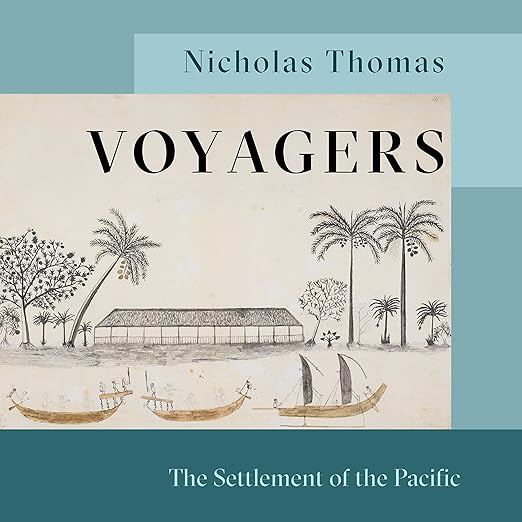
Quick Take
- Narration: Mark Robertson handles the academic register competently, with clear steady pacing that suits the scholarly tone, though the delivery is occasionally dry where the subject invites more wonder.
- Themes: Prehistoric migration, Polynesian seafaring technology, the formation of Pacific civilizations
- Mood: Dense and quietly astonishing, as the scale of what these migrations required keeps surfacing between the scholarly sentences
- Verdict: An impressive short synthesis of current knowledge about Pacific settlement that rewards patient listeners, though those wanting emotional narrative drive should calibrate expectations.
Four hours is almost impossibly short for what Nicholas Thomas attempts in Voyagers. The settlement of the Pacific, from the Philippines and Indonesia through Micronesia, Melanesia, Fiji, Samoa, Tonga, the Marquesas, Easter Island, and finally New Zealand, spans thousands of years, dozens of language groups, and some of the most impressive feats of navigation in human history. Thomas manages to hold it all, though not without cost to depth in places where the subject demands more room.
I came across this one while working through a reading project on Pacific history, somewhere between a dense monograph on the Lapita cultural complex and a more accessible account of the Polynesian triangle. Voyagers sits in a useful middle position: academic in its sources and careful about evidence, but written to be understood by non-specialists. Thomas is an anthropologist at the University of Cambridge, and that disciplinary background shows. He’s as interested in the cultures that emerged as in the migrations themselves, not just in tracking movement but in understanding what the people who made those voyages were like and what they built after they arrived.
The Technology That Made It Possible
The sections on seafaring technology are where the book earns its place most distinctively. The image of Polynesian migration that most people carry, something like small boats and brave navigators on open water, is accurate as far as it goes, but it flattens the sophistication of what was actually happening. Thomas describes the wayfinding systems, the vessel designs, and the navigational knowledge that made voyages across thousands of miles of open Pacific not only possible but apparently routine across many generations. The settlement of Easter Island and the Marquesas, some of the most remote inhabited places on Earth, required vessels and knowledge systems of a high order. The technical detail in this compressed format is one of the audiobook’s genuine pleasures, precisely because it forces you to reckon with just how advanced these seafaring cultures were.
Thomas also addresses the mechanics of why people undertook these migrations in the first place, the social pressures, resource dynamics, and cultural motivations that sent communities out across open ocean rather than consolidating where they were. That analytical layer gives the migration story more depth than a purely technical account would.
The Academic Register and Its Trade-offs
The reviewer who described the book as having a “dry, academic tone and pacing” is pointing at something real. Thomas writes as a scholar, and Robertson reads him accordingly, measured and even, without dramatization. For listeners who want to feel the sheer improbability of what these voyagers accomplished, the register can feel like a barrier. The wonder is there in the content, but you sometimes have to extract it from the prose rather than have it delivered to you. The reviewer who praised the book for weaving together first-hand historical encounters with cross-disciplinary discoveries, drawing on genetics, linguistics, archaeology, and oceanography together, is identifying precisely what the book does well at the level of synthesis. That’s the more useful frame for approaching it.
Scope, Coverage, and What Gets Left Out
At three hours and fifty-one minutes, coverage is necessarily selective. The Austronesian expansion from around 3000 BC through to the final settlement of New Zealand around AD 1250 is an enormous sweep, and Thomas moves quickly through each stage. The New Zealand chapters, covering the arrival of Polynesian ancestors of the Maori, are necessarily compressed. Melanesian cultural complexity gets somewhat less attention than Polynesian expansion narratives, which reflects broader patterns in Pacific historiography rather than a particular failure of this book. The reviewer who noted plenty of references confirms that Thomas is transparent about the scholarly infrastructure beneath the synthesis, which allows listeners to follow up on any section that interests them more deeply.
This is a genuinely excellent short synthesis that works best as an introduction to a larger subject. If you already know the field, it confirms and updates. If you’re arriving fresh, it gives you the vocabulary and the framework to read more substantially. Robertson’s narration is competent if not inspiring, which is perhaps the right way to deliver scholarship that is impressive without being performed.
One thing worth noting for listeners who have a particular interest in the connection between Polynesia and the Americas: Thomas addresses the contested question of pre-European contact between Polynesian navigators and the South American coast. The evidence for trans-Pacific contact, including the presence of the sweet potato across Polynesian islands long before European ships arrived, points to exactly the kind of long-distance navigation the book establishes was within these cultures’ capabilities. That thread is one of several that demonstrate why this is active scholarship rather than settled history, and why four hours is genuinely not enough to exhaust the subject. That is a feature, not a flaw, and it points you onward rather than leaving you satisfied and static.
Frequently Asked Questions
Does Voyagers require background knowledge in Pacific history or anthropology?
No. Thomas writes accessibly for non-specialists, and the book functions as an entry point rather than an advanced study. Familiarity with basic world geography will help you follow the migration routes, but no prior specialist knowledge is assumed or required.
What is the timeframe covered, and does it include European contact with the Pacific?
No. The book focuses on prehistoric settlement, from the Austronesian expansion around 3000 BC through to the final Polynesian settlement of New Zealand around AD 1250. European exploration of the Pacific is outside the scope entirely. This is pre-contact Pacific history only.
How does Nicholas Thomas use evidence from different disciplines?
He draws on genetics, linguistics, archaeology, and oceanography together, reflecting the genuinely cross-disciplinary nature of Pacific settlement research. DNA evidence tracking population movements, linguistic family trees showing language spread, and archaeological records of the Lapita cultural complex are all woven into the narrative, which is one of the book’s genuine strengths.
Is there a companion reading that goes deeper into Polynesian navigation specifically?
David Lewis’s We, the Navigators remains a landmark on the navigational techniques specifically. For broader Pacific anthropology, Thomas’s own academic work goes much deeper than this accessible synthesis. Patrick Kirch’s archaeology of the Pacific is authoritative for listeners who want to engage the evidence more technically.