Quick Take
- Narration: Robin Sachs brings measured British gravitas that suits the class-stratified world Davenport-Hines is mapping; among Sachs’s later recordings before his 2013 death.
- Themes: Class, Edwardian society at its peak and fracture point, the human geography of disaster
- Mood: Elegiac and richly contextual, social history as portrait gallery
- Verdict: A companion volume to the disaster rather than a retelling of it, most rewarding for listeners who already know the basic chronology and want the social texture behind the names.
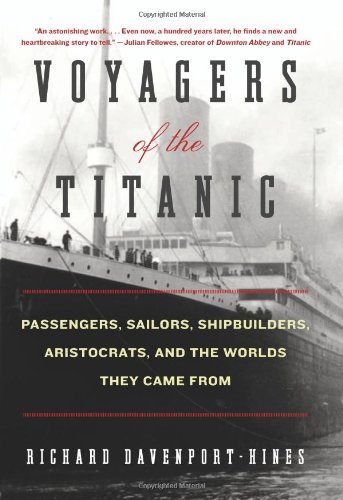
The Titanic is one of those historical events that has been so thoroughly processed by film, museum, and popular culture that it takes a specific act of repositioning to encounter it freshly. Richard Davenport-Hines manages this by doing something the blockbuster versions cannot: he treats the ship as a cross-section of Edwardian society, a stratified world of deal-makers and immigrants, of J.P. Morgan and the nameless steerage passengers hoping to find a better life in America, and he uses that cross-section to ask what the sinking meant for the world that built the ship and filled it.
Robin Sachs was one of the most reliable narrators of historically dense nonfiction, and this recording benefits from his characteristic combination of British authority and reader accessibility. He does not rush through the social detail, and Davenport-Hines provides a great deal of it. Sachs died in 2013, which makes recordings like this a valuable archive. His approach here is appropriately elegiac, which is the right register for a book that is fundamentally a portrait of a world about to end.
First Class as an Edwardian Social Register
Davenport-Hines is at his best when detailing the first-class passenger list as a living social document. J.P. Morgan, who helped build and operate the ship, chose not to sail. John Jacob Astor IV did sail, and his story, wealth, recent remarriage, age difference from his new wife, and social disapproval from the establishment he nominally represented, becomes a microcosm of the anxieties the Edwardian upper class carried even into its leisure. Molly Brown is here, famously, and Davenport-Hines has the courtesy to treat her as more than a comic figure of American new money.
What the book does particularly well is the pre-voyage context: who built the ship, what it represented to the White Star Line’s rivalry with Cunard, how the passenger profiles were assembled. The disaster, when it comes, lands differently when you understand the social architecture of what went down with it.
Below Decks: The Less-Told Story
Davenport-Hines is also good on the ship’s design as a statement of intent: the first-class interiors modeled on Edwardian country houses, the technology of the wireless room, the competitive pressure from Cunard’s Mauretania and Lusitania that drove White Star toward larger and more lavish rather than simply faster. The ship was a commercial and cultural argument, not just a vessel, and understanding that makes the sinking feel like more than an accident.
The third-class and crew sections are shorter than the first-class material, and this is a genuine limitation that some listeners will feel. The book is titled Voyagers of the Titanic, but the voyagers below decks are proportionally underrepresented. Davenport-Hines acknowledges this implicitly; the archival record for first-class passengers is vastly richer than for steerage, and he works with what survived.
Still, the passages about the men and women traveling below decks hoping to find a better life in America carry real weight. The diversity of origins, Irish, Eastern European, Lebanese, Scandinavian, and the specific economic calculations that put each family on that particular ship at that particular time, is documented with care. The fact that survival rates correlated so directly with class is not new information, but Davenport-Hines makes it feel like a judgment rather than a statistic.
A Centennial Publication and the Weight of Occasion
The book was published to commemorate the centennial anniversary of the sinking, and the commemorative frame is audible in Sachs’s performance. This is not revisionist history. It is, in the best sense, a settling of accounts: a careful enumeration of who was on the ship, what they brought with them, and what was lost. The book has no reviews in this listing, which likely reflects its specialized audience among Titanic historians rather than a quality gap. The 4.2 average across 163 ratings is a meaningful signal for a book of this nature, one that requires a prior interest in the subject rather than promising to create one.
Who Should Listen and Who Should Skip
This is the audiobook for listeners who already know the disaster and want the social history behind the names. If you have seen the Cameron film and want to understand who Rose’s equivalent would actually have been in 1912, and what the class architecture of the ship meant in lived terms, this is your book. If you want a chronological account of the sinking itself, Walter Lord’s A Night to Remember still serves that function better.
Sachs’s narration is among the draws here for listeners who collect his work; this is one of his cleaner late recordings, well-suited to material that asks for presence rather than performance. The 163 ratings and 4.2 average reflect a specialized audience rather than a mass-market phenomenon. Davenport-Hines is a respected British social and cultural historian, and his approach to the Titanic is firmly in that tradition: the ship as a lens for understanding the society that built it and the moment in history at which it sank. April 1912 was, as the book makes clear, not simply a shipping disaster. It was the fracture of a particular Edwardian confidence, the last moment before war, before the long unraveling. Sachs performs that weight with the care it deserves.
Frequently Asked Questions
Does Voyagers of the Titanic cover the actual sinking in detail?
The sinking is covered but is not the book’s primary focus. Davenport-Hines is more interested in the social world the passengers inhabited before the voyage and what the disaster revealed about Edwardian class structure. For a detailed minute-by-minute account, Walter Lord’s A Night to Remember serves that purpose better.
Is J.P. Morgan’s decision not to sail covered in the book?
Yes. Morgan’s non-appearance despite being among the ship’s financiers and expected passengers is addressed, along with the broader context of how the ship’s ownership and operation intersected with the Gilded Age financial world.
How does the book treat the disparity in survival rates between classes?
Directly and without evasion. The survival statistics are presented as a structural outcome of how the ship was organized, who had access to lifeboats, and whose safety the procedures were designed to prioritize. It functions as social critique embedded in historical documentation.
Does the book cover the Titanic’s crew as well as its passengers?
Yes, though with less depth than the first-class passenger profiles. Davenport-Hines treats the crew’s composition and the class dynamics among the ship’s working population as part of the broader social portrait, not just as background figures in the disaster narrative.