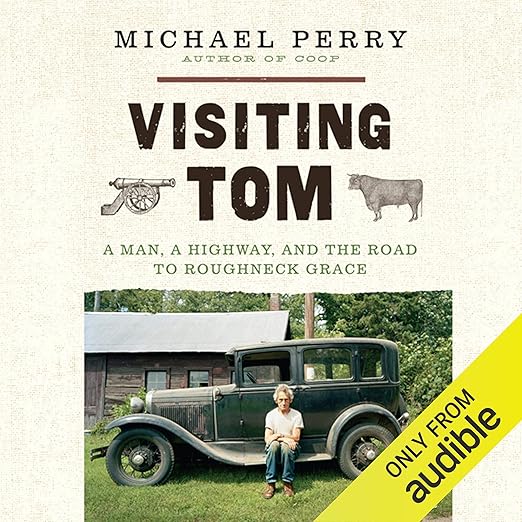
What can an 82-year-old man who builds his own cannons in a shop he describes as “an antique store stocked by Rube Goldberg, curated by Hunter Thompson, and rearranged by a small earthquake” actually teach a writer about life, love, and stubbornness? That's the real question sitting underneath Visiting Tom, Michael Perry's memoir built entirely around his visits, often with his young daughters along, to Tom Hartwig, his elderly neighbor on a small farm in west central Wisconsin. Perry narrates his own book across seven hours and twenty-two minutes, and the audiobook format suits this material especially well, since so much of Visiting Tom is really about the rhythm of conversation itself, two men talking across a kitchen table, rather than a tightly plotted narrative arc.
Homemade Cannons Give Way to a Quieter Register
Tom Hartwig is the kind of subject a lesser memoir would flatten into pure eccentric-old-man charm, homemade cannons, a team of oxen he drives in local parades, batches of what Perry describes as potentially “extralegal” explosives, and Visiting Tom absolutely gives that surface color its due. But the book earns its emotional weight in the quieter register underneath the eccentricity: Tom's approaching sixtieth wedding anniversary with his wife Arlene, his anti-authoritarian streak sharpened daily by the four-lane interstate that was built through his own front yard in 1965 and now sends millions of vehicles past his kitchen window every year, and the specific, unvarnished tenderness that surfaces when he and Perry talk as fathers of daughters rather than as the folksy old-timer and his visiting biographer.
Reviewers consistently describe this as Perry's most mature work, which tracks with how deliberately the book avoids easy sentimentality even while clearly being a love letter to its subject. Lawrence J. Gautsch's review states plainly that Perry, across his career, has “from his first book, been a good writer,” and that here “he elevates his prose to very good and, on occasion, great.” Howard L. Milkman's review reaches a similar conclusion from a different angle: “Of all of his books, this book is his most mature.” Both readings point to the same thing: this isn't Perry's funniest book or his most eventful, but reviewers consistently rank it as his most fully realized as a writer.
Reviewers Call This Perry's Most Mature Book
Perry's own body of work, built largely around his life on a small Wisconsin farm and the small-town neighbors who populate it, gives Visiting Tom a specific vantage point worth naming: he's spent years writing about rural life from the inside rather than visiting it as an outsider gathering color for a single book, and that accumulated familiarity is part of why Tom Hartwig registers as a fully realized person rather than a quirky local character discovered for the occasion. Longtime readers of Perry's essays will recognize the same unhurried attention to small, specific detail, an oxcart harness, a shop's particular smell, that has defined his writing since his earlier books.
Perry's daughters are a quieter presence throughout but a meaningful one, since so many of the visits happen with them in tow, and Tom's warmth toward them, distinct from his gruffer public persona around the highway and the town council, gives Perry a second angle into who this man actually is beyond the eccentric-neighbor reputation. Watching Tom soften around two young girls who aren't his own becomes its own quiet argument about what the book is really interested in: not spectacle, but the specific, unglamorous work of paying attention to someone else's life.
Perry's Own Cadence Carries the Kitchen Table
Perry narrating his own material is close to essential here, in the same way self-narration matters for any memoir this rooted in a specific, real relationship; his cadence carries the actual texture of these conversations in a way a hired narrator reading the same transcript couldn't fully recreate. Perry's background as a working essayist shows in how comfortably he handles his own long, meandering sentences, the ones that circle through a description of Tom's shop before landing on an observation about mortality or fatherhood, since he wrote them to be read exactly the way he's now reading them aloud.
The specific detail throughout, gag shovel handles, parts for quarter-million-dollar farm equipment, a Model A Tom still talks about decades later, all delivered by Perry with the same plainspoken warmth reviewers describe as central to his written voice, gives the audiobook a lived-in, conversational quality that suits its kitchen-table setting better than a more polished, theatrical reading would. M. C. Will's review captures a common entry point into Perry's work generally, discovering him through a radio interview and finding his books “even better than I was expecting them to be,” a fair description of how this one tends to land with new listeners too.
Tom Stays a Person, Never a Symbol
This is genuinely a slow, meandering memoir by design, built around repeated visits and accumulating conversation rather than a single dramatic arc, and listeners expecting a more conventional narrative with clear rising stakes should recalibrate before starting. Howard L. Milkman's review, while positive overall, references some rougher patches in the prose here and there, worth knowing if you're expecting uniformly polished writing throughout rather than the occasional looser, more conversational stretch that comes with a book this rooted in real, unscripted dialogue.
The regional specificity, rural west-central Wisconsin, farm equipment culture, a very particular anti-authoritarian streak aimed at a highway that reshaped one man's front yard, is a genuine strength for the right listener and a potential distancing factor for anyone with no interest in rural American life or small-town character studies specifically. At a 4.4 rating from 403 listeners, response has been strong and consistent, which suggests the regional focus reads as authenticity rather than a limitation for most people who actually pick this one up.
The book also resists turning Tom into a simple symbol of a vanishing rural way of life, the kind of easy elegiac framing this subject matter could invite; Perry keeps returning Tom to specific, ordinary present-tense detail, a joke he tells badly, a genuine disagreement between them, rather than letting him calcify into a nostalgic archetype. That choice keeps the book grounded in an actual friendship rather than turning into a broader essay about rural America using Tom as its illustration.
Character-Driven Memoir Over a Plotted Arc
Fans of character-driven memoir over plot-driven nonfiction are the ideal audience, along with anyone who already loves Perry's other books and existing readers of rural-America writing in the vein of a slower, more observational tradition than standard biography. It also rewards anyone with an elderly neighbor or relative whose stories they've never quite sat down to properly collect.
City readers with zero patience for meandering, front-porch-style storytelling should probably pass, since the entire appeal here depends on being willing to sit inside slow, accumulating conversation rather than pushing toward a payoff. It's also a thinner pick for anyone hoping for a broader survey of rural American life beyond one specific friendship, since Perry keeps his lens tightly focused on Tom and his own family throughout rather than widening out to a larger social or political argument.
Questions Listeners Ask
Do I need to have read Michael Perry's other books before this audiobook?
No. Visiting Tom stands on its own, though reviewers describe it as his most mature work, so longtime readers of his earlier essays and memoirs may appreciate the growth in his prose even more than a first-time listener would.
Why does Michael Perry's self-narration matter for this particular audiobook?
Because so much of the book is about the texture of real conversation with Tom Hartwig, and Perry's own cadence carries that lived-in quality in a way a hired narrator reading the same transcript couldn't fully recreate.