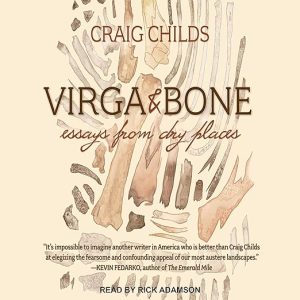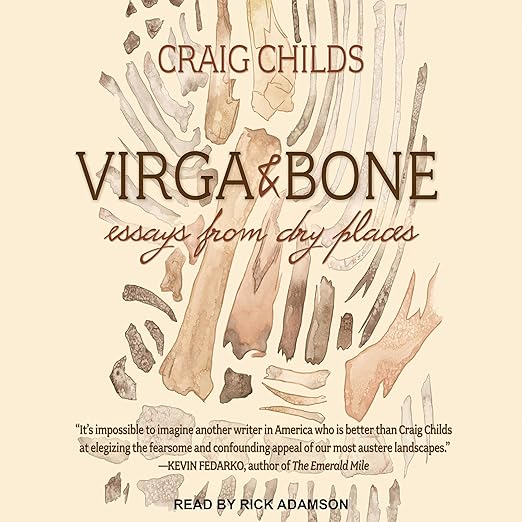
Virga and Bone is not a book that announces itself. Craig Childs' essay collection - fourteen pieces built around desert icons of the American Southwest - arrives quietly and then expands, the way a landscape does when your eyes adjust to the scale. I put this audiobook on during a long afternoon with no particular destination in mind, and three hours later found I had barely moved. The narration by Rick Adamson functions less like delivery and more like weather - you stop noticing it and start noticing what it carries. For anyone who has read Childs' earlier work, particularly The Secret Knowledge of Water or House of Rain, this audiobook will feel like returning to a landscape that has been waiting.
The Verdict, Briefly
The organizing principle of these essays is a series of vivid desert icons: virga - rain that evaporates before reaching the ground - over Monument Valley; white seashells lying in parched desert sand; boulders balanced impossibly on narrow pedestals of stone. Childs uses these images not as scenic backdrop but as entry points into questions about deep time, geological memory, and the nature of presence in landscapes that predate human consciousness by vast margins. The comparison to Edward Abbey, offered by one reviewer, is apt in the sense that Childs shares Abbey's reverence and his refusal to make the desert merely picturesque. But Childs is quieter, more interior, more interested in what observation costs the observer than in what the landscape owes the visitor.
At three hours and seven minutes, this is a short audiobook by any measure, and the length fits the material. These are essays - dense, compressed, asking to be sat with - not a narrative that builds toward resolution. Childs himself has described this as a book about primacy of the land and the profound nature of the more-than-human, a phrase that sounds abstract until you are forty minutes into listening and realize that the essays have somehow relocated you into the desert without your noticing.
Why Virga & Bone Works as an Audiobook
The question of why to choose audio for an essay collection is a real one, and the answer here is Rick Adamson's narration. Adamson has a voice suited to geological thinking - unhurried without being sluggish, precise without being clinical. The pacing of the essays, which slow down and speed up with the rhythm of the writing rather than a conventional sentence-by-sentence cadence, benefits from a narrator who treats the silences as structural. This is the kind of listening that rewards a long drive through empty country or an afternoon with windows open and no screens competing for attention.
One reviewer who holds House of Rain and The Secret Knowledge of Water as their two favorite Childs books found this collection somewhat less powerful than those longer works - a fair observation, given that extended narrative allows Childs to build the kind of geological and personal depth that essays, by their nature, compress. But that reviewer also called the collection engaging and worth the effort, which tracks with what Virga and Bone offers: not the full immersion of a Childs-length sustained work, but a series of entry points into the same territory, each one a door into the desert.
The Adamson-Childs pairing has produced something worth seeking out for its own sake. Another reviewer described the prose as mesmerizing and reminiscent of Edward Abbey, noting that the collection shares archaeological observation with contemporary voice. That combination - ancient subject, alive writing - is what the audio format amplifies rather than diminishes.
Points to Consider
One reviewer noted that the collection has a quality of being "a bit depressing for some reason" - a response that is worth taking seriously. These essays do not offer comfort or resolution. The desert Childs describes is indifferent in the most profound sense: it predates human concern and will outlast it. For listeners who find ecological literature energizing when it affirms life, this collection may sit differently. For listeners who find that same indifference clarifying or even peaceful, it will feel exactly right.
The short runtime - three hours and change - means this is not a book to arrive at with long-form expectations. If you want the full depth of Childs' craft in sustained narrative, House of Rain or The Secret Knowledge of Water serve that need better. Virga and Bone is a different animal: concentrated, imagistic, best taken one or two essays at a time with space to breathe between them. Listening straight through is possible, but the material rewards a slower approach.
Who Should Pick Up Virga & Bone
This audiobook is for listeners who already have some relationship with desert literature - readers of Abbey, Annie Dillard, Terry Tempest Williams - and who want a short, concentrated addition to that conversation. It is particularly strong for anyone who has spent time in the American Southwest and wants writing that articulates what that landscape does to human perception. Rick Adamson's narration makes the audio format a genuine advantage over reading silently.
Listeners new to Childs are better served starting with The Secret Knowledge of Water or House of Rain, where the sustained length allows his particular combination of scientific observation and lyric prose to build fully. Virga and Bone rewards listeners who already know what they are entering; for those who don't, the essays may feel elliptical without the grounding a longer Childs work would provide. And listeners expecting conventional travel writing - practical, destination-focused, experiential in the tourism sense - should know this is something different: landscape philosophy in essay form.
At a Glance
- Narration: Rick Adamson gives Childs' desert prose the unhurried gravity it needs - a voice that matches the ancient pace of the landscapes being described without losing the urgency in the writing.
- Themes: desert ecology, human smallness in geological time, the more-than-human world
- Mood: Still and ruminative, with sudden moments of awe that arrive without warning
- Verdict: An essay collection best experienced as pure listening - Adamson and Childs together create something closer to immersive audio than conventional audiobook narration.
Frequently Asked Questions
Does this audiobook work as an introduction to Craig Childs, or should I read his longer works first?
Listeners new to Childs are generally better served starting with The Secret Knowledge of Water or House of Rain, which allow his sustained narrative approach to develop fully. Virga and Bone is an essay collection - dense and compressed - that rewards listeners who already have some sense of his style and subject matter.
Is the Virga and Bone audiobook worth choosing over the print version for this kind of essay writing?
Yes, in this case. Rick Adamson's narration adds genuine dimension to the material - his pacing treats the essays' silences as structural rather than incidental. Desert writing that slows the reader down works particularly well when the narrator embodies that same unhurried quality.